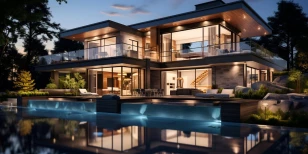

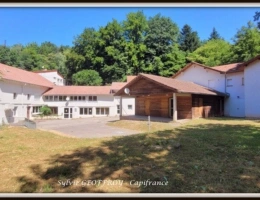
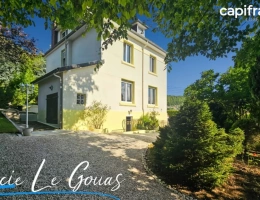
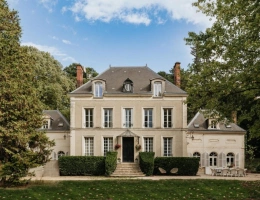
Finding a chateau for sale in Moselle means dealing with a border territory shaped by both French and Germanic influences, between the Sarre valley, the Metz area and the wooded hills in the north of the department. Residences here reflect this dual history: classical Lorraine houses around Metz, more Germanic-looking manor houses in the Sarreguemines and Bitche area, and older fortified manors reshaped near the border. Some properties still keep a park planted in the nineteenth century by industrial families from the coal basin. Browse every chateau for sale listed by the private owners, agencies and notaries of Moselle.
Here you will find real price benchmarks for large residences in the department, the areas where they stand, the features of their construction and the checks worth making beforehand, including matters tied to local law. Before committing, our guide to buying prestige property in France sets out the steps of a heritage purchase, particularly in a department governed by local law. Demand stays concentrated around Metz and its outskirts, while the northern border area tends to trade more slowly for lack of numerous local buyers.
DVF land registry data does not identify chateaux as such: the benchmarks below cover sales of houses over 300 m² of living space on 0.05 to 10 ha, above €1,000/m², tracked by our observatory. They frame the market for large residences without describing it entirely: an estate with 30 ha of parkland or a listed monument sold with its farmland falls outside this scope.
DVF statistics do not cover this department, which is governed by the Livre foncier land register: only figures for the Grand Est region are given. Across the Grand Est region, the 2021-2025 median stands at €550,000 (149 sales), against €822,000 in France in 2025 (981 sales).
| Scope | Sales | Median price | Floor – ceiling (P10–P90) | €/m² living space (median) |
|---|---|---|---|---|
| Grand Est (2021-2025) | 149 | €550,000 | €371,900 – €892,000 | 1,475 |
| France (2025) | 981 | €822,000 | €428,000 – €3,100,000 | 2,308 |
The breakdown by stratum (coastal, rural tourist, ordinary rural) and the five-year trend are in our observatory of prestige property prices in France (in French). Before making an offer, work out purchase costs and borrowing capacity with our financial tools and calculators.
Source: DVF (DGFiP), transactions from 1 January 2021 to 31 December 2025, processed by ma-propriete.fr; prices rounded to the nearest €100.
Moselle buildings combine the pale limestone of the Metz area, with classical façades and slate roofs, with constructions further north influenced by Rhineland architecture, with bulkier volumes and steeply pitched tiled roofs. Eighteenth and nineteenth-century chateaux dominate supply, often built or extended by families enriched by metalworking, glassmaking or coal from the coal basin. Older fortified manors survive near the border, reshaped through successive occupations.
Outbuildings include service wings, orangeries, chapels and sometimes former industrial buildings converted for properties near the mining basins. Roof condition and the insulation of often sizeable volumes should be examined carefully before making an offer. Prospective buyers should also check whether original interior woodwork and stonework have survived successive renovations, since these details affect restoration cost.
Large residences are concentrated around Metz and its residential outskirts, along the Moselle valley toward Thionville, and in the Sarreguemines area on the German border. The Vosges du Nord regional nature park, around Bitche and Sarrebourg, offers more wooded and secluded properties, while the Forbach and Saint-Avold coal basin keeps a distinct industrial and residential heritage.
Metz has a station served by the TGV, putting Paris under two hours away on a direct service, and the A4 motorway crosses the department from east to west. Areas near Metz and the Moselle valley remain the most sought-after, while the coal basin and the Vosges du Nord offer more affordable properties of comparable construction. The Bitche area, more remote, and the Sarre valley to the south-west complete this contrasting geography, between farmland and wooded hills.
Moselle falls under the local law of Alsace-Moselle: land registration relies on the Livre foncier rather than the standard French mortgage registry, which changes certain notarial steps and should be discussed in advance with the notary handling the sale. Some residences are listed or registered historic monuments, notably around Metz, which subjects exterior work to the opinion of the Architecte des Bâtiments de France. Buyers should also confirm the exact wording of the Livre foncier extract with a local notary, since terminology and formatting differ from standard French records.
In the coal basin, check with the relevant authorities for former mine galleries or ground-movement risk before any building project. Also check the condition of the roof timbers, the drainage system, and the heating cost of old volumes that are often poorly insulated. Also ask about the property's occupation history during periods of conflict, which has sometimes left traces on older structures.
Chateau listings in Moselle are published by private owners, specialist agencies and notaries; you can filter them by price, living space, land area, outbuildings and distance to Metz or the German border, then set up an e-mail alert to follow new properties as they come to market. To open your search to neighbouring departments, also see the chateaux for sale in Grand Est. Listings generally specify the applicable land-registration regime, useful for anticipating local notarial steps.