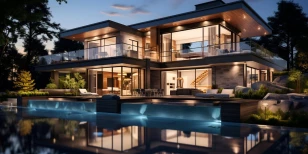

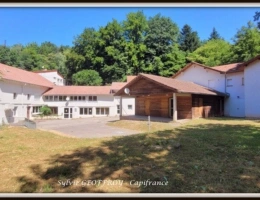
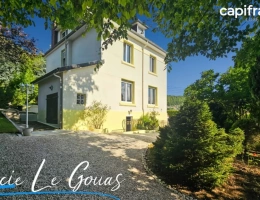
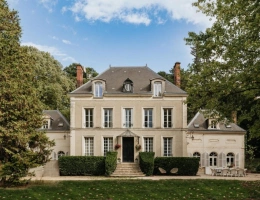
Looking for a chateau for sale in Haut-Rhin means exploring the southern Alsace plain, between the Vosges range, the Alsace vineyards and the Sundgau, a rural, rolling area near the Swiss border. Properties for sale range from wine-estate residences tucked between Colmar and Guebwiller to industrial manor houses inherited from Mulhouse's textile boom, along with older chateaux on the first Vosges foothills. Some outbuildings still keep partial half-timbering, typical of Alsatian architecture. Browse every chateau for sale listed by the private owners, agencies and notaries of Haut-Rhin.
This page gathers real price benchmarks for large residences in the department, the areas where they stand, the features of their construction and the checks worth making before buying, including matters tied to local law. Before committing to a wine estate or a bourgeois residence, our guide to buying prestige property in France sets out the steps of a heritage purchase. Demand stays concentrated around Colmar and the wine route, while the Sundgau tends to trade at a more measured pace.
DVF land registry data does not identify chateaux as such: the benchmarks below cover sales of houses over 300 m² of living space on 0.05 to 10 ha, above €1,000/m², tracked by our observatory. They frame the market for large residences without describing it entirely: an estate with 30 ha of parkland or a listed monument sold with its farmland falls outside this scope.
DVF statistics do not cover this department, which is governed by the Livre foncier land register: only figures for the Grand Est region are given. Across the Grand Est region, the 2021-2025 median stands at €550,000 (149 sales), against €822,000 in France in 2025 (981 sales).
| Scope | Sales | Median price | Floor – ceiling (P10–P90) | €/m² living space (median) |
|---|---|---|---|---|
| Grand Est (2021-2025) | 149 | €550,000 | €371,900 – €892,000 | 1,475 |
| France (2025) | 981 | €822,000 | €428,000 – €3,100,000 | 2,308 |
The breakdown by stratum (coastal, rural tourist, ordinary rural) and the five-year trend are in our observatory of prestige property prices in France (in French). Before making an offer, work out purchase costs and borrowing capacity with our financial tools and calculators.
Source: DVF (DGFiP), transactions from 1 January 2021 to 31 December 2025, processed by ma-propriete.fr; prices rounded to the nearest €100.
Haut-Rhin buildings split between bourgeois-style manor houses, built in the nineteenth century by industrial families from Mulhouse and its region, and wine-estate properties, more modest in size but often equipped with an old winery, set on the vineyard hillsides. Pink Vosges sandstone appears in the surrounds of many façades, while half-timbering marks the outbuildings of the oldest estates. True large-scale chateaux remain rare: the market mainly offers "small chateaux" and gentlemen's residences.
Outbuildings include service wings, sometimes a chapel, and on wine estates a press house or a traditional storeroom. The condition of half-timbering and roofs, along with the quality of façade restoration, strongly affects the value of old properties. Prospective buyers should also check whether the timber frame has been treated against insect damage, a recurring concern on older half-timbered outbuildings in the region.
Properties are concentrated first along the wine route, between Colmar, Guebwiller and Thann, an area known for its wine villages and hillsides. Mulhouse and its outskirts keep a heritage of industrial residences, while the Sundgau, to the south, offers a more scattered and more affordable rural settlement pattern, close to the Swiss border. The first Vosges foothills, toward Munster and the Markstein, add more wooded and secluded properties.
The department has TGV stations at Colmar and Mulhouse, putting Paris just over two hours away, and the A35 motorway serves the whole plain. Areas near Colmar and the wine route remain the most sought-after, while the Sundgau offers more affordable properties of comparable construction. The Thur valley, toward Thann and Saint-Amarin, adds more industrial properties, inherited from the textile and engineering trades.
Haut-Rhin falls under the local law of Alsace-Moselle: land registration relies on the Livre foncier, which changes certain notarial steps that should be discussed in advance with the notary handling the sale. Along the wine route, some residences are listed or registered historic monuments, which subjects exterior work to the opinion of the Architecte des Bâtiments de France. Buyers should also have the Livre foncier extract reviewed by the notary in charge of the sale, since its wording and terminology differ from standard French land records.
If the property includes vineyards, clearly separate the vine-growing land, subject to farming rules and sometimes a rural tenancy, from the residential buildings. On the technical side, have the half-timbering condition, roof watertightness and drainage checked, particularly for estates isolated in the rural Sundgau. Also check how the vines are farmed when entrusted to a third party, a common arrangement on wine estates in the area.
Chateau listings in Haut-Rhin are published by private owners, specialist agencies and notaries; you can filter them by price, living space, land area, outbuildings and vineyard surface where relevant, then set up an e-mail alert to follow new properties as they come to market. To widen your comparison beyond the Sundgau and the vineyards, browse the chateaux for sale in Grand Est. Listings generally state whether the vines are farmed directly or let under a tenancy, a point worth clarifying before any offer.