
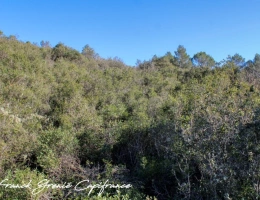

Anyone looking for hunting property for sale in Vaucluse finds a compact department with sharp contrasts. In the north-east, Mont Ventoux and the Monts de Vaucluse, extended by the Albion plateau and the Pays de Sault, form the most wooded area: beech and pine at altitude, downy and holm oak on the slopes, lavender and cereals on the plateaux. In the south, the Luberon ridges are covered with garrigue and oak woods within the regional nature park. Wild boar dominate everywhere, roe deer have settled on the higher ground and red deer remain localised; red-legged partridge, hare, thrushes and woodcock complete the picture. On our site, these properties appear among the hunting estates offered across France by private sellers, estate agents and notaires: hunting woods, a bastide with its hills, a farmhouse surrounded by garrigue.
The data section further down gives the forest prices recorded in Vaucluse and the big game bags published by the French Biodiversity Agency (OFB). The rest of the page compares the department’s two main types of ground and lists what to check before buying, from the hunting lease to brush clearance.
A hunting estate is rarely valued with a single figure: its price adds up the value of the woodland, the ponds, the buildings and the shooting facilities. The statistics below give benchmarks for wooded land and ponds, based on sales actually recorded.
According to the ma-propriete.fr forest price observatory, built from sales recorded in the French DVF land registry database, the median price of a hectare of forest in Vaucluse was €4,276/ha in 2025*, across 38 sales, with an average of €6,919/ha. That puts the department below the Provence-Alpes-Côte d’Azur median (€4,854/ha) and below the national median (€4,936/ha). Compared with 2024, the median changed by −18.9%, a movement to interpret with care given the number of sales. Over the more robust 2020-2025 period, 207 sales give a median of €5,549/ha for a median plot size of 2.5 ha.
| Indicator | Vaucluse (84) | Provence-Alpes-Côte d’Azur | France |
|---|---|---|---|
| Median price 2025 | €4,276/ha* | €4,854/ha | €4,936/ha |
| Average price 2025 | €6,919/ha* | €7,876/ha | €6,214/ha |
| Number of sales 2025 | 38 | 346 | 6,329 |
| Change in median 2024 → 2025 | −18.9%* | −15.9% | +1.9% |
| Median price 2020-2025 | €5,549/ha | €5,207/ha | €4,778/ha |
| Number of sales 2020-2025 | 207 | 2,101 | 35,100 |
Nationally, the price per hectare rises with size: the large properties that appeal to hunters sell for more per hectare than medium-sized woods.
| Size of forest sold (France, 2020-2025) | Median price | Number of sales |
|---|---|---|
| 10 to 20 ha | €4,010/ha | 3,161 |
| 20 to 50 ha | €5,330/ha | 1,850 |
| 50 to 100 ha | €6,810/ha | 581 |
| Over 100 ha | €7,361/ha | 320 |
Ponds trade at a very different level: with too few sales in Vaucluse, the benchmark is the regional median of €22,942/ha for ponds sold without buildings between 2020 and 2025.
On the listings side, 18 hunting properties are offered on ma-propriete.fr across France as of 2 October 2026, none in Provence-Alpes-Côte d’Azur at that date. Their median asking price is €888,000 for a median size of about 68 ha. These are asking prices for complete properties: they describe the supply on offer more than the average price of a wooded hectare.
* 30 to 99 sales: indicative value. Source: DVF (French tax authority), processed by ma-propriete.fr; forests of 1 ha or more, cadastral type woodland; ponds without buildings of at least 2,000 m²; July 2020 to December 2025; Moselle, Bas-Rhin and Haut-Rhin are not covered by DVF. Listings recorded on ma-propriete.fr on 2 October 2026.
The game bag records published by the French Biodiversity Agency (OFB) measure hunting pressure and, indirectly, the presence of big game. In Vaucluse, 7,946 wild boar and 1,471 roe deer were taken in the 2024-2025 season, along with 92 red deer.
| Species | 2021-2022 season | 2024-2025 season | Change |
|---|---|---|---|
| Red deer | 143 | 92 | −36% |
| Roe deer | 1,546 | 1,471 | −5% |
| Wild boar | 8,575 | 7,946 | −7% |
Source: OFB, wild ungulates network, departmental big game bags (total culls, data published on data.gouv.fr).
Mont Ventoux, a UNESCO biosphere reserve, and the Monts de Vaucluse make up the department’s main wooded area. Nineteenth-century plantings, notably black pine and cedar, stand alongside beech on the north-facing slopes and oak on the southern ones. Wild boar are driven over large areas and roe deer stalked or shot from high seats; on the Albion plateau and in the Pays de Sault, lavender and cereal fields sustain hare and partridge. A hunting estate here often takes the form of a large single block of oak woodland attached to a farm or sheepfold, with long tracks to maintain. To the east, these plateaux run on towards the Montagne de Lure, and hunting grounds in Alpes-de-Haute-Provence offer comparable areas.
In the Luberon, garrigue of holm oak and box, downy oak woods and pine cover narrow ridges where boar are driven and small game is shot over pointing dogs. Thrush hides, a Provençal tradition, can still be found on the hills. The Luberon regional nature park does not ban hunting, but its charter and the Natura 2000 sites govern certain works. Around the Dentelles de Montmirail and in the Comtat plain, properties take the form of bastides or wine estates backing onto a few wooded hills: the huntable area is smaller, and getting on with growers, walkers and neighbouring houses becomes a selection criterion. Avignon TGV station makes viewings easier for buyers from northern France or abroad.
In Vaucluse, hunting is organised mainly around communal hunting societies and private grounds: hunting rights go with the land, but they are often leased. Ask for details of current leases, their length and the terms for taking the rights back. Request the cull plan allocations for roe and red deer and the level of boar damage in nearby vineyards and orchards: a holder of hunting rights who does not control game can be held financially liable. Fire risk also shapes management, since the statutory brush-clearance duty applies around buildings and access to the hills is restricted in summer according to the danger level.
Lastly, an enclosed park must comply with the act of 2 February 2023. In natural areas, the fence may be no higher than 1.20 m, must sit 30 cm off the ground and let wildlife move freely; fences put up since 1993 must be brought into line before 1 January 2027. Our article on fencing in natural areas gives the details.
On ma-propriete.fr, hunting properties in Vaucluse come from private sellers, estate agents and notaires; use the price and size filters, and let an alert do the work if nothing suits you yet. Sellers can publish their property in a few steps. If you mainly want woodland, see our forest listings in Vaucluse; to compare with the Var or the Alps, browse the hunting grounds for sale in Provence-Alpes-Côte d’Azur.