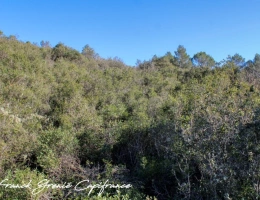

A hunting property for sale in Bouches-du-Rhône is usually found either in the Camargue or in the limestone hills of Provence, two worlds with almost nothing in common. Around the Rhône delta, from Arles to Saintes-Maries-de-la-Mer and Port-Saint-Louis-du-Rhône, the marshes, reed beds, salt flats and rice fields of the Camargue draw duck, teal and coot in winter: this is one of France’s great wildfowling areas. To the east and north, the Alpilles, Sainte-Victoire, the Sainte-Baume and the Étoile and Garlaban hills carry garrigue, holm oak and Aleppo pine; wild boar dominate there, roe deer are scarce and red deer almost absent. Properties on offer range from a wildfowling marsh with its cabin to a farmhouse surrounded by wooded hills; you will find them with the other hunting property listings from private sellers, estate agents and notaires.
The data shown just after this introduction, covering forest prices and big game bags, adds context to the listings. Below it you will find a practical description of the department’s two main types of ground and the questions to ask before committing.
A hunting estate is rarely valued with a single figure: its price adds up the value of the woodland, the ponds, the buildings and the shooting facilities. The statistics below give benchmarks for wooded land and ponds, based on sales actually recorded.
According to the ma-propriete.fr forest price observatory, built from sales recorded in the French DVF land registry database, the median price of a hectare of forest in Bouches-du-Rhône was €9,872/ha in 2025*, across 47 sales, with an average of €11,663/ha. That puts the department above the Provence-Alpes-Côte d’Azur median (€4,854/ha) and above the national median (€4,936/ha). Compared with 2024, the median changed by +54.4%, a movement to interpret with care given the number of sales. Over the more robust 2020-2025 period, 213 sales give a median of €7,000/ha for a median plot size of 3.5 ha.
| Indicator | Bouches-du-Rhône (13) | Provence-Alpes-Côte d’Azur | France |
|---|---|---|---|
| Median price 2025 | €9,872/ha* | €4,854/ha | €4,936/ha |
| Average price 2025 | €11,663/ha* | €7,876/ha | €6,214/ha |
| Number of sales 2025 | 47 | 346 | 6,329 |
| Change in median 2024 → 2025 | +54.4%* | −15.9% | +1.9% |
| Median price 2020-2025 | €7,000/ha | €5,207/ha | €4,778/ha |
| Number of sales 2020-2025 | 213 | 2,101 | 35,100 |
Nationally, the price per hectare rises with size: the large properties that appeal to hunters sell for more per hectare than medium-sized woods.
| Size of forest sold (France, 2020-2025) | Median price | Number of sales |
|---|---|---|
| 10 to 20 ha | €4,010/ha | 3,161 |
| 20 to 50 ha | €5,330/ha | 1,850 |
| 50 to 100 ha | €6,810/ha | 581 |
| Over 100 ha | €7,361/ha | 320 |
Ponds trade at a very different level: with too few sales in Bouches-du-Rhône, the benchmark is the regional median of €22,942/ha for ponds sold without buildings between 2020 and 2025.
On the listings side, 18 hunting properties are offered on ma-propriete.fr across France as of 2 October 2026, none in Provence-Alpes-Côte d’Azur at that date. Their median asking price is €888,000 for a median size of about 68 ha. These are asking prices for complete properties: they describe the supply on offer more than the average price of a wooded hectare.
* 30 to 99 sales: indicative value. Source: DVF (French tax authority), processed by ma-propriete.fr; forests of 1 ha or more, cadastral type woodland; ponds without buildings of at least 2,000 m²; July 2020 to December 2025; Moselle, Bas-Rhin and Haut-Rhin are not covered by DVF. Listings recorded on ma-propriete.fr on 2 October 2026.
The game bag records published by the French Biodiversity Agency (OFB) measure hunting pressure and, indirectly, the presence of big game. In Bouches-du-Rhône, 7,503 wild boar and 789 roe deer were taken in the 2024-2025 season, along with 8 red deer.
| Species | 2021-2022 season | 2024-2025 season | Change |
|---|---|---|---|
| Red deer | 29 | 8 | −72% |
| Roe deer | 567 | 789 | +39% |
| Wild boar | 8,464 | 7,503 | −11% |
Source: OFB, wild ungulates network, departmental big game bags (total culls, data published on data.gouv.fr).
In the Camargue, a wildfowling marsh is valued first for its water. Many marshes are fed with water from the Rhône, pumped and then carried along channels (roubines) and controlled by sluices (martelières); salinity, water depth and the date of flooding decide whether duck come in at evening and morning flight. A Camargue estate often combines marshes, grazing for a herd of bulls or horses (manade), rice fields and salt flats: ask about water rights, the condition of pumps and structures and, where relevant, membership of the irrigation or drainage boards. The delta falls within the Camargue regional nature park, several Natura 2000 sites and the Ramsar convention; dyke works, dredging and new ponds are all regulated. Lead shot is banned in wetlands. If water matters more to you than shooting, see also our ponds and lakes in Bouches-du-Rhône.
In the hills, hunting takes another form. Boar drives bring together local hunting societies on garrigue hills that are busy with walkers, which calls for careful signage and hunting days known to the neighbours. Red-legged partridge, rabbit and hare are shot over pointing dogs in the Alpilles, protected by a regional nature park, and on the lower slopes of Sainte-Victoire; thrushes and woodcock arrive with winter. Properties for sale are often farmhouses or bastides with a few dozen hectares of hills, olive groves and vines, under strong development pressure near Aix-en-Provence and Marseille. For the same area, a hunting ground hemmed in between housing estates and roads is hard to hunt; look at how continuous the plots are and how far they lie from houses. Further north, hunting estates in Vaucluse offer larger hill areas.
Hunting rights go with the land, but they are frequently leased to a hunting society or to private guns: ask for the leases, their end dates and the terms for taking them back. For roe deer, the cull plan sets how many animals may be taken; for wild boar, look at the history of damage to nearby vineyards, orchards or rice fields, because a holder of hunting rights who neglects control can be made to bear part of it. In the hills, access is restricted in summer according to fire danger, and any building in or at the edge of woodland requires regular brush clearance.
If the estate is fenced, the act of 2 February 2023 applies in natural areas: height limited to 1.20 m, a 30 cm gap at ground level, and a deadline of 1 January 2027 to adapt fences put up since 1993, with exceptions for some farm fencing. Our article on the fencing act sets out its scope.
Hunting properties in Bouches-du-Rhône listed on ma-propriete.fr come from private sellers, estate agents and notaires; narrow the list by price and size, then create an alert to receive the next marshes or hill estates. Owners can advertise their property there too. For wooded land, see our forests and woods in Bouches-du-Rhône; for a regional search, browse the hunting properties in Provence-Alpes-Côte d’Azur.