
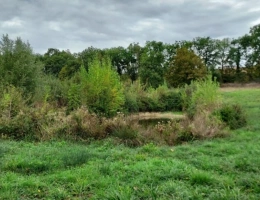
Searching for lakes and ponds for sale in Occitanie means accepting a paradox first. The region’s great expanses of water, coastal lagoons or Pyrenean lakes, almost never come up for sale: the former mostly belong to the public maritime domain or the Conservatoire du littoral, the latter to local authorities or hydroelectric concessions. The private market lies elsewhere, and it is narrow: hill reservoirs on the slopes of Gascony and the Lauragais, gravel pits in the great valleys, farm ponds in the Ségala and the Haut-Languedoc uplands, small valley ponds at the foot of the Pyrenees. Most are sold with a house or farmland. Put up for sale by owners, agents or notaires, these properties are gathered in our private lakes and ponds for sale.
The price data placed just below bear this out: with too few sales of ponds without buildings, only a regional benchmark is published. The rest of the page describes, area by area, what really exists and which rules apply, from the mountain planning law to the sharing of irrigation water. General checks are gathered in our guide to buying a water body.
According to the ma-propriete.fr pond price observatory, which keeps only ponds, lakes and pools sold without buildings in the French DVF land registry data, 28 ponds were sold in Occitanie between July 2020 and December 2025, at a median price of €10,466/ha† and an average of €14,521/ha, or about €1.05 per square metre at the median. The region sits below the national median for the period (€25,694/ha). With 4 sales in 2025, no regional annual price can be published: the full period remains the benchmark.
| Department | Sales 2020-2025 | Median price | Average price |
|---|---|---|---|
| Gers (32) | 7 | not published | not published |
| Haute-Garonne (31) | 3 | not published | not published |
| Hérault (34) | 3 | not published | not published |
| Tarn-et-Garonne (82) | 3 | not published | not published |
| Aude (11) | 2 | not published | not published |
| Gard (30) | 2 | not published | not published |
| Lot (46) | 2 | not published | not published |
| Hautes-Pyrénées (65) | 2 | not published | not published |
| Tarn (81) | 2 | not published | not published |
| Aveyron (12) | 1 | not published | not published |
| Pyrénées-Orientales (66) | 1 | not published | not published |
| Ariège (09) | 0 | not published | not published |
| Lozère (48) | 0 | not published | not published |
| Occitanie | 28 | €10,466/ha† | €14,521/ha† |
| France | 2,053 | €25,694/ha | €32,291/ha |
In 1 department, the price rests on 10 to 29 sales: the sample is too small for these average and median prices to be truly representative of the local market, and the regional price remains the soundest benchmark; in 13 others, fewer than 10 sales do not allow a price to be published. Measured against the total area, banks included, a pond’s value depends heavily on its size: small, well-equipped ponds cost more per hectare. The figures concern ponds sold on their own, without a house or a large wood.
On the listings side, 26 properties with a pond are offered on ma-propriete.fr across France as of 2 October 2026, 1 of them in Occitanie. Their median asking price is €94,000 for a median size of about 2.6 ha. These asking prices apply to complete properties, often with buildings, a pond or hunting rights: they cannot be compared directly with DVF medians per hectare. Finally, remember the purchase costs, which you can estimate with our notary fee calculator.
Source: DVF (French tax authority), processed by ma-propriete.fr; ponds, lakes and pools without buildings of at least 2,000 m², with water covering at least half of the property; July 2020 to December 2025. Listings recorded on 2 October 2026.
The slopes of Gascony hold the region’s main stock of private ponds. In Gers, the second half of the 20th century saw hill reservoirs (lacs collinaires) multiply: each one an earth embankment across a small valley, holding back winter rainfall for irrigated crops. The department now has a very dense network of them; older still, the ponds of the Armagnac, part of the Natura 2000 network, are of recognised ecological value. Gers rivers are themselves topped up by the Neste canal, dug in the 19th century in Hautes-Pyrénées. A Gers reservoir is sold with the farm or land it serves, or on its own as a fishing pond at the bottom of a valley: our page of hill lakes and ponds in Gers gathers the listings.
To the north, the Lomagne and the Bas-Quercy extend this landscape into Tarn-et-Garonne, where the Garonne and the Tarn have also left gravel pits. At their confluence, at Saint-Nicolas-de-la-Grave, a large stretch of water protected under Natura 2000 hosts a bird reserve and a leisure park. In Hautes-Pyrénées, the Lac de Puydarrieux, a late 20th-century reservoir built to keep the Baïse flowing in dry spells, has become a Natura 2000 site visited by common cranes.
Around Toulouse, sand and gravel quarries along the Garonne have left many lakes, sought after by carp and predator anglers but often in flood-risk areas. To the east, the Lauragais, shared by Haute-Garonne, Tarn and Aude, is lined with reservoirs built to irrigate arable crops; on the Aude side, the Lac de la Ganguise serves both irrigation and sailing. In Tarn, the Gaillac hills follow the same pattern, while the east of the department, from the Monts de Lacaune to the Montagne Noire, combines small farm ponds with dam lakes such as the Raviège. Our page on reservoirs and ponds in Tarn details the local offer.
On the acid soils of the Ségala and the Lévézou, Aveyron offers farm ponds and, around Pareloup, hydroelectric lakes that support angling tourism. Lozère, a land of springs, combines the glacial lakes of the Aubrac, the reservoirs of the Margeride and large dams such as Naussac; private ponds there are small, cold and suited to trout. In Lot, the Ségala holds the Lac du Tolerme, the department’s largest artificial lake, given over to leisure. On the Causse de Gramat, by contrast, water vanishes into the limestone: small basins cut into the rock, the lacs de Saint-Namphaise, collect rain for the flocks. For a true pond, look instead to the crystalline uplands, as our Ségala and Lévézou ponds in Aveyron show.
From the Rhône to the Spanish border, the coast is lined with lagoons that locals call étangs: the Charnier and the Scamandre in the Gard’s Petite Camargue, the Étang de l’Or and the Thau lagoon in Hérault, Bages-Sigean, Gruissan and La Palme within the Narbonnaise regional natural park in Aude, Salses-Leucate, shared with Pyrénées-Orientales. Given over to shellfish farming, fishing and birds, these lagoons are not for sale. What can be bought is a mas with its duck-shooting marshes in the Petite Camargue or, inland, an irrigation basin or a small garrigue reservoir that summer can almost empty. For the Gard marshes and ponds, see our Petite Camargue and Gard ponds.
In the mountains, the word étang often means a high-altitude lake: the Bassiès lakes in Ariège, or the estanys of the Carlit massif in Pyrénées-Orientales, around the Lac des Bouillouses, dammed in the early 20th century to power the Train Jaune. In Hautes-Pyrénées, the Néouvielle and Orédon lakes serve as reserves for the Neste canal. None of these sites is for sale. What does sell are modest valley-floor ponds, fed by a spring or a trout stream and attached to a barn or a house, from the Couserans to the Comminges and from the Capcir to the Cerdagne.
Water here falls mainly under two major basins with distinct rules: Adour-Garonne in the west and Rhône-Méditerranée in the east. For a hill reservoir, the key question is the right to use the water: the authorised volume, membership of collective irrigation management, and the minimum flow to be left in the stream below. In every case, insist on seeing the order that authorised the structure or, failing that, proof that it was declared.
In mountain communes, the loi Montagne in principle puts the natural banks of a lake or pond off-limits to building over a three-hundred-metre strip, except around the very largest waters. Near the lagoons, the loi Littoral restricts building in turn. The climate adds its own checks: drought orders that ban filling a pond in summer, Mediterranean storms that test dams in autumn, and the legal duty to clear brush (obligations légales de débroussaillement) around a house with a pond in the garrigue.
On ma-propriete.fr, each water body in Occitanie is described by the person or firm selling it: a private owner, an agency or a notaire’s office. As the offer is scattered across a vast territory, filter by department, compare prices and sizes, and let an email alert flag each new piece of land with a pond; if you are selling, list your property with us. If you want trees around the water, see also our forests for sale across Occitanie.