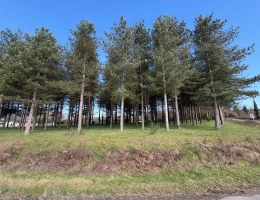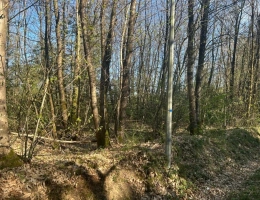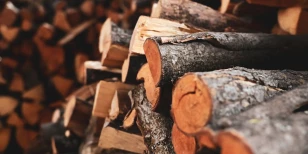
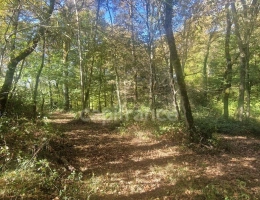
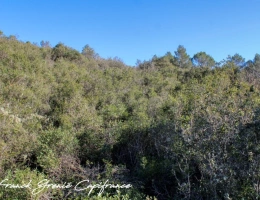
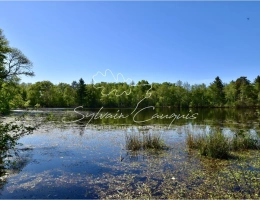
Looking for woodland for sale in France to cut your own firewood, to walk in your own trees or to round off a property? This page gathers listings of woods, wooded land and small forests, from a few thousand square metres to a few dozen hectares, listed nationwide by private owners, agencies and notaires’ offices. It is the most affordable end of the French forest market, and the most local one: most of these woods are bought by people from the surrounding villages, by neighbours or by families who want a patch of countryside close to home.
A small wood still deserves as much scrutiny as a large forest: poorly secured access, uncertain boundaries or trees of little value can turn a bargain into a burden. After the woodland prices by plot size, you will find below the main uses of a small wood, how to assess a plot, the formalities that apply to small areas and the regions where listings are most plentiful. Our guide to buying woodland in France covers each step in more detail.
According to our forest price observatory, built from sales recorded in the French DVF land registry database, the median price of a hectare of forest in France was €4,936/ha in 2025 (6,329 sales). But this national figure hides a strong size effect: over 2020-2025, more than six sales in ten involved less than 5 ha, and the smallest plots fetch the highest prices per hectare.
| Area sold (France, 2020-2025) | Share of sales | Median price | Average price |
|---|---|---|---|
| 1 to 2 ha | 28.5% | €6,059/ha | €7,783/ha |
| 2 to 5 ha | 36.8% | €3,985/ha | €5,413/ha |
| 5 to 10 ha | 17.6% | €3,443/ha | €4,805/ha |
| 10 to 20 ha | 9.2% | €4,010/ha | €5,365/ha |
| 20 to 50 ha | 5.4% | €5,330/ha | €6,445/ha |
| 50 to 100 ha | 1.7% | €6,810/ha | €7,537/ha |
| Over 100 ha | 0.9% | €7,361/ha | €8,016/ha |
The curve is U-shaped. Between 1 and 2 ha, a hectare sells for around €6,059/ha at the median: these small woods are sought for firewood, leisure or to enlarge a property, and their total price stays affordable. It falls to about €3,443/ha between 5 and 10 ha — too large for amenity use and too small for profitable forestry — then rises again above 20 ha, where timber and hunting value take over.
On the listings side, 59 woods and forests are offered on ma-propriete.fr as of 2 October 2026, mainly in Centre-Val de Loire (12), Occitanie (9), Brittany (8), at a median asking price of €145,750 for a median size of about 17 ha. Of these, 23 cover 10 ha or less, at a median asking price of €26,000. To estimate the full cost of a purchase, fees included, use our notary fee calculator.
Source: DVF (French tax authority), processed by ma-propriete.fr; forests of 1 ha or more, cadastral type woodland; July 2020 to December 2025; Moselle, Bas-Rhin and Haut-Rhin are not covered by DVF. Listings recorded on ma-propriete.fr on 2 October 2026.
This is the most common reason to buy. A coppice of oak, hornbeam or sweet chestnut, cut in successive sections, can heat a house for years, provided you have the equipment, the time and access for a tractor. Coppice regrows from the stumps after felling: well managed, it renews itself without replanting. Before buying for this purpose, assess how much wood can actually be harvested and how far the plot is from your home, because hauling logs quickly eats into the savings.
Many buyers simply want a leisure wood to walk in, watch wildlife, gather mushrooms and chestnuts or introduce their children to nature. One or two hectares are often enough, as long as access is easy and the wood is close to home. Be aware that in communes with an approved municipal hunting association (ACCA), a small plot is in principle included in the association’s shooting territory. Withdrawing land so you can shoot over it yourself requires at least 20 ha in one block, or more in some departments; an owner who objects to hunting on grounds of conscience can, however, have the land withdrawn whatever its size, while giving up the right to hunt there.
A few hectares of wooded land can also be a long-term store of value, especially with young oak high forest or a well-tended Douglas fir plantation. Income is low and irregular, and conveyancing costs weigh more heavily on a small purchase. The most sensible buyer is often the neighbour: by acquiring the wood next to their own, an owner consolidates their land, makes harvesting easier and adds value to the whole. Above a few dozen hectares, properties belong to our section of forest properties and forests for sale in France.
First check how you get into the wood. A plot bordering a public road or a rural lane is straightforward; a landlocked plot that touches no road depends on a right of way across a neighbour’s land, whose existence and route must be established, ideally in a deed. An informal arrangement counts for nothing if there is a dispute or the neighbouring land changes hands. Also check whether a tractor or forwarder can get in, and whether there is room beside the track to stack cut timber.
The same hectare might carry chestnut coppice ready for cutting, quality oak high forest, a half-grown poplar plantation or a clear-fell waiting to be replanted. Identify the main species, the approximate age of the trees and their vigour. For a forest plot of a few hectares, a forestry expert or a cooperative can estimate the standing volume and tell you whether the asking price reflects the trees or only the land. Be wary of plots harvested shortly before the sale: the seller has pocketed the value of the timber, and you are buying ground that will produce nothing for many years.
Woodland boundaries are often vague: missing markers, filled-in ditches, an approximate cadastral plan. A boundary survey by a géomètre-expert (chartered surveyor) prevents many disputes, particularly at felling time. Look for easements such as a power line, a pipeline, a protection zone around a drinking-water source or a public footpath. Finally, check tree health: ash dieback, ink disease in chestnut, bark beetle in spruce. Declining trees along a road or near a house make the owner liable if they fall.
A wood is not a building plot. It usually lies in a natural or agricultural zone of the local plan (PLU), sometimes in a protected woodland area (“espace boisé classé”), where no house, chalet or holiday home can be built. Even a cabin or a shed may be banned by local rules, and a static caravan can in principle only be placed on a campsite or a holiday park. Before buying a wood to spend weekends in, read our article can you build in a French wood? and ask the town hall (mairie).
When a wooded property of less than 4 ha is put up for sale, the seller must notify the owners of adjoining woodland of the price and terms, by recorded-delivery letter or hand delivery against receipt. Each of them has two months to exercise the forest right of first refusal; if several neighbours come forward, the seller is free to choose between them, and the sale must then be completed within four months. The commune where the wood lies has a similar right. A sale made without following this procedure can be annulled.
The procedure does not apply to every sale. It is set aside in particular when the wood is sold together with other property, built or not, when the buyer is a relative of the seller up to the fourth degree, or when the buyer already owns adjoining woodland. If you own the wood next door, you can therefore buy directly, without the other neighbours being consulted. The notaire checks these situations, sends the necessary notices and clears any other priority rights, such as the state’s when the wood borders a state forest.
As the owner of a wood, you pay land tax on undeveloped property and are liable for damage caused by your trees, so suitable third-party liability insurance is strongly advised. Below 20 ha a simple management plan is generally not required, but you can sign up to your region’s code of good forestry practice (“code des bonnes pratiques sylvicoles”), a light commitment that frames your fellings. In a forest without a management document, felling more than half the volume of mature timber trees over an area above the departmental threshold requires authorisation.
Small woods come up everywhere, but supply is often greater where private woodland is split among many owners.
In Brittany and Normandy, woodland is largely made up of hedgerow copses, coppice and small stands of high forest scattered among the pastures. See our woods for sale in Brittany, where oak, beech and chestnut grow alongside conifer plantations, and our wooded land in Normandy, sought after by shooting buyers and city dwellers looking for a foothold in the country.
Woods and small forests in Centre-Val de Loire are among the most numerous listings on the site: Sologne woods, Berry coppice, copses in Touraine and the Perche. Further east, the Bresse, the Charolais and the foothills of the Morvan offer wooded plots in Bourgogne-Franche-Comté, planted with oak or Douglas fir.
Woods for sale in Nouvelle-Aquitaine range from the chestnut coppice of the Périgord and Limousin to maritime pine plots in the Landes. Wooded land in Occitanie combines oak woods in the Quercy and Ségala, woods in the Pyrenean foothills and plantations in the Montagne Noire. In Auvergne-Rhône-Alpes, the highly fragmented farm woodland of the Livradois-Forez, Cantal or Ardèche often sells in small lots of conifers or broadleaves.
As the table above shows, the price per hectare depends strongly on size: the smallest plots cost the most per hectare, but their total price remains within reach of many budgets. Within the same size band, value varies mainly with the trees, access and the region. Add conveyancing costs to the price; part of them does not depend on the amount, so they weigh more heavily on a small purchase.
You can harvest your wood, but within limits. A large clear-fell in a wood without a management document may need authorisation from the prefecture, and restocking may be required in woodland blocks above a certain size. In a protected woodland area, a declaration to the town hall is generally needed, and on Natura 2000 sites some operations are subject to an impact assessment. Check with the departmental territorial office (DDT) before any major felling.
No. Even for a small plot sold privately, the sale must be recorded in an authenticated deed so it can be registered with the land registry, and it is the notaire who clears the neighbours’ right of first refusal. You can, however, find the wood and agree the price directly with the seller, since many listings are posted by private owners.
A small wood rarely makes money: fellings are years apart, and land tax, insurance and edge maintenance remain your responsibility. Its value lies first in what you use it for, whether firewood, leisure or enlarging your land, and in how rarely woods come up for sale near towns. Buy it for that use rather than in the hope of a quick capital gain.
Woodland listings are sorted by region and department; you can rank them by size and price and see at a glance which come from private sellers, agents or notaires. Woods near towns sell quickly, so set up an alert on ma-propriete.fr to receive an email for each new plot that matches your search.
A listing for a small wood draws attention when it gives the exact area, the species, the access and how the plot sits in relation to its neighbours. Add photos of the trees and the access track, mention when it was last felled, and read our advice on selling a wood on good terms, from notifying the neighbours to signing the deed.