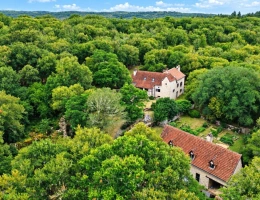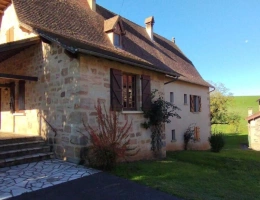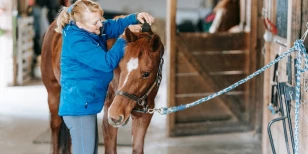
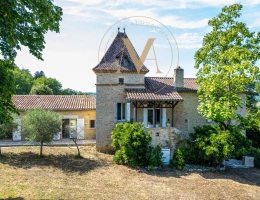

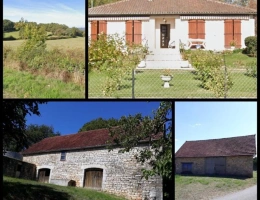
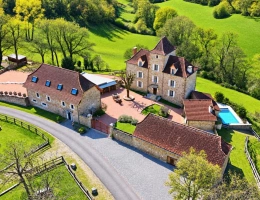
An equestrian property for sale in Lot usually means a Quercy stone house set in grazing, with boxes fitted into an old barn. Private sellers, estate agents and notaires offer homes with stables for sale on the Gramat and Limogne causses, leisure properties in the Quercy blanc, former livestock farms in the Ségala and Limargue, and larger estates in the Lot, Célé and Dordogne valleys. Listings detail the acreage of pasture, the boxes, any arena and the state of the buildings. To widen your search, browse every equestrian property for sale across France.
In Lot, value depends first on grass and water: the thin pastures of the causses are not priced like the deeper grassland of the north-east or the alluvial land along the rivers, and the house, often old, weighs heavily. Further down are reference prices, local features and the checks worth making before you buy, with each step of the purchase explained in our French equestrian property buying guide.
An equestrian property combines pasture and a house, so its price is best read against two public benchmarks, farmland and country houses, alongside the asking prices of current listings.
In 2025, 43 farmland sales were recorded in Lot (DVF data, vineyards excluded)*: the median price was €5,500/ha and the average €6,345/ha, with 80% of sales between €3,399 and €9,880/ha. Over four years, the median changed by +14.3% compared with 2021. For land and pasture sold free of any lease, the 2025 SAFER scale gives €5,590/ha (-1.1% over one year). By local farming area, values range from €5,430/ha (Quercy blanc, Causses) to €5,820/ha (Limargue, Ségala). Benchmarks stand at €7,015/ha in Occitanie and €5,307/ha nationally.
The house, usually at the heart of a leisure property, costs €168,508 at the median in Lot: that is the 2025 country house price, or €1,685/m² across 1,295 sales in rural communes, compared with €210,000 in Occitanie and €189,200 nationally. For homes of over 300 m², common on larger estates, the regional median reaches €640,000 across 786 sales recorded from mid-2020 to the end of 2025.
On 24 September 2026, 7 equestrian properties were for sale in Lot on ma-propriete.fr. On the same date, the 41 equestrian listings in Occitanie showed a median asking price of €650,000, half of them between €418,000 and €899,750, with a median area of 4.7 hectares.
| 2025 benchmark | Lot (46) | Occitanie | France |
|---|---|---|---|
| Farmland: DVF median | €5,500/ha* | €7,015/ha | €5,307/ha |
| Land and pasture with vacant possession: SAFER scale | €5,590/ha | €7,260/ha | €6,460/ha |
| Country house: median price | €168,508 | €210,000 | €189,200 |
| Country house: median price per m² | €1,685/m² | €1,987/m² | €1,830/m² |
Sources: 2025 DVF sales (French tax authority) processed by ma-propriete.fr, houses in rural communes; 2025 SAFER land value scale (Agreste, July 2026); homes over 300 m²: DVF mid-2020 to end-2025; asking prices of listings on 24 September 2026. * Indicative value (30 to 99 sales). Not published: fewer than 30 sales or area not covered.
The table places Lot well below the Occitanie average for farmland, yet slightly above the national level. The internal gap follows the geology: the Quercy blanc and the causses sit at the bottom, the greener Limargue and Ségala at the top of the range. Country houses cost markedly less than in the wider region and remain below the French median. For more detail, open our farmland price observatory or value a plot using the land value tool.
Most of what comes up in Lot is a home with land for horses: a limestone house, sometimes with a dovecote, a few boxes in a barn, paddocks with field shelters and fields enclosed by dry-stone walls or electric fencing. On the Gramat and Limogne causses, properties often include large areas of dry grassland, better suited to hardy horses or trail riding than to intensive breeding. In the Ségala and Limargue to the north-east, deeper soils carry more horses per hectare with less bought-in hay.
View a house with stables in Lot with a rider's eye: headroom in boxes converted from barns, ventilation, a wash bay, access to the fields, a tack room and dry hay storage. An arena or lunge pen adds value if the often stony ground has been drained and levelled. On the causses, factor in the cost of water too.
A livery yard for sale in Lot is often found near Cahors or Figeac, with an arena and sometimes an indoor school. A few riding centres and pony clubs also come up to take over, valued as much for their school and holiday clientele as for their buildings. A horse farm in Lot often combines breeding, livery and hosting trail riders, and equestrian gîtes benefit from visitors to the Dordogne valley, Rocamadour and the Causses du Quercy regional nature park. Larger estates, rarer, pair a main house and stone outbuildings with extensive woodland and rough grazing.
The department falls into three parts. At its heart, the Gramat and Limogne causses, largely within the Causses du Quercy regional nature park, offer open grazing, tracks lined with dry-stone walls and stone villages. To the north-east, the Limargue and Ségala around Figeac are greener, while the Quercy blanc in the south-west is a landscape of limestone hills. The Lot, Célé and Dordogne valleys bring fresher meadows, but also strong demand from residents and holidaymakers around Cahors, Figeac and Souillac.
No TGV station serves Lot, but the Paris-Toulouse line stops at Souillac, Gourdon and Cahors via Brive, and the A20 motorway crosses the department from north to south. Brive-Vallée de la Dordogne airport, close by, completes these links. A livery or gîte business does best near Cahors, Figeac or Souillac; a home with a few horses can look further out.
On the causses, water comes first: check the mains connection, any well, tank or lavogne (a stone-lined pond), and the summer supply, as thin pastures burn off quickly in a drought. The limestone is riddled with caves and sinkholes that must be located before levelling an arena or building an indoor school. In the valleys, look at the flood risk plan; within the protected surroundings of the many listed monuments, the heritage architect (Architecte des Bâtiments de France) reviews any new building, and the local plan (PLU) requires an indoor school in a farming zone to be justified.
A frequent misunderstanding: fields the seller rents are not sold with the house. The seller's lease stays with the seller and does not pass to you; to keep that land, you would have to negotiate a lease in your own name with each owner, with no guarantee of agreement. Only a transferable lease (bail cessible), which is uncommon, or certain cases within the close family are exceptions. The SAFER may also use its pre-emption right on farmland in the sale, and breeding or keeping horses at livery generally places you under the farming regime, with MSA registration depending on size.
Listings here come from private owners, rural estate agents and notaires. Narrow them down by acreage, number of boxes or indoor school, then save an e-mail alert for new properties in Lot. On Facebook, the group « Propriétés équestres à vendre - ma-propriete.fr » passes them on to riders as well. If your search extends to neighbouring Aveyron or Tarn-et-Garonne, see all the equestrian properties for sale in Occitanie.
Preparing the sale of a house with horses or a horse farm in Lot? List your property with photos, a cadastral plan of the fields and an inventory of facilities. You decide how precisely the location is shown, which protects a livery business still in operation. On request, we can arrange a valuation study of the land and refer you to rural property specialists.