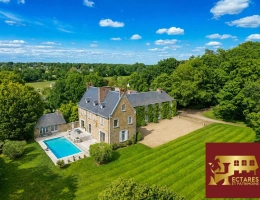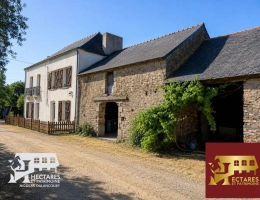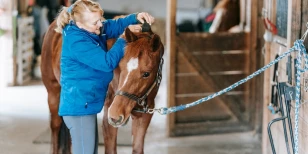
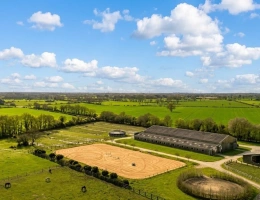
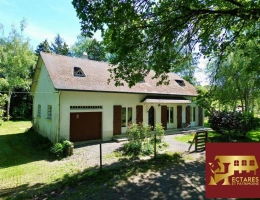
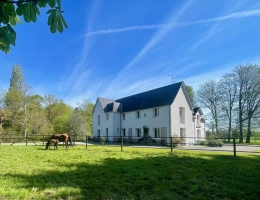
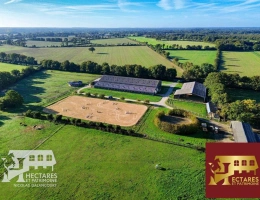
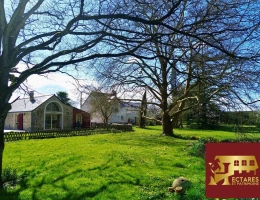
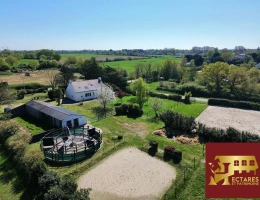
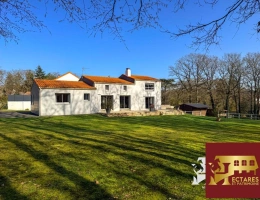
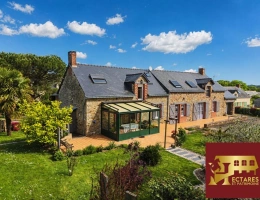
From the Châteaubriant bocage to the Loire estuary, an equestrian property for sale in Loire-Atlantique can take many forms. Here you will find stud farms for sale set among hedged meadows, breeding estates with a period house, longères in the Pays de Retz, livery yards on the edge of Nantes and older farms converted for horses. Private owners, rural agents and notaires list them with the acreage, the share of grassland, the number of boxes, any arena or indoor school and the condition of the house. To widen the search, browse equestrian properties for sale across France.
In this department the price depends mainly on the house and its distance from Nantes or the coast; the land itself, often damp, is inexpensive. The sections that follow set out land and country house prices, the areas worth knowing and the checks specific to Loire-Atlantique. The legal and practical steps are covered in our guide to purchasing a horse property in France.
Two public benchmarks help to place the price of an equestrian property: the value of land and pasture, which carries the acreage, and the price of country houses, which carries the buildings; asking prices of listings complete the picture.
A hectare of farmland in Loire-Atlantique sold for a median of €2,200 in 2025, across 380 recorded sales (DVF, vineyards excluded); the average was €2,476/ha and the central range ran from €1,596 to €3,533/ha. Over four years, the median changed by +10.0% compared with 2021. For land and pasture sold free of any lease, the 2025 SAFER scale gives €2,890/ha (0.0% over one year). By local farming area, values range from €2,230/ha (Estuaire de la Loire et région nantaise) to €3,660/ha (Pays de Sèvre et Maine). For comparison, the median land price is €3,267/ha in Pays de la Loire and €5,307/ha nationally.
For the buildings, the benchmark is the country house: 3,119 sales in rural communes of Loire-Atlantique in 2025, at a median of €230,000 and €2,302/m², compared with €190,000 in Pays de la Loire and €189,200 nationally. For homes of over 300 m², common on larger estates, the regional median reaches €657,000 across 384 sales recorded from mid-2020 to the end of 2025.
On 24 September 2026, 14 equestrian properties were for sale in Loire-Atlantique on ma-propriete.fr. On the same date, the 28 equestrian listings in Pays de la Loire showed a median asking price of €442,450, half of them between €303,735 and €622,660, with a median area of 6.2 hectares.
| 2025 benchmark | Loire-Atlantique (44) | Pays de la Loire | France |
|---|---|---|---|
| Farmland: DVF median | €2,200/ha | €3,267/ha | €5,307/ha |
| Land and pasture with vacant possession: SAFER scale | €2,890/ha | €4,100/ha | €6,460/ha |
| Country house: median price | €230,000 | €190,000 | €189,200 |
| Country house: median price per m² | €2,302/m² | €1,875/m² | €1,830/m² |
Sources: 2025 DVF sales (French tax authority) processed by ma-propriete.fr, houses in rural communes; 2025 SAFER land value scale (Agreste, July 2026); homes over 300 m²: DVF mid-2020 to end-2025; asking prices of listings on 24 September 2026. * Indicative value (30 to 99 sales). Not published: fewer than 30 sales or area not covered.
The figures point to an unusual pattern: farmland in Loire-Atlantique is markedly cheaper than elsewhere in Pays de la Loire and well below the national level, while country houses cost markedly more than both benchmarks, so most of the budget goes on the buildings. Land is cheapest in the Estuaire de la Loire et région nantaise area and dearest in the Pays de Sèvre et Maine. More detail is available in our farmland price observatory, and you can price the fields of a property with our land value tool.
In the north, the Pays de Châteaubriant is still hedged, stock-rearing country, with enclosed meadows, large stone farmhouses and farm buildings that convert readily into stables. A stud farm for sale in Loire-Atlantique will typically offer foaling boxes, barns for youngstock, paddocks with field shelters and a hay barn. Further south, the Pays de Retz and the land around the Lac de Grand-Lieu hold flatter breeding estates, some edged by marshland, with post-and-rail fencing around the fields nearest the house.
For a breeding project, judge the property on how the ground holds up in winter, the number of water points, the space for hay and whether mares, foals and stallions can be kept apart. When the meadows surround the yard, foaling is easier to watch and fields easier to rotate; land scattered across several communes adds daily driving.
Around Nantes, buyers mostly want livery yards with an arena, an indoor school, a tack room and a clubhouse. Riding centres and pony clubs to take over tend to sit on the edge of the city or near Saint-Nazaire, close to their clients; their value lies in the business, the number of riders and the state of the facilities. Families often look for a longère or rural bungalow with a few boxes and some hectares of grazing. Horse farms in the bocage and a handful of trekking gîtes near the Brière complete the picture.
Racing takes place at the Petit-Port racecourse in the north of Nantes and at Pornichet, beside La Baule; living nearby saves a breeder or trainer time on race days. The department is a patchwork: bocage in the north, the Brière marshes within a regional nature park, the Loire estuary, the Sèvre et Maine vineyards where Muscadet is made, and in the south the Pays de Retz, the Lac de Grand-Lieu and the edge of the Marais breton. Wetlands give good spring grass but call for drier fields in winter.
TGV services stop at Nantes, Saint-Nazaire and La Baule, bringing the coast and the vineyards within reach of Paris. Roads converge on Nantes: the A11 heads for Angers and Paris, the A83 for Niort, the N165 for Vannes and the N137 for Rennes. From the Pays de Châteaubriant or the Pays de Retz, Nantes is within commuting distance.
Much of the department is wetland: the Brière, the surroundings of the Lac de Grand-Lieu, the estuary meadows and the Marais breton. Waterlogged in winter, some of this ground floods: check drainage, the paddocks and the commune's flood risk plan. Several of these areas are also protected, which restricts building work. In coastal communes and around the Lac de Grand-Lieu, the loi Littoral tightly limits new construction, and in an agricultural zone of the local plan (PLU), new stables or an indoor school must be justified by the equestrian activity.
Also check how much of the grazing the seller actually owns. Rented fields farmed by the seller stay outside the sale: continuing to use them would require a fresh lease from each landowner, and none is obliged to grant one. The current lease does not pass to you, except for the rare transferable lease (bail cessible) or certain situations within the immediate family. The SAFER also has a pre-emption right on most farmland sales, and breeding or livery is in principle treated as farming, with MSA membership depending on scale.
Listings on ma-propriete.fr come from private owners, rural agencies and notaires. Sort them by acreage, number of boxes or indoor school, and save an e-mail alert to hear about new properties in the department. New listings also reach riders through the « Propriétés équestres à vendre - ma-propriete.fr » group on Facebook. To look further afield, visit the equestrian properties for sale in Pays de la Loire page.
Own a stud farm, a yard or a longère with paddocks? Advertise your property with a gallery of photos, a map of the plots and a description of the stabling and arenas. You decide how precisely the location appears, which helps protect a business that is still running. On request, a rural property specialist can assist you, and we can prepare a land valuation study to support your asking price.