Buying one hectare of agricultural land costs on average €6,400 in France in 2024. At the same time, the European Union average stands at €15,224/ha, and a Dutch farmer must pay nearly €96,600 for the same area. In other words, French agricultural land is roughly 2.4 times cheaper than the European average, and up to 15 times cheaper than in the Netherlands. This often-overlooked fact raises a question: why does a country with the largest agricultural territory in Western Europe display such contained prices? Is it the sign of an undervalued market, or the consequence of a specific regulatory model?
In this article, we compare the price of agricultural land in France with that of other European countries, based on Eurostat data (dataset apri_lprc, March 2026 update), statistics from the French Ministry of Agriculture (SAFER source) and our own analyses of DVF transactions. An important clarification: all the figures presented concern agricultural land excluding vineyards (arable land and grassland), as vineyards follow a completely different market logic.
Two sources allow us to measure the price of French agricultural land, and they converge remarkably.
The first is the official statistic from the French Ministry of Agriculture, established from SAFER notifications: in 2024, the average price of vacant land and meadows stands at €6,400/ha, while tenanted land (sold with a farmer in place) trades at €5,220/ha, a discount of 18% linked to the rural lease. It is this vacant land value that Eurostat uses for France in its European comparisons.
The second source is our own analysis of DVF transactions (Demandes de Valeurs Foncières), the database of sales recorded by the French tax administration. Across 14,395 sales of agricultural land analysed in 2024, the average price comes to €6,038/ha and the median price to €5,284/ha — the median price, which divides sales into two equal halves, being less sensitive to atypical transactions than the average. The 2025 data, now complete, confirms the trend with an average price of €6,059/ha. All of these statistics can be consulted on our agricultural land price observatory.
Key figures 2024
France: €6,400/ha (SAFER vacant land) — EU-27 average: €15,224/ha (Eurostat, estimate) — Netherlands: €96,608/ha — Change 2015-2024: +6.7% in France versus +37.9% for the EU-27.
Every year, Eurostat publishes the price of arable land in the Member States. The table below presents the latest available values, ranked in descending order. The hierarchy is spectacular: a twentyfold difference between the Baltic states and the Netherlands.
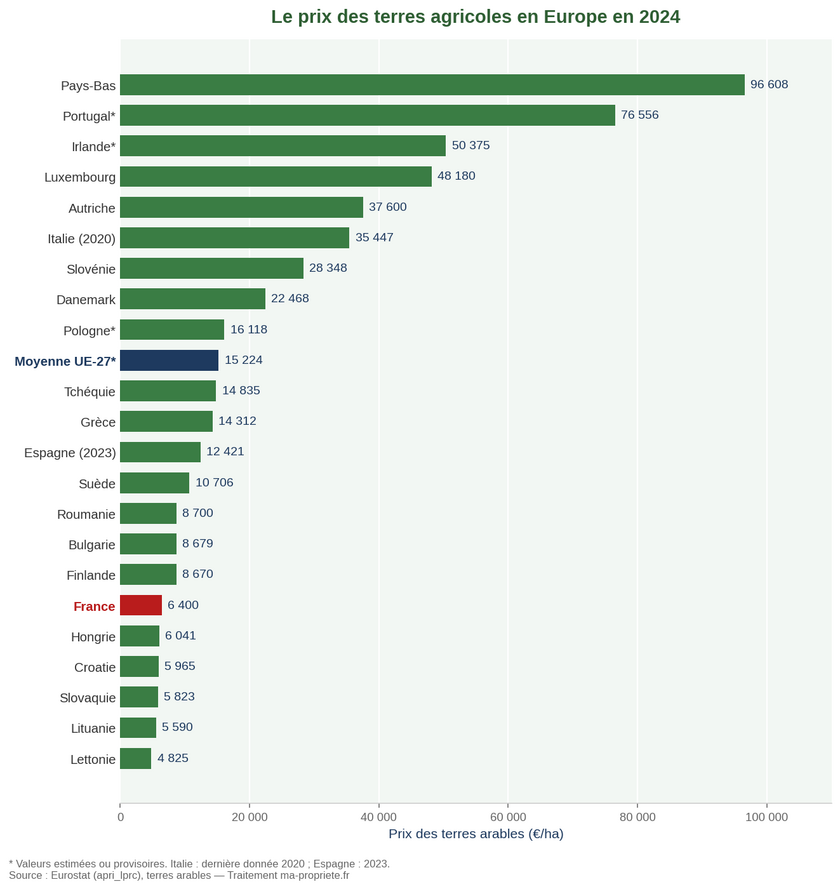
Arable land prices in Europe in 2024 — Source: Eurostat (apri_lprc), analysis by ma-propriete.fr
|
Country
|
2024 price (€/ha)
|
Gap with France
|
|
Netherlands
|
96,608
|
x 15.1
|
|
Portugal*
|
76,556
|
x 12.0
|
|
Ireland*
|
50,375
|
x 7.9
|
|
Luxembourg
|
48,180
|
x 7.5
|
|
Austria
|
37,600
|
x 5.9
|
|
Italy (2020)
|
35,447
|
x 5.5
|
|
Slovenia
|
28,348
|
x 4.4
|
|
Denmark
|
22,468
|
x 3.5
|
|
Poland
|
16,118
|
x 2.5
|
|
EU-27 average*
|
15,224
|
x 2.4
|
|
Czechia
|
14,835
|
x 2.3
|
|
Greece
|
14,312
|
x 2.2
|
|
Spain (2023)
|
12,421
|
x 1.9
|
|
Sweden
|
10,706
|
x 1.7
|
|
Romania
|
8,700
|
x 1.4
|
|
Bulgaria
|
8,679
|
x 1.4
|
|
Finland
|
8,670
|
x 1.4
|
|
France
|
6,400
|
Benchmark
|
|
Hungary
|
6,041
|
- 6%
|
|
Croatia
|
5,965
|
- 7%
|
|
Slovakia
|
5,823
|
- 9%
|
|
Lithuania
|
5,590
|
- 13%
|
|
Latvia
|
4,825
|
- 25%
|
Arable land prices in Europe, latest available values — Source: Eurostat (apri_lprc), analysis by ma-propriete.fr. * Estimated or provisional values according to Eurostat. Italy: latest data 2020; Spain: 2023.
At €96,608/ha in 2024, the Netherlands holds the record among Europe's major agricultural countries. The explanation lies in a simple equation: one of the most intensive and profitable agricultural sectors in the world (horticulture, dairy farming, greenhouse crops) on a tiny territory where land is contested by housing, infrastructure and, now, environmental policies aimed at reducing livestock numbers. Scarcity drives prices. Luxembourg (€48,180/ha) and Ireland (€50,375/ha, provisional figure) follow the same logic of land scarcity and strong economic pressure.
The most striking movement of the past decade is playing out in the East. Czechia rose from €4,775/ha in 2015 to €14,835/ha in 2024, a threefold increase. Bulgaria more than doubled (€3,891 to €8,679/ha), as did Estonia (€2,567 to €7,033/ha). The direct consequence: Romania, Bulgaria and Poland, long regarded as land-buying eldorados, now display prices higher than those in France. European economic convergence, CAP subsidies and the arrival of institutional investors have profoundly reshuffled the deck.
The contained price of French agricultural land is not a market anomaly: it results from structural choices and favourable geography.
The SAFERs (Sociétés d'aménagement foncier et d'établissement rural) hold a right of pre-emption over the vast majority of agricultural land sales. Their mission of steering the market — supporting new farmers, combating speculation — acts as a natural brake on price escalation. This mechanism, unique in Europe in its scale, keeps land values close to their productive value, i.e. what the land can actually yield for the person who farms it.
The French rural lease gives the tenant farmer a near-automatic right of renewal and a regulated rent (the fermage). This protection deters some purely asset-driven investors and explains the 18% discount on tenanted land (€5,220/ha) compared with vacant land (€6,400/ha). You can find the details of these series in our articles on the price of vacant farmland in France since 2011 and the price of tenanted farmland since 2012.
With approximately 27 million hectares of utilised agricultural area (UAA), France has the largest agricultural territory in the European Union. This depth of supply mechanically moderates pressure on prices, especially as the major extensive livestock regions (Massif Central, Bourgogne-Franche-Comté, where the average DVF price remains below €3,000/ha) pull the national average downwards.
Comparing trajectories is even more telling than comparing levels. Between 2015 and 2024, the average price of arable land in the EU-27 rose from €11,043 to €15,224/ha (Eurostat estimate), an increase of +37.9%. Over the same period, France went from €6,000 to €6,400/ha: only +6.7%, i.e. near-stability in constant euros once inflation is taken into account.
For a farmer, this moderation is good news: it preserves the ability to set up and expand a farm, whereas Dutch or Czech farmers are seeing the cost of access to land soar. For an investor, it raises questions: French farmland, whose price remains anchored to its productive value, offers genuine asset security but a more limited prospect of capital gain than in deregulated countries. Our guide on how to assess the price of agricultural land details the criteria that determine the value of a plot.
Comparing agricultural land prices between countries requires a few precautions:
The average price stands at €6,400/ha for vacant land (SAFER source) and €6,038/ha according to our analysis of DVF transactions, with a median price of €5,284/ha. Tenanted land trades at around €5,220/ha.
The Netherlands, at €96,608/ha in 2024 for arable land, roughly 15 times the French price. Portugal, Ireland and Luxembourg also exceed €48,000/ha.
No, but it is among the cheapest. Only a few countries such as Hungary, Croatia, Slovakia, Lithuania and Latvia display lower prices in 2024. Romania, Bulgaria and Poland are now more expensive than France.
Three structural factors: market regulation by the SAFERs, the tenant farming statute that protects the sitting farmer, and the abundance of French agricultural land, which limits pressure on prices.
At €6,400/ha in 2024, France remains one of the most accessible agricultural land markets in Europe, and above all one of the most stable: +6.7% over ten years, versus +37.9% for the European average. This singularity, the fruit of SAFER regulation and the tenant farming statute, protects the productive purpose of the land and farmers' ability to set up. It also makes French agricultural land a defensive wealth asset, whose value rests on the real economy rather than on speculation. One question remains open: will European convergence, which has already pushed Central European prices above French levels, eventually exert upward pressure on our countryside?