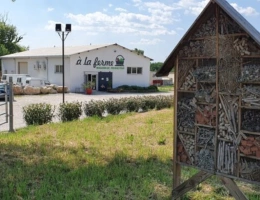
Taking over a poultry farm for sale in Bouches-du-Rhône means settling in a department where poultry remains a secondary enterprise, run on a modest scale between the Crau plain, the Alpilles and the Aix countryside. Farmhouse chickens, guinea fowl and ducks sit alongside flocks of laying hens whose table eggs go to markets and to shops across the Marseille conurbation. The properties shown are entrusted to us by farmers arranging their departure, by Provençal rural agencies and by notaries; each entry states the covered area, the rearing system, the size of the ranges and the outlet behind the business. They appear among the poultry farms for sale across France.
Beyond the listings, this page sets out what really weighs on a purchase: farmland values in the department, the areas where holdings still change hands, how to judge a livestock building under a Mediterranean climate, and the obligations that come with the sector. If you are planning a first set-up, our white paper « Créer une exploitation agricole » (in French) works through every step.
Land remains the largest item when buying a poultry farm. According to sales recorded by the French tax administration (DVF, vineyards excluded), the median price of agricultural land in Bouches-du-Rhône (13) stood at €20,637/ha in 2025, with an average of €19,365/ha across 24 sales; 80% of transactions fall between €10,674 and €24,734/ha, against a national median of €5,307/ha. * Fewer than 30 recorded sales: indicative value.
The SAFER benchmark of land values (2025 figures) puts vacant land and pasture at €16,720/ha (-4.2% year on year, -2.1% over ten years), against a national average of €6,460/ha; land already let sells around 17% lower.
In this climate, value rests first on the buildings and on how well they cope with heat: orientation of the house, roof insulation, misting, ventilation, shade over the range and a secure water supply. Then come the equipment, the flock in place, the health approval of any slaughter or packing room, and above all the customer base built up at markets and with local shops. To place an asking price in context, use our land price observatory and our financial calculators.
Nothing here is industrial in scale. Buildings are usually modest, sometimes converted sheds, with a few mobile houses placed on a wooded range and laying units kept on the floor or run as genuinely free-range poultry. Buyers look at the frame and roof, at insulation, at ventilation, at the heating used for young batches, at silos, drinkers and the state of the floor during the sanitary break. A house recently brought up to standard, with a compliant entry room and an access track lorries can use, sells above an older volume whose return to service implies heavy work.
Equipment matters here because it governs daily work: feed line, pressure washer, catching gear, cold room and the grading tables of a small packing station. Where the sale includes a mas or a bastide, ask for the house, the production tool and the land to be priced separately: a single figure often hides a large residential share here. A laying unit with a farm shop open all year is not valued like a bare building.
Poultry units sit mostly on the edges of arable ground and sheep country: the Crau plain around Saint-Martin-de-Crau, the foot of the Alpilles towards Eyguières and Mouriès, the Salon countryside, the terraces of the Aix area and, further north, around Lambesc and the Durance valley. The Camargue, given over to rice and bulls, has few. Across all of them, farmland is contested by other enterprises and by residential demand, which keeps complete units scarce. The southern half, between the Étang de Berre, Marseille and Aubagne, offers scarce and keenly contested land, where any farm block competes with residential uses.
The main asset is a dense local market: stalls, grocers and restaurants are within reach, provided the holding has usable road access and a delivery round that stays manageable. The more affordable properties lie inland, away from the urban centres, where land prices remain steadier than along the coastal fringe. A delivery round that stays within an hour's drive is usually what makes the accounts work, so it is worth timing before you commit.
Two checks matter above all others. The first of them is planning, and it comes before everything else here: in so sought-after a department, the local plan's zoning, any farmland protection perimeter and any easement tied to the irrigation canals will govern future building, so a further house is something to prepare before making an offer, not after. The second is the French classified installations regime: depending on flock size the unit falls under declaration, registration or authorisation, a change of operator must be notified to the prefecture, and minimum distances from neighbouring dwellings frame any extension.
Add to that the manure spreading plan or disposal route, an up-to-date biosecurity plan, and avian influenza measures that require birds to be housed during risk periods. Rented parcels pass on with the rural lease, subject to the landlord's agreement, and the deal remains subject to the structures control, the French authorisation regime for taking over farmland, and to SAFER's pre-emption right. Water rights, often attached to an irrigation share, deserve checking on paper.
Behind each entry stands a private vendor, a rural estate agency or a local notary. Set the filters on covered area, budget and production type, whether a short-chain chicken farm, a broiler farm under contract or an egg farm whose laying flock you would bring back up to size, then create an alert so new sales reach you first. You can also widen the search to every poultry farm for sale in Provence-Alpes-Côte d'Azur.