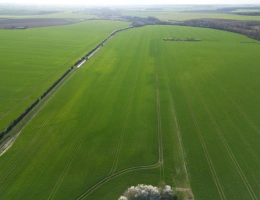
Looking for a farm for sale in Centre-Val de Loire means choosing between systems with little in common: an arable block on the Beauce plain, a mixed holding in the Boischaut, a dairy goat herd in the Sancerrois or the Pays Fort, a vegetable unit in the Loire valley or a walled vineyard in Touraine. The region ranks among France's leading arable and seed-producing areas while keeping extensive livestock country south of the Loire. The properties listed come from farmers arranging their retirement, from rural property specialists, from notaries and from advisers who handle farm successions; every listing sets out the usable area, the soil type, how the parcels are held and the equipment that goes with the farmstead. They complete our national selection of farms for sale in France.
This page goes further than a catalogue of adverts: land values department by department, the sectors shaping each farming district, where supply renews itself, and the checks to run before signature. To prepare a first entry into farming, or a takeover beyond the family circle, our white paper « Créer une exploitation agricole » (in French) walks through the regulatory steps and the way such a project is financed.
Land forms the base of a farm's value. DVF, the property sales database published by the French tax administration (vineyards excluded), records a 2025 median of €5,480 per hectare in Centre-Val de Loire, an average of €5,892 and 1,195 sales; four transactions in five fall between €3,003 and €9,349, against a national median of €5,307.
The SAFER land value benchmark sets €6,260 per hectare for vacant land and pasture offered for sale in the same year, -6.1% over one year and +8.3% over ten, against €6,460 nationally. Land sold with a tenancy in place is valued at €5,700, a discount of about 9%.
These figures place regional land values; they do not price a farm, which depends first on its buildings, its herd and its outlets. For department-level detail, see our land price observatory, then cost your purchase with our financial calculators.
| Department | DVF sales 2025 | Median price/ha | SAFER vacant land |
|---|---|---|---|
| Cher (18) | 199 | €4,750 | €5,770 |
| Eure-et-Loir (28) | 213 | €8,300 | €10,030 |
| Indre (36) | 249 | €4,500 | €5,730 |
| Indre-et-Loire (37) | 201 | €5,477 | €5,370 |
| Loir-et-Cher (41) | 173 | €4,647 | €5,090 |
| Loiret (45) | 160 | €5,122 | €6,390 |
The northern half lives on arable crops: milling wheat, barley, oilseed rape and sugar beet on the deep loams of the Beauce and the Gâtinais, with a strong specialisation in seed multiplication and a well established local processing industry. The Loire valley adds market gardening, ornamental horticulture and orchards on the alluvial terraces, while the Sologne and the Brenne set woodland, lakes and rough grazing side by side. Further south, the Berry and the Boischaut remain country for suckler herds and sheep, extended by the dairy goat flocks of the Cher and Indre slopes, whose cheeses carry several appellations.
That north-south gradient dictates the capital required. A working farm in the Beauce is bought on uniform soils, unbroken blocks and heavy machinery, with few buildings to maintain. A mixed farming unit in the Berry rests instead on grassland, functional livestock housing and a herd whose health status and genetics deserve as much scrutiny as the land. Between the two, holdings in the Sologne and Touraine often combine crops, woodland and diversified income.
Eure-et-Loir (28) and Loiret (45) carry the largest arable structures, across the Beauce plain and the Gâtinais, the latter adding a nursery and horticultural sector of national standing. The Perche district of Eure-et-Loir is the exception, with its pastures, hedgerows and long livestock tradition. Loir-et-Cher (41) divides between cultivated plains in the north, the woods and lakes of the Sologne, and the vineyard and vegetable slopes of the Cher valley.
Indre-et-Loire (37) combines Touraine vineyards, field crops on the plateaux and vegetable production in the Loire, Indre and Cher valleys. Cher (18) sets the arable Champagne berrichonne alongside the Pays Fort and the Sancerrois with their goat herds, and the cattle country of the Boischaut. Indre (36) follows the same pattern, from the Champagne berrichonne to the hedged farmland of the Boischaut Sud, with the lakes of the Brenne in between.
The most numerous and most affordable properties lie in the southern departments — Indre, Cher and the Boischaut fringes — where retirements are piling up and livestock units struggle to find a successor. The northern plains hold the highest values, with direct competition between neighbours looking to expand. Vineyard slopes and vegetable valleys form a separate market, where appellation and water supply drive the price.
Across the northern half, the value of a holding depends closely on its abstraction rights. The Beauce aquifer is managed by agreed volume: allocations are shared between irrigators, then cut by order when levels fall. A property with an authorised borehole, an allocated volume and well maintained irrigation equipment is not worth the same as a parcel farmed dry, particularly for sugar beet, seed crops, potatoes and field vegetables.
Elsewhere the difference lies in the soils: deep loams in the north, flinty clays on the plateaux, acid sands in the Sologne, fertile but flood-prone alluvium in the valleys, shallow limestone in the Berry. Ask for the available analyses, the map of drainage already installed and the yield history parcel by parcel: within a single commune, the gap in potential usually explains the gap in price.
From the preliminary contract onwards, the notary informs the regional SAFER, which may step into the buyer's place and then reopen the property to applications, new entrants remaining its stated priority. Making yourself known before the property goes on the market, with a technical file and a financing plan, works better than discovering the procedure once terms are agreed with the seller.
Farming the land also requires authorisation under structural control, whose regional plan sets the thresholds and the order of priorities. Then comes the tenancy position: a sitting tenant holds a priority right to buy and a lease that is hard to end, so an agricultural property largely let out will not come free on the buyer's timetable. Remember too that the northern plains fall within a nitrate vulnerable zone, with the soil cover and fertilisation duties that go with it.
Retiring farmers, rural estate agencies and notaries across the six departments entrust their instructions to this page as handovers come up. The search filters by department, production, area or budget; an e-mail alert then flags each new property matching your criteria. If you are selling a holding yourself, listing it takes a few minutes. To think on a national scale, browse farms for sale in France.