
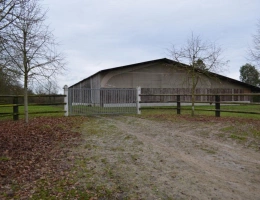

Buying a dairy farm for sale in Loire-Atlantique means dealing with a department shared between livestock, the Nantes vineyards, arable ground and a city region that keeps spreading. Milk production nevertheless holds firm, particularly in the north and east, and the milk collected goes to dairies and cooperatives across western France rather than into a local protected cheese. Offers are placed by farmers stepping back, by rural property firms and by notaries in Nantes, Ancenis, Châteaubriant or Machecoul, with detail on buildings, stock and fields. They sit alongside the dairy farms for sale published in other regions.
This page adds to the listing what really settles a purchase: the value of grassland in Loire-Atlantique, the districts where holdings are handed on, the condition to expect from bocage livestock buildings and the controls that apply to milk production. Putting the setting-up project together is covered step by step in our white paper « Créer une exploitation agricole » (in French).
Pricing the land comes first in any plan to buy a dairy farm. On the basis of 2025 DVF sales (vineyards excluded), the median in Loire-Atlantique (44) works out at €2,200/ha and the average at €2,476/ha, across 380 transactions. The central range covering 80% of sales runs from €1,596 to €3,533/ha; nationally the median is €5,307/ha.
With no local SAFER average published, the French reference applies: €6,460/ha for vacant land and pasture, €5,350/ha for tenanted land.
The worth of a dairy holding here goes well past its acreage: cow housing and bedding, milking parlour or robot, tank and pre-cooler, properly sized slurry store and midden, silage clamps, drier or barn, the water system and the tracks out to the paddocks. The herd, its genetics and its health status complete the picture, as does the outlet — a contract with a dairy, a cooperative commitment or direct sales on the edge of the conurbation. Set all of that against our land price observatory before modelling your plan with our financial calculators.
Local buildings run from the expansion-era cubicle shed to more recent designs built around a robot. Look at the height under the roof and the ventilation, the orientation against westerly winds, lying comfort, the quality of the scraping system, the collecting yard and the tank room. Slurry store and midden must fit the cows actually kept and the closed periods for spreading. The clamps, their concrete base and their cover, tell you a great deal about general upkeep. A grazing system finally requires firm tracks and a spread of paddocks reachable from the buildings, something a listing photograph never shows.
The dairy herd is read through milk recording, cell counts, calving interval, IBR and BVD status and the replacements coming through. Where a house, outbuildings and land are included, splitting the price becomes decisive: close to Nantes or the coast the residential share can outweigh the production tool, which unbalances the funding of a working farm if nothing is separated out.
The north-east, around Châteaubriant, Nozay and Derval, remains the densest livestock area, with well-structured farms and more affordable land. The Ancenis country mixes livestock, crops and vines on the Loire slopes. The Pays de Retz, from Machecoul to Sainte-Pazanne, combines grassland, marsh and vegetable growing. Around Lac de Grand-Lieu and in the Brière, wet meadows support summer grazing. The south-east, in the Nantes vineyard, leaves little room for milk, while the approaches to Nantes and Saint-Nazaire face sustained competition for land.
The consequence is straightforward: a unit in the north of the department usually offers a better balance between acreage, buildings and price than one inside the Nantes belt. Buyers preparing a farm takeover are therefore well advised to widen their search towards the borders with Mayenne and Maine-et-Loire.
Nitrate vulnerable zone status brings an action programme whose application has to be verified on site: real storage capacity, the spreading calendar, soil cover between crops. The number of cows kept then sets the holding's position in the French classified installations regime, declaration or registration, with a prefecture formality at the point of takeover. In the marshes and around Lac de Grand-Lieu, wetlands, European habitat protection sites and agri-environment schemes govern drainage, the ploughing up of permanent grassland and the dates work may be done: call for the commitments in force before imagining a new forage system.
The second point is urban pressure. Look at how the fields are zoned in the local planning document, at infrastructure schemes already announced, and at the distance from the buildings to neighbouring houses, which commands both spreading and any later extension. In rural law terms, tenancy dominates: taking over the leases requires the owners' consent, the purchase still needs an authorisation to farm, and SAFER follows this peri-urban market closely. Finally, make sure of what becomes of the payment entitlements, of the milk contract and of the terms the dairy sets for a new supplier.
The properties on this page come from private sellers, rural agencies and local notary offices. Filter by area, price or milking installation, whether you want a small herd or a farm already running a milking robot, set up an alert, and continue the search among dairy farms for sale in Pays de la Loire.