


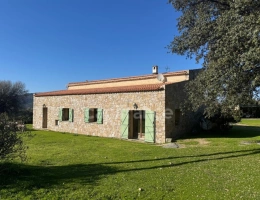
A goat farm for sale in Corse-du-Sud rarely looks like a lowland dairy unit: the herd spends most of the year outside, on maquis and oak grazing that climbs from the shore to the inland ridges. What you see here is released by southern breeders preparing to step back, by notarial offices in Ajaccio or Sartène and by firms dealing in rural land; each file gives herd size, how grazing is managed, the status of the ground used and where the milk ends up. You will find them within our national register of goat farms for sale.
Beyond the list itself, this page gives you the means to place an offer: what island farmland is worth, the districts where handovers cluster, how to read buildings put up piece by piece, and the checks that on-farm cheese making brings with it. If setting up is ahead of you, the white paper « Créer une exploitation agricole » (in French) works through the administrative and financial stages.
Land weighs heavily on the budget for a goat farm. Transfers published by the French tax authorities (DVF, excluding vineyards) put the median for farmland in Corse-du-Sud (2A) at €5,435/ha in 2025, with an average of €7,019/ha over 6 sales. Eight transactions in ten settle between €3,174 and €12,448/ha, where the national median is €5,307/ha. * Fewer than 30 recorded sales: indicative value.
No SAFER land value is published for this territory, so the benchmark stays national: €6,460/ha for vacant land and pasture and €5,350/ha where a tenant is in place.
With property of this kind, a large share of the asking figure sits outside the hectares. It lies in the goat house and its bedded area, the parlour and bulk tank, the make room and its ripening cellar, the water resource, how usable the access tracks are, and then in the animals themselves and the custom built up around the farm's own cheeses. Set those items against our land price observatory and our financial calculators.
Southern buildings were seldom designed in one go: an old masonry core, a timber-framed extension, a sheet-metal shelter out on the grazing block. Judge coherence before size — how effluent leaves the building, cross ventilation, shade during the hot hours, resistance to wind, and covered storage for hay, part of which arrives by boat. Where milking is mechanised it sits in a small in-line unit whose milk line, vacuum pump and cooling all need testing. Water autonomy counts just as much: a declared borehole, a capped spring or a tank, with late-summer flow worth checking on site.
Processing weighs heavily on the price. An approved room, a drying room, a cold store and a sales point that works through the summer are worth far more than they cost to build, because they come with an established local buying habit. Conversely, a goat cheese farm offered without a workshop means finding an outlet for the milk, which here is settled case by case. Where the dwelling forms part of the deal, insist on a clear split between house, livestock buildings, animals and land.
Goat keeping in this department belongs above all to the interior. The Alta Rocca around Levie and Zonza, the Taravo valley, the upper Prunelli above Bastelica, the Cruzzini and the Sorru offer wide grazing, varied altitude and land values bearing no relation to the coast. The Sartenais and the Ortolo valley sit somewhere between, with herds often run alongside other enterprises. Along the coastal strip from Porto-Vecchio to Ajaccio, residential demand lifts the price of every parcel, while opening a direct outlet that pays well through the season.
One point recurs in almost every file: the area genuinely controlled differs from the area advertised. Sectional ground, jointly owned parcels and grazing arrangements never set down in writing make up much of the land in use. Ask, parcel by parcel, what is held outright, what is let under a written lease and what rests on tolerated use: the herd's forage base depends on it, and so does the value of the holding.
Unresolved land title is the first hurdle to buying in the south of the island. Many parcels have never been divided between heirs, others carry old deeds never updated, and the long regularisation effort has not absorbed everything. Bring the notary in early, before the figure is even discussed, to learn whether the sale can realistically complete within a sensible timeframe. On the farming side, a dairy goat holding falls under departmental health regulations or, above a certain herd size, under the French classified installations regime, with any change of operator to be declared.
Check the herd's health status next, CAEV — caprine arthritis-encephalitis — and brucellosis first among them, then, where milk is processed, the food safety plan and the laboratory results of recent seasons. Island planning deserves close reading: farmland is firmly protected, building near the shore tightly controlled, and an extension to the cheese room is not something to decide after signing. Fire risk on scrub-invaded grazing finally calls for a look at access routes and water points.
Breeders at the end of their career, rural estate agencies and local notaries keep this section supplied. Sort what you see by pastoral area, by price or by whether a workshop is attached, then set up an alert: a smallholding of this type comes up seldom and moves fast. Handing over your own? Post the listing. Widen the search to goat farms for sale in Corsica.