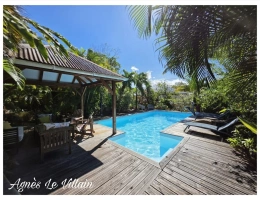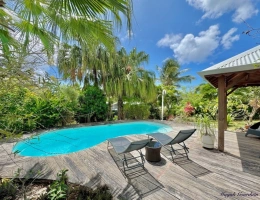
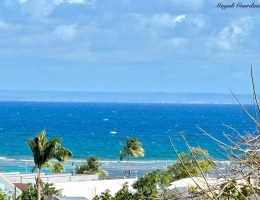
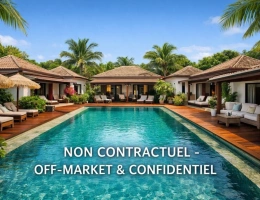
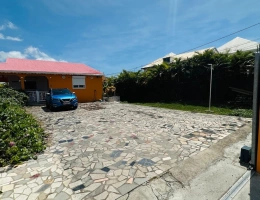
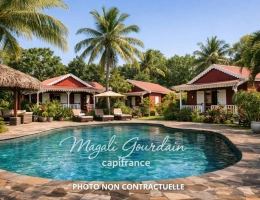

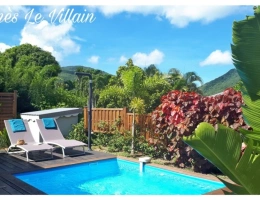



A tourism property for sale in Guadeloupe serves visitors who come, mostly during the European winter, for the Caribbean Sea, the lagoons of Grande-Terre and the rainforest of Basse-Terre. Several draws support demand: the beaches of the south coast, diving in the Cousteau reserve off Bouillante, hikes up La Soufrière and through the national park, and the quieter islands of Marie-Galante, Les Saintes and La Désirade. Most travellers land at Pôle Caraïbes airport, which has direct flights from Paris.
The range of properties is broad: clusters of wooden bungalows around an owner's house, villas with a pool and separate units, large homes converted to hospitality, former plantation houses, hotels, holiday residences and, less often, campsites or resort complexes. This page covers the whole archipelago and is meant for investors, often based in mainland France, for buyers taking over a trading business and for owners preparing a sale.
As of 25 September 2026, 11 tourism properties in Guadeloupe are listed on ma-propriete.fr: 5 gîtes, 5 manor houses and châteaux, 1 campsite. The median asking price is €899,000; half are priced between €809,950 and €1,520,000, ranging from €440,000 to €2,808,000.
Source: listings published on ma-propriete.fr on 25 September 2026 (asking prices, not sale prices). The ma-propriete.fr DVF observatory does not cover this territory.
The ma-propriete.fr DVF observatory does not cover the overseas departments, so prices here are built up from components. Land comes first: plots near the shore are scarce, and a sea view or a beach within walking distance widens the gaps. Then the buildings: number of lettable units, hurricane and earthquake design, water tank, solar power, pool. Finally the business, judged on turnover and EBITDA (EBE in French accounts) over recent seasons. The supply is mainly split between gîte clusters and large villas or homes let to visitors, while campsites are rare; the benchmark location is coastal, on the south coast of Grande-Terre, where demand and prices peak.
A typical bungalow sale involves an owner's house with several small timber units, each with a terrace, let by the week in the spirit of the Creole case. Every unit is a furnished tourist let that must be declared and registered. Check the timber, roof fixings and sewage connection before you buy. For this type of property, see the gîtes for sale in Guadeloupe page.
Beach hotels clustered on the south coast of Grande-Terre: Le Gosier, the first resort, and Sainte-Anne, which developed alongside it, then Saint-François around the marina and beaches. The stock ranges from small boutique hotels to self-catering holiday residences and resort complexes combining bungalows, pool, restaurant and beach bar. A hotel is a public-access building (ERP) that needs fire-safety approval; its 1-to-5-star rating is issued by Atout France for five years. Taking over a hotel-restaurant also means checking the drinks or restaurant licence and its transfer at the town hall. For a holiday residence, review the commercial leases signed with the operator. Browse hotels for sale and inns and hotel-restaurants.
Large villas arranged in suites often run as B&Bs in Guadeloupe, limited to 5 rooms and 15 guests. Former sugar or coffee plantation houses and Creole mansions, sometimes turned into wedding estates, appear among manor houses and fine homes or on the event venues in Guadeloupe page. Lodges and tree houses on Basse-Terre belong with glamping and unusual stays.
Always separate the property itself, conveyed before a notary, from the business goodwill (customers, name, contracts, equipment), which has its own transfer formalities. Furnished holiday lets fall under the Le Meur Act of 19 November 2024, which extends registration nationwide (the national online service it provides for is not yet in place and is expected to open in the fourth quarter of 2026) and strengthens the powers of local councils: check the rules already in force with the town hall. The climate sets the calendar: the dry season, or carême, runs from January to April and coincides with the high tourist season, which starts in December, while the wet season, or hivernage, from June to November, is the hurricane season and a quieter period. The islands are also rated high seismic risk, so have roof anchoring, storm shutters and extensions checked. On the coast, the cinquante pas géométriques strip belongs to the State: verify the title and the status of any building within it. Finally, look at sargassum seaweed, shoreline retreat and natural-disaster insurance.
It depends on real occupancy outside the dry season, nightly rates and upkeep, which is costly in a salty, humid climate. Ask for recent accounts and booking-platform statements, then test your figures with the holiday-let simulator (in French).
Yes, provided someone runs it on site. Visit during the wet season to see the low season, meet the staff you will take on, review supplier contracts and guest reviews, and have the licence and public-access approvals audited before signing.
Asking-price benchmarks appear in the block above. Add purchase costs, which you can estimate with the notary fee calculator (in French), a reserve for hurricane upgrades and, where relevant, the price of the business and stock.
To compare, see tourism properties in Martinique and Réunion, set up an e-mail alert (in French), or list your property if you own a business on the islands.