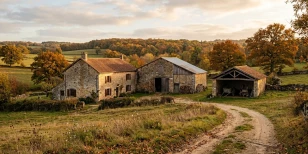
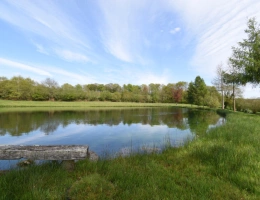
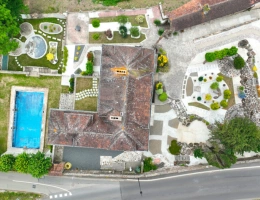
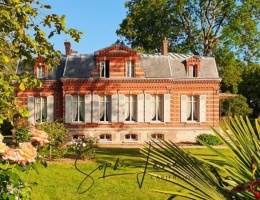
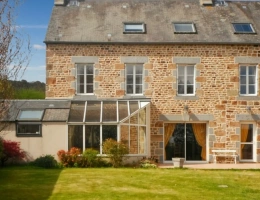
Buying a mill for sale in Normandy means settling in one of the regions of France richest in watermills: the Seine, Eure, Orne, Touques, Risle and Sée rivers once powered hundreds of flour, fulling and tanning mills, and the Mont-Saint-Michel bay even keeps a few rare tide mills. On this page, ma-propriete.fr brings together the mills for sale in Normandy: watermills to renovate in the Pays d'Auge, former flour mills in the Seine valley, tide mills in Manche and half-timbered millers' houses.
You will also find price benchmarks based on actual sales, an overview of the areas by department, and the specific points to check before buying a mill. To prepare your project, read our white paper on setting up a rural gîte, whose advice applies fully to a mill.
There are no official statistics dedicated to mills: sales are too rare and too varied (a ruin to restore, a habitable mill, a flour mill with a turbine). The most reliable market benchmark remains the price of country houses, which a habitable mill resembles, with a premium for the water, the character and the water rights, and a discount for the work required.
How much does a country house cost in Normandy? According to DVF data (notarised sales) analysed by the ma-propriete.fr observatory, the median price of a country house in Normandy stood at €189,000 in 2025, with an average price of €197,998 and a median price of €1,872/m² of living space (14,367 house sales in rural municipalities over the year). 10% of houses sold for less than €100,000 (floor price, 1st decile) and 10% for more than €304,000 (ceiling price, 9th decile). The typical country house offers 106 m² of living space on an average plot of 3,500 m², i.e. around 0.3 ha.
The region is close to the national median (€189,200). Since the second half of 2020, the regional median price has risen from €169,900 to €189,000, i.e. +11.2%; over one year (2024-2025) the change is +3.0%.
| 2025 indicator | Normandy | France |
|---|---|---|
| Median price | €189,000 | €189,200 |
| Average price | €197,998 | €207,100 |
| Floor price (1st decile) | €100,000 | €90,000 |
| Ceiling price (9th decile) | €304,000 | €340,000 |
| Median price per m² of living space | €1,872/m² | €1,830/m² |
| Average living space | 106 m² | 108 m² |
| Average plot size | 3,500 m² | 3,181 m² |
| Number of sales in 2025 | 14,367 | 150,313 |
Differences between departments are significant: the median ranges from €139,000 in Orne (61) to €225,400 in Calvados (14). The table below compares 2025 prices and their change since 2020.
| Department | Median price 2025 | Average price 2025 | Median price per m² | Change 2020-2025 | Sales 2025 |
|---|---|---|---|---|---|
| Calvados (14) | €225,400 | €239,811 | €2,092/m² | +15.8% | 2,485 |
| Eure (27) | €185,000 | €191,736 | €1,900/m² | +4.8% | 3,503 |
| Manche (50) | €180,000 | €188,527 | €1,750/m² | +17.6% | 3,263 |
| Orne (61) | €139,000 | €146,959 | €1,427/m² | +11.1% | 1,719 |
| Seine-Maritime (76) | €201,000 | €208,792 | €2,013/m² | +11.6% | 3,397 |
A regional average also hides large gaps between municipalities. A smallholding to renovate, a restored longère with its outbuildings, a farmhouse on several hectares of land or a manor house with parkland do not sell at the same price, and the location matters as much as the building: coastline, tourist area, peri-urban countryside close to a job market or deep countryside. The table below shows the median price of country houses in Normandy by type of municipality (cumulative sales from mid-2020 to 2025) and its change between 2021 and 2025.
| Type of municipality | Median price 2020-2025 | Median price per m² | Change 2021-2025 | Sales 2020-2025 |
|---|---|---|---|---|
| Tourist coastline | €238,300 | €2,462/m² | +9.9% | 3,849 |
| Residential coastline | €204,000 | €2,015/m² | +6.5% | 4,975 |
| Inland tourist areas (hinterland, mountains) | €194,850 | €1,878/m² | +1.6% | 2,145 |
| Peri-urban countryside (city catchment area) | €197,000 | €1,926/m² | +7.5% | 41,469 |
| Deep countryside (outside urban influence) | €158,566 | €1,600/m² | +5.2% | 35,192 |
These benchmarks help you assess a listing, estimate a property before putting it up for sale, or set your budget, whether you are looking for a holiday home, a permanent move to the French countryside or a property to turn into a rural gîte. To go further, see our observatory of country house prices in France (national, regional and departmental analysis, downloadable annual report) and work out the full cost of your purchase, including French notary fees, with our notary fees calculator.
In Calvados, the Touques, the Dives and the Orne powered many watermills in the Pays d'Auge and the Bessin area, often built in timber framing or Caen stone. In Eure, the Eure river itself, the Iton, the Avre and the Risle run through steep valleys lined with flour mills, some of which still keep their water wheel. In Orne, the young Sarthe, the Orne and the Rouvre drove flour mills across the Bocage ornais and the Perche area. The Bray area, between Eure and Seine-Maritime, also has mills once tied to the region's dairy and cheese-making tradition.
Manche stands out for its tide mills, extremely rare in France: the Mont-Saint-Michel bay and the Cotentin peninsula keep a few notable examples, alongside classic watermills on the Sée, Sélune and Vire rivers. In Seine-Maritime, the Caux plateau and its steep valleys (Béthune, Varenne, Durdent) hold mills once tied to watercress farming and flour milling, not far from the industrial Seine valley. Some of these mills kept a secondary agricultural use, notably for pressing cider apples in the Pays d'Auge.
The Pays d'Auge, between Lisieux, Pont-l'Évêque and Deauville, offers a sought-after but competitive setting for a half-timbered mill. The Eure valley, around Louviers and Pacy-sur-Eure, less than an hour from Rouen's TGV station, remains in high demand from Paris-region buyers. In Manche, the area around Avranches and the Mont-Saint-Michel bay is attractive for its tide and water mills, while the Perche area in Orne around Mortagne-au-Perche remains more affordable. Proximity to the regional nature park of the Seine Normande meanders adds to the appeal of some riverside mills.
The closer you get to Deauville, Rouen or the Côte Fleurie coastline, the higher restored mills sell, at the price of fine properties. Conversely, the more rural Bocage ornais and southern Manche remain among the most accessible areas in Normandy for a mill to renovate. The rural Cotentin, around Coutances and Saint-Lô, offers an interesting balance between calm, heritage and a controlled budget. Local heritage associations can also provide useful background on the history of a specific mill before a purchase.
Always check the water rights (a mill fondé en titre or holding an authorisation), the condition of the millrace, weir and sluice gates. Many Normandy rivers are classified for ecological continuity, which can constrain a hydroelectric turbine project; a tide mill is also subject to specific rules tied to the public maritime domain. Old millstones and machinery need an expert assessment before any restoration. A local water-rights specialist can help clarify a mill's administrative history before any offer is made.
The steep valleys of the Eure, the Risle and the Cotentin expose some mills to flood zoning and damp: check this point along with drainage. Outbuildings (miller's house, apple-drying room, barn) often make it possible to plan a gîte, an activity particularly well suited to a tourist region such as Normandy. Also have the foundations checked, since they are often in direct contact with the millrace water, before making any commitment.
On ma-propriete.fr, mill listings in Normandy are published by private sellers, estate agents and notaries. Filter by budget, living space and land area, set up an email alert to be told of new listings, and browse all rural properties for sale if your search extends beyond mills. Do not hesitate to visit a mill several times across different seasons to judge damp levels and the millrace's water level.