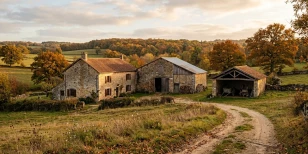

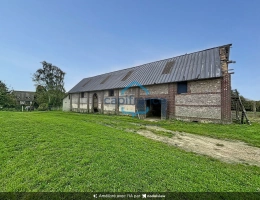
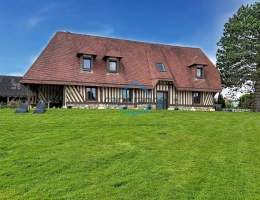
A mill for sale in Seine-Maritime (76) is typically tucked into one of the small valleys of the Pays de Caux or the Pays de Bray, where rivers such as the Béthune, the Austreberthe, the Varenne, the Yères and the Eaulne once powered watermills and flour mills for centuries. On this page, ma-propriete.fr brings together the mills for sale in Seine-Maritime: former watermills to renovate, flour mills converted into homes, and miller's houses with outbuildings. The department is among the richest in Normandy for small, still-recognisable valley mills.
You will also find price benchmarks based on actual sales, an overview of where these properties are concentrated, and the points to check before buying a mill, in particular how common flood zoning is along these narrow valleys and how variable the state of restoration can be from one property to the next. To prepare your project, read our white paper on creating a rural gîte, whose advice applies fully to a former Normandy mill, especially on surveying old stone and flint walls.
There are no official statistics dedicated to mills: sales are too rare and too varied (a ruin to restore, a habitable mill, a flour mill with a turbine). The most reliable market benchmark remains the price of country houses, which a habitable mill resembles, with a premium for the water, the character and the water rights, and a discount for the work required.
How much does a country house cost in Seine-Maritime (76)? According to DVF data (notarised sales) analysed by the ma-propriete.fr observatory, the median price of a country house in Seine-Maritime (76) stood at €201,000 in 2025, with an average price of €208,792 and a median price of €2,013/m² of living space (3,397 house sales in rural municipalities over the year). The price range is wide: 10% of houses sold for less than €123,740 (floor price, 1st decile) and 10% for more than €303,000 (ceiling price, 9th decile). The typical country house here offers 105 m² of living space on an average plot of 2,568 m², i.e. around 0.3 ha.
This market is above the regional median (Normandy: €189,000) and above the national median (€189,200). Since the second half of 2020, the median price has risen from €180,000 to €200,950, i.e. +11.6%; over one year (2024-2025) the change is +2.5%.
| 2025 indicator | Seine-Maritime | Normandy | France |
|---|---|---|---|
| Median price | €201,000 | €189,000 | €189,200 |
| Average price | €208,792 | €197,998 | €207,100 |
| Floor price (1st decile) | €123,740 | €100,000 | €90,000 |
| Ceiling price (9th decile) | €303,000 | €304,000 | €340,000 |
| Median price per m² of living space | €2,013/m² | €1,872/m² | €1,830/m² |
| Average living space | 105 m² | 106 m² | 108 m² |
| Average plot size | 2,568 m² | 3,500 m² | 3,181 m² |
| Number of sales in 2025 | 3,397 | 14,367 | 150,313 |
A departmental average hides large gaps. A smallholding to renovate, a restored longère with its outbuildings, a farmhouse on several hectares of land or a manor house with parkland do not sell at the same price, and the location matters as much as the building: coastline, tourist area, peri-urban countryside close to a job market or deep countryside. The table below shows the median price of country houses in Seine-Maritime (76) by type of municipality (cumulative sales from mid-2020 to 2025) and its change between 2021 and 2025.
| Type of municipality | Median price 2020-2025 | Median price per m² | Change 2021-2025 | Sales 2020-2025 |
|---|---|---|---|---|
| Tourist coastline | €209,500 | €2,246/m² | +10.1% | 608 |
| Residential coastline | €215,600 | €2,117/m² | +5.2% | 1,454 |
| Inland tourist areas (hinterland, mountains) | €183,300 | €1,970/m² | +17.9% | 155 |
| Peri-urban countryside (city catchment area) | €205,000 | €2,000/m² | +8.3% | 11,523 |
| Deep countryside (outside urban influence) | €175,000 | €1,784/m² | +4.5% | 6,475 |
These benchmarks help you assess a listing, estimate a property before putting it up for sale, or set your budget for a holiday home or a permanent move to the French countryside. To go further, see our observatory of country house prices in France (national, regional and departmental analysis, downloadable annual report) and work out the full cost of your purchase, including French notary fees, with our notary fees calculator.
The Pays de Caux, a fairly dry farming plateau, is cut through by narrow valleys carrying the Béthune near Envermeu and Arques-la-Bataille, the Varenne near Bellencombre, the Saâne near Longueville-sur-Scie, and the Austreberthe near Barentin and Duclair. These rivers carried a very large number of watermills and flour mills, many of which survive as houses with a millrace and part of a water wheel, some still keeping a former millstone room intact.
The Pays de Bray, in the east of the department around Neufchâtel-en-Bray, adds its own bocage rivers, in a landscape of wet meadows and orchards. On the exposed Caux plateau itself, windmills once existed but are now very rare and sought after; the Seine estuary itself keeps almost no genuine tide mill in working condition.
The Béthune and Eaulne valleys, around Arques-la-Bataille, Envermeu and Neufchâtel-en-Bray, hold a large number of former mills accessible from Dieppe, in villages that have kept much of their flint building stock intact. Near Rouen, the Austreberthe valley and the Barentin and Duclair area benefit from good access via Rouen railway station and the A150 motorway. The coastal Pays de Caux, between Fécamp and Yvetot, adds mills on shorter valleys running down to the Channel, often near a small port.
Areas close to Rouen and the Seine axis are noticeably more expensive than the rural valleys around Envermeu or Neufchâtel-en-Bray, where a mill to renovate remains more affordable, particularly in the Pays de Bray, further from the main employment centres.
Always check the water rights attached to the mill (fondé en titre or holding an authorisation), the condition of the millrace, the weir and sluice gates, and the ecological-continuity obligations on classified rivers of the Pays de Caux and Pays de Bray, closely monitored by the water authorities. A small hydroelectric turbine project remains possible on some sites but needs a serious prior study, as these are low-flow watercourses.
On the building, in flint and brick or timber framing depending on the area, check for damp at the bottom of the valley and flood zoning, common along these Normandy rivers, along with the state of the roof structure, often in slate or thatch on the oldest examples. The outbuildings (barn, former flour mill, miller's house) suit a gîte project well, in a department popular with visitors to the Alabaster Coast and the meanders of the Seine.
On ma-propriete.fr, mill listings in Seine-Maritime are published by private sellers, estate agents and notaries. Filter by budget, living space and land area, set up an email alert to be told of new listings, and browse all mills for sale in Normandy if your search extends beyond the department.