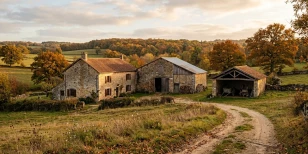

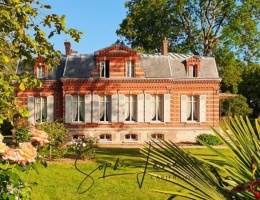
Looking for a mill for sale in Eure (27) means looking at a Normandy department crossed by many rivers with strong, steady flow: the Eure, Iton, Risle, Andelle and Charentonne rivers powered hundreds of watermills, as well as paper mills and fulling mills tied to the region's textile industry, which thrived from the Middle Ages through the 19th century. On this page, ma-propriete.fr brings together the mills for sale in Eure: watermills to renovate, former flour mills, converted industrial mills or millers' houses with water rights.
You will also find price benchmarks based on actual sales, an overview of the areas where these properties are concentrated, and the specific points to check before buying a mill, from water rights to the condition of old machinery. To prepare your project, read our white paper on setting up a rural gîte, whose advice on outbuildings and financing applies fully to a Normandy mill, whether it once ground grain, threw silk or made paper.
There are no official statistics dedicated to mills: sales are too rare and too varied (a ruin to restore, a habitable mill, a flour mill with a turbine). The most reliable market benchmark remains the price of country houses, which a habitable mill resembles, with a premium for the water, the character and the water rights, and a discount for the work required.
How much does a country house cost in Eure (27)? According to DVF data (notarised sales) analysed by the ma-propriete.fr observatory, the median price of a country house in Eure (27) stood at €185,000 in 2025, with an average price of €191,736 and a median price of €1,900/m² of living space (3,503 house sales in rural municipalities over the year). The price range is wide: 10% of houses sold for less than €110,272 (floor price, 1st decile) and 10% for more than €280,000 (ceiling price, 9th decile). The typical country house here offers 103 m² of living space on an average plot of 2,676 m², i.e. around 0.3 ha.
This market is close to the regional median (Normandy: €189,000) and close to the national median (€189,200). Since the second half of 2020, the median price has risen from €176,488 to €185,000, i.e. +4.8%; over one year (2024-2025) the change is +0.0%.
| 2025 indicator | Eure | Normandy | France |
|---|---|---|---|
| Median price | €185,000 | €189,000 | €189,200 |
| Average price | €191,736 | €197,998 | €207,100 |
| Floor price (1st decile) | €110,272 | €100,000 | €90,000 |
| Ceiling price (9th decile) | €280,000 | €304,000 | €340,000 |
| Median price per m² of living space | €1,900/m² | €1,872/m² | €1,830/m² |
| Average living space | 103 m² | 106 m² | 108 m² |
| Average plot size | 2,676 m² | 3,500 m² | 3,181 m² |
| Number of sales in 2025 | 3,503 | 14,367 | 150,313 |
A departmental average hides large gaps. A smallholding to renovate, a restored longère with its outbuildings, a farmhouse on several hectares of land or a manor house with parkland do not sell at the same price, and the location matters as much as the building: coastline, tourist area, peri-urban countryside close to a job market or deep countryside. The table below shows the median price of country houses in Eure (27) by type of municipality (cumulative sales from mid-2020 to 2025) and its change between 2021 and 2025.
| Type of municipality | Median price 2020-2025 | Median price per m² | Change 2021-2025 | Sales 2020-2025 |
|---|---|---|---|---|
| Residential coastline | €212,875 | €2,125/m² | +0.2% | 346 |
| Inland tourist areas (hinterland, mountains) | €185,000 | €1,847/m² | +3.1% | 560 |
| Peri-urban countryside (city catchment area) | €197,500 | €1,989/m² | -0.1% | 12,578 |
| Deep countryside (outside urban influence) | €170,400 | €1,785/m² | +0.0% | 7,930 |
Note: in Eure (27), the municipalities classified as "coastline" have no access to the sea. They are municipalities bordering lakes of more than 1,000 hectares (or, in Eure, the Seine estuary) covered by the 1986 Loi Littoral, which also applies to such inland lakes and estuaries.
These benchmarks help you assess a listing, estimate a property before putting it up for sale, or set your budget for a holiday home or a permanent move to the French countryside. To go further, see our observatory of country house prices in France (national, regional and departmental analysis, downloadable annual report) and work out the full cost of your purchase, including French notary fees, with our notary fees calculator.
Eure has one of the highest concentrations of watermills in the country, a legacy of a thriving 18th- and 19th-century textile and papermaking past. The Andelle valley, around Pont-Saint-Pierre and Fleury-sur-Andelle, was long home to well-known paper mills; the Iton valley, between Évreux and Conches-en-Ouche, and the Charentonne valley near Bernay saw a proliferation of fulling mills tied to woollen cloth and drapery production, an industry that shaped the region's economy for generations.
The Risle, from Rugles to Pont-Audemer, and the Eure itself, from Louviers to Pacy-sur-Eure, complete this dense network of millraces and sluices, with several successive mills sometimes standing within just a few kilometres of each other. Windmills are rare in the department, with the Neubourg plateau being one of the few areas where a small number could once be found, nearly all of which have since disappeared.
The Eure valley, between Louviers and Pacy-sur-Eure, and the Iton valley around Conches-en-Ouche, offer the best balance between rural heritage and proximity to Évreux, the department's capital. The Ouche area near Bernay, and the Lyons area around Lyons-la-Forêt and the Andelle valley, attract buyers looking for old brick and timber-framed buildings typical of inland Normandy. Near Pont-Audemer, known as 'little Venice of Normandy', mills built along the Risle in town are particularly sought after.
Properties near Vernon, under an hour from Paris via Vernon-Giverny station, and those in the Seine valley, sell clearly above the department average, driven by proximity to the Paris region and demand from second-home buyers. The south of Eure, around Verneuil-sur-Avre and Damville, remains more affordable for a mill to renovate, in a more rural and less pressured setting, with somewhat longer drives to the main stations.
The industrial history of Eure's mills means carefully checking the water rights (whether fondé en titre or authorised), the condition of the millrace and sluice gates, and the ecological-continuity obligations now imposed on the Andelle, Iton and Charentonne, classified as migratory-fish rivers for sea trout and eel. Former industrial use can also call for a check on residual soil pollution, particularly on former tannery, dye-works or bleaching sites.
The building, in brick, flint or timber frame depending on the area, is often at the bottom of a valley: check for damp and flood zoning, a real issue on the Iton and Andelle. Large industrial outbuildings (drying sheds, workshops, storerooms) lend themselves well to a gîte or artist's studio project, an activity already found along the Andelle and Risle, provided the old timber framing is checked for solidity before any conversion work begins, ideally with a specialist heritage surveyor familiar with old mill buildings.
On ma-propriete.fr, mill listings in Eure are published by private sellers, estate agents and notaries across the whole department. Filter by budget, living space and land area, set up an email alert to be told of new listings, and browse all mills for sale in Normandy if your search extends beyond the department, notably towards Calvados or Seine-Maritime, both with a similarly rich mill heritage shaped by centuries of local textile and paper-making industry.