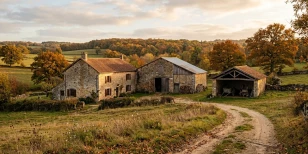

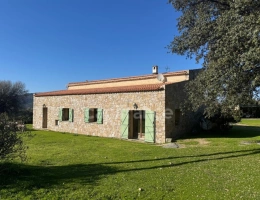
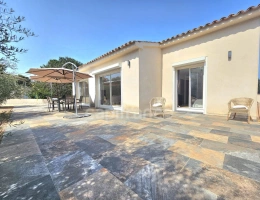
A mill for sale in Haute-Corse (2B) is more common than in Corse-du-Sud, thanks to the Castagniccia, the island's historic chestnut-growing region, where chestnut mills long set the rhythm of village life. On this page, ma-propriete.fr brings together the available mills for sale in Haute-Corse: chestnut mills, former watermills on the Golo or Tavignano rivers, and olive-oil mills in Cap Corse and Balagne, a much more varied stock than elsewhere on the island.
You will also find price benchmarks based on actual sales, an overview of the areas where these properties are concentrated, and the specific points to check before buying a Corsican mill, particularly the condition of the machinery and access to the site, often along narrow, unlit mountain roads. To prepare your project, read our white paper on setting up a rural gîte, whose advice applies fully to a mill in the Castagniccia or Balagne, from financial planning through to welcoming your first guests.
There are no official statistics dedicated to mills: sales are too rare and too varied (a ruin to restore, a habitable mill, a flour mill with a turbine). The most reliable market benchmark remains the price of country houses, which a habitable mill resembles, with a premium for the water, the character and the water rights, and a discount for the work required.
How much does a country house cost in Haute-Corse (2B)? According to DVF data (notarised sales) analysed by the ma-propriete.fr observatory, the median price of a country house in Haute-Corse (2B) stood at €341,000 in 2025, with an average price of €368,987 and a median price of €3,221/m² of living space (229 house sales in rural municipalities over the year). The price range is wide: 10% of houses sold for less than €164,436 (floor price, 1st decile) and 10% for more than €600,680 (ceiling price, 9th decile). The typical country house here offers 111 m² of living space on an average plot of 2,269 m², i.e. around 0.2 ha.
This market is below the regional median (Corsica: €398,800) and well above the national median (€189,200). Since the second half of 2020, the median price has risen from €270,108 to €341,000, i.e. +26.2%; over one year (2024-2025) the change is +0.9%.
| 2025 indicator | Haute-Corse | Corsica | France |
|---|---|---|---|
| Median price | €341,000 | €398,800 | €189,200 |
| Average price | €368,987 | €461,933 | €207,100 |
| Floor price (1st decile) | €164,436 | €200,000 | €90,000 |
| Ceiling price (9th decile) | €600,680 | €811,266 | €340,000 |
| Median price per m² of living space | €3,221/m² | €3,688/m² | €1,830/m² |
| Average living space | 111 m² | 116 m² | 108 m² |
| Average plot size | 2,269 m² | 2,413 m² | 3,181 m² |
| Number of sales in 2025 | 229 | 448 | 150,313 |
A departmental average hides large gaps. A smallholding to renovate, a restored longère with its outbuildings, a farmhouse on several hectares of land or a manor house with parkland do not sell at the same price, and the location matters as much as the building: coastline, tourist area, peri-urban countryside close to a job market or deep countryside. The table below shows the median price of country houses in Haute-Corse (2B) by type of municipality (cumulative sales from mid-2020 to 2025) and its change between 2021 and 2025.
| Type of municipality | Median price 2020-2025 | Median price per m² | Change 2021-2025 | Sales 2020-2025 |
|---|---|---|---|---|
| Tourist coastline | €357,130 | €3,296/m² | +8.1% | 834 |
| Residential coastline | €306,432 | €2,903/m² | +26.3% | 336 |
| Inland tourist areas (hinterland, mountains) | €272,960 | €2,648/m² | +18.3% | 344 |
These benchmarks help you assess a listing, estimate a property before putting it up for sale, or set your budget for a holiday home or a permanent move to the French countryside. To go further, see our observatory of country house prices in France (national, regional and departmental analysis, downloadable annual report) and work out the full cost of your purchase, including French notary fees, with our notary fees calculator.
Haute-Corse owes its distinctive character to the Castagniccia, a massif of centuries-old chestnut groves where almost every village had its own chestnut mill, powered by small streams flowing down from Monte San Petrone. These granite buildings, often single-storey and built into the hillside, produced chestnut flour, a traditional staple of the island still used today in several locally protected specialities carrying a designation of origin, including the well-known Castagniccia PDO chestnut flour, an ingredient in several traditional Corsican desserts still made at home today, from cakes to fritters.
Elsewhere in the department, classic watermills can be found on the Golo, Corsica's main river, and the Tavignano near Corte, alongside olive oil mills in Cap Corse and Balagne, two areas long known for the quality of their olive oil and their small family-run mills open to visitors. Windmills remain absent from the island, as relief and mountain torrents have always favoured local hydraulic power over wind power.
The Castagniccia, around Piedicroce and La Porta, holds the largest number of mills and stone buildings to restore, in wooded, steep-sided valleys that are hard to reach but rich in built heritage, waymarked hiking trails and small chestnut-processing hamlets tucked deep between the trees. Cap Corse, between Bastia and Rogliano, and Balagne, around Calvi and Île-Rousse, offer olive mills close to the coast and its beaches. The Golo valley, between Ponte-Leccia and Corte, and the more mountainous Niolo area round out the offer for a wilder, quieter setting away from the summer crowds.
Mills near Bastia, Calvi and the Balagne coast sell clearly above the island average, driven by both tourist and residential demand for coastal properties. The deep Castagniccia and the Niolo, more remote and quieter in season, remain the most affordable areas, despite limited supply and infrequent transactions, often agreed privately between longstanding neighbours in the same village.
Check for any existing water rights, the condition of the small channel or millrace feeding the wheel, often fragile after decades of neglect and little maintenance in remote hamlets far from any tradesman, and the ecological-continuity rules on the classified Golo and Tavignano rivers, protected for the endemic macrostigma trout. The millstone mechanisms of chestnut mills, in local granite, are a rare heritage feature that should be preserved rather than over-modernised.
The granite building requires checking access (mountain tracks sometimes impassable in winter, especially after heavy rain), flood zoning in case of flooding, and wildfire risk, significant in both the Castagniccia and Balagne in summer. Outbuildings lend themselves to a gîte project, a well-established format in Corsica's touristic interior, provided a secure water and electricity supply can be arranged, often limited in the most isolated mountain hamlets far away from the coast.
On ma-propriete.fr, mill listings in Haute-Corse are published by private sellers, estate agents and notaries across the whole department. Filter by budget, living space and land area, set up an email alert to be told of new listings, and browse all mills for sale in Corsica if your search extends beyond the department, notably towards Corse-du-Sud, where supply differs but is just as limited.