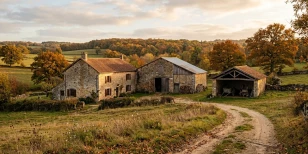

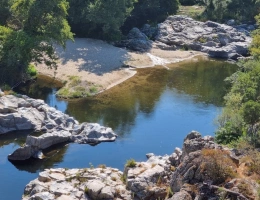
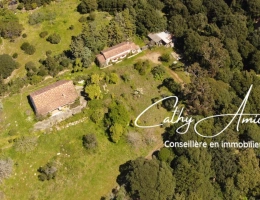
A mill for sale in Corse-du-Sud (2A) remains a rare find: the department's mountainous terrain, shaped by torrents rather than steady rivers, never allowed a large stock of watermills to develop as it did on mainland France, and windmills are practically unknown there. On this page, ma-propriete.fr nonetheless brings together the available mills for sale in Corse-du-Sud, along with related properties: former olive-oil or chestnut mills, which are in fact more common than grain mills on the island, usually set on a small plot planted with olive or chestnut trees, sometimes with an attached spring or wash-house.
You will also find price benchmarks based on actual sales, an overview of the areas where these rare properties are concentrated, and the specific points to check before buying a Corsican mill. To prepare your project, read our white paper on setting up a rural gîte, whose advice applies just as well to a mill as to a restored sheepfold or farmhouse in Corsica, from financing to choosing the right renovation team familiar with local stone construction and traditional Corsican materials.
There are no official statistics dedicated to mills: sales are too rare and too varied (a ruin to restore, a habitable mill, a flour mill with a turbine). The most reliable market benchmark remains the price of country houses, which a habitable mill resembles, with a premium for the water, the character and the water rights, and a discount for the work required.
How much does a country house cost in Corse-du-Sud (2A)? According to DVF data (notarised sales) analysed by the ma-propriete.fr observatory, the median price of a country house in Corse-du-Sud (2A) stood at €500,000 in 2025, with an average price of €559,123 and a median price of €4,444/m² of living space (219 house sales in rural municipalities over the year). The price range is wide: 10% of houses sold for less than €215,980 (floor price, 1st decile) and 10% for more than €1,052,448 (ceiling price, 9th decile). The typical country house here offers 121 m² of living space on an average plot of 2,563 m², i.e. around 0.3 ha.
This market is well above the regional median (Corsica: €398,800) and well above the national median (€189,200). Since the second half of 2020, the median price has risen from €389,250 to €500,000, i.e. +28.5%; over one year (2024-2025) the change is +7.2%.
| 2025 indicator | Corse-du-Sud | Corsica | France |
|---|---|---|---|
| Median price | €500,000 | €398,800 | €189,200 |
| Average price | €559,123 | €461,933 | €207,100 |
| Floor price (1st decile) | €215,980 | €200,000 | €90,000 |
| Ceiling price (9th decile) | €1,052,448 | €811,266 | €340,000 |
| Median price per m² of living space | €4,444/m² | €3,688/m² | €1,830/m² |
| Average living space | 121 m² | 116 m² | 108 m² |
| Average plot size | 2,563 m² | 2,413 m² | 3,181 m² |
| Number of sales in 2025 | 219 | 448 | 150,313 |
A departmental average hides large gaps. A smallholding to renovate, a restored longère with its outbuildings, a farmhouse on several hectares of land or a manor house with parkland do not sell at the same price, and the location matters as much as the building: coastline, tourist area, peri-urban countryside close to a job market or deep countryside. The table below shows the median price of country houses in Corse-du-Sud (2A) by type of municipality (cumulative sales from mid-2020 to 2025) and its change between 2021 and 2025.
| Type of municipality | Median price 2020-2025 | Median price per m² | Change 2021-2025 | Sales 2020-2025 |
|---|---|---|---|---|
| Tourist coastline | €550,000 | €5,030/m² | +6.0% | 715 |
| Residential coastline * | €420,000 | €3,660/m² | -16.5% | 47 |
| Inland tourist areas (hinterland, mountains) | €320,055 | €3,374/m² | +51.5% | 306 |
| Peri-urban countryside (city catchment area) | €430,000 | €3,920/m² | +7.0% | 201 |
* Between 30 and 99 sales: indicative value.
These benchmarks help you assess a listing, estimate a property before putting it up for sale, or set your budget for a holiday home or a permanent move to the French countryside. To go further, see our observatory of country house prices in France (national, regional and departmental analysis, downloadable annual report) and work out the full cost of your purchase, including French notary fees, with our notary fees calculator.
It has to be said plainly: Corse-du-Sud has very few watermills in the mainland sense of the word. The department's watercourses, such as the Taravo, the Gravona or the Prunelli, are irregular mountain torrents, better suited to a handful of small olive or chestnut mills than to large flour mills built on a permanent millrace, for lack of sufficient summer flow to justify a permanent installation. Windmills are completely absent from the island, for lack of any local wind-milling tradition.
What is actually available are mostly former oil mills (frantoi) tied to centuries of olive growing, notably in the Sartenais, and a few rare chestnut mills in the Alta Rocca valleys. These buildings, often modest in scale, are closer to a restored sheepfold or hamlet than to the monumental mills found on the mainland, with smaller interior volumes throughout, low ceilings and narrow doorways typical of rural Corsican building.
The Alta Rocca, around Levie and Zonza, and the Sartenais, near Sartène, keep the most traces of olive and chestnut mills, in a landscape of maquis scrubland and steep valleys well suited to small torrents. The Taravo valley, between Petreto-Bicchisano and Propriano, and the Gravona valley upstream of Ajaccio, offer occasional opportunities for old stone buildings near a small stream, often sold with a few hectares of maquis and occasionally an open view over the Gulf of Ajaccio.
The rare mills or related buildings close to Ajaccio and the coast sell clearly above the island average, in line with the whole Corsican coastal property market, in high demand year-round from both French and international buyers drawn by the island's coastline. The mountainous interior, around Zonza and the Coscione plateau, remains the most affordable area, though supply there is very limited and irregular, sometimes down to a single opportunity a year.
For an old watermill or oil mill, check for any existing water rights, the condition of the millrace or feeder channel, very exposed in Corsica to sudden flash floods, and the ecological-continuity rules applying to classified torrents. Original millstone or press mechanisms, where they survive, are of genuine heritage interest but rarely of immediate practical use without full, costly restoration.
The building, in granite or schist depending on the valley, should be checked for access (tracks are sometimes difficult in winter), flood zoning in case of flash floods, and the wildfire risk of the surrounding maquis, a real concern every summer that calls for regular scrub clearance around the buildings. Outbuildings lend themselves to a gîte project, an activity much sought after in Corsica's hinterland, provided a reliable year-round water source and stable electricity supply are available.
On ma-propriete.fr, listings for mills and related buildings in Corse-du-Sud are published by private sellers, estate agents and notaries across the whole department. Filter by budget, living space and land area, set up an email alert to be told of new listings, and browse all mills for sale in Corsica if your search extends beyond the department, for instance towards Haute-Corse.