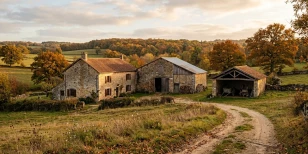

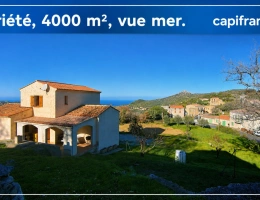
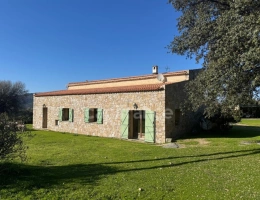
Buying a mill for sale in Corsica means taking an interest in a distinctive heritage: the island mainly developed the chestnut mill, a pillar of the subsistence economy of Castagniccia, and the olive mill in the terraced olive groves of Balagne, rather than the classic grain mill found on the mainland. On this page, ma-propriete.fr brings together mills for sale across the island's two departments.
You will also find price benchmarks based on actual sales, an overview of the areas where these properties are concentrated, and the specific points to check before buying a mill in Corsica. To prepare your project, our white paper on setting up a rural gîte covers the steps useful for restoring an old building.
There are no official statistics dedicated to mills: sales are too rare and too varied (a ruin to restore, a habitable mill, a flour mill with a turbine). The most reliable market benchmark remains the price of country houses, which a habitable mill resembles, with a premium for the water, the character and the water rights, and a discount for the work required.
How much does a country house cost in Corsica? According to DVF data (notarised sales) analysed by the ma-propriete.fr observatory, the median price of a country house in Corsica stood at €398,800 in 2025, with an average price of €461,933 and a median price of €3,688/m² of living space (448 house sales in rural municipalities over the year). 10% of houses sold for less than €200,000 (floor price, 1st decile) and 10% for more than €811,266 (ceiling price, 9th decile). The typical country house offers 116 m² of living space on an average plot of 2,413 m², i.e. around 0.2 ha.
The region is well above the national median (€189,200). Since the second half of 2020, the regional median price has risen from €328,600 to €398,800, i.e. +21.4%; over one year (2024-2025) the change is +3.2%.
| 2025 indicator | Corsica | France |
|---|---|---|
| Median price | €398,800 | €189,200 |
| Average price | €461,933 | €207,100 |
| Floor price (1st decile) | €200,000 | €90,000 |
| Ceiling price (9th decile) | €811,266 | €340,000 |
| Median price per m² of living space | €3,688/m² | €1,830/m² |
| Average living space | 116 m² | 108 m² |
| Average plot size | 2,413 m² | 3,181 m² |
| Number of sales in 2025 | 448 | 150,313 |
Differences between departments are significant: the median ranges from €341,000 in Haute-Corse (2B) to €500,000 in Corse-du-Sud (2A). The table below compares 2025 prices and their change since 2020.
| Department | Median price 2025 | Average price 2025 | Median price per m² | Change 2020-2025 | Sales 2025 |
|---|---|---|---|---|---|
| Corse-du-Sud (2A) | €500,000 | €559,123 | €4,444/m² | +28.5% | 219 |
| Haute-Corse (2B) | €341,000 | €368,987 | €3,221/m² | +26.2% | 229 |
A regional average also hides large gaps between municipalities. A smallholding to renovate, a restored longère with its outbuildings, a farmhouse on several hectares of land or a manor house with parkland do not sell at the same price, and the location matters as much as the building: coastline, tourist area, peri-urban countryside close to a job market or deep countryside. The table below shows the median price of country houses in Corsica by type of municipality (cumulative sales from mid-2020 to 2025) and its change between 2021 and 2025.
| Type of municipality | Median price 2020-2025 | Median price per m² | Change 2021-2025 | Sales 2020-2025 |
|---|---|---|---|---|
| Tourist coastline | €430,000 | €3,933/m² | +6.9% | 1,549 |
| Residential coastline | €320,000 | €2,950/m² | +19.8% | 383 |
| Inland tourist areas (hinterland, mountains) | €297,495 | €2,955/m² | +31.9% | 650 |
| Peri-urban countryside (city catchment area) | €415,000 | €3,851/m² | +6.2% | 215 |
These benchmarks help you assess a listing, estimate a property before putting it up for sale, or set your budget, whether you are looking for a holiday home, a permanent move to the French countryside or a property to turn into a rural gîte. To go further, see our observatory of country house prices in France (national, regional and departmental analysis, downloadable annual report) and work out the full cost of your purchase, including French notary fees, with our notary fees calculator.
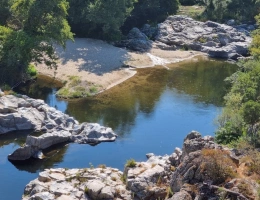
In Corsica, the torrents of the Golo, the Tavignano, the Fium'Orbo and the Rizzanese powered small rural watermills, often used to grind chestnuts rather than wheat: Castagniccia, the historic chestnut-growing area, holds the largest number, scattered among the granite hamlets of Bozio and Casinca. In Balagne, around Calvi and L'Île-Rousse, olive mills instead processed the fruit of the terraced groves.
Windmills are practically unknown on the island, for lack of a grain tradition comparable to the Beauce or the Antilles. Many of these rural mills, built in granite or schist, are limited to a small technical building attached to a miller's house, without a large residential wing. A few old grain mills also survive on the eastern plain, where wheat was grown before it gave way largely to market gardening and vines.
Corse-du-Sud (2A) holds the Balagne olive mills on the west side and Castagniccia remains on the east near Vico and Sartène, in very mountainous terrain. The Ajaccio area attracts the highest prices, while the interior, towards Zicavo or Petreto-Bicchisano, remains more affordable but sometimes harder to access. Haute-Corse (2B) holds the heart of Castagniccia (Piedicroce, Morosaglia, La Porta) and its chestnut mills, as well as Balagne around Calvi and L'Île-Rousse.
The touristic coastline, from Porto-Vecchio to Calvi, sells noticeably above average, while the mountainous interior, especially Castagniccia, remains the most affordable area for a mill to renovate, despite remarkable heritage. Around Corte, in the centre of the island, prices sit somewhere in between, reflecting proximity to the university town and the railway line.
In Corsica, water use often relies on shared « prises d'eau » or irrigation servitudes split between several properties, distinct from the classic mainland water rights regime: have this checked before any project, especially a hydroelectric one. Corsican torrents, which run dry for part of the summer, also require checking the actual available flow.
Buildings in granite or schist, often in maquis scrubland, are more exposed to wildfire risk than to classic flood zoning, except at the bottom of valleys. The remaining outbuildings lend themselves to a gîte project, a well-established activity on an island that is very popular in summer.
On ma-propriete.fr, mill listings in Corsica are published by private sellers, estate agents and notaries. Filter by budget, living space and land area, set up an email alert to be told of new listings, and browse all rural properties for sale if your search extends beyond this specific type of property, from Balagne stone houses to inland hamlets.