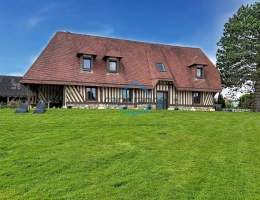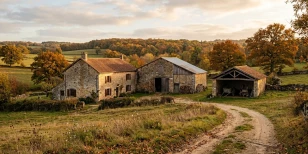
Looking for a country house for sale in Seine-Maritime (76)? Between the Pays de Caux, the Pays de Bray and the Seine valley, the department offers a distinctive Norman building style: half-timbered longères under thatch or tile, flint-and-brick manor houses, 19th-century manor-style houses on the edge of market towns. This page brings together the country houses for sale in Seine-Maritime published on ma-propriete.fr by private sellers, estate agents and notaries.
We present the actual prices of country houses in Seine-Maritime, the areas worth knowing between Rouen, Dieppe and the Alabaster Coast, and the criteria that determine the value of a property in the Pays de Caux or the Pays de Bray. Our complete guide to buying a country house in France completes these benchmarks, from surveying an old building to financing.
How much does a country house cost in Seine-Maritime (76)? According to DVF data (notarised sales) analysed by the ma-propriete.fr observatory, the median price of a country house in Seine-Maritime (76) stood at €201,000 in 2025, with an average price of €208,792 and a median price of €2,013/m² of living space (3,397 house sales in rural municipalities over the year). The price range is wide: 10% of houses sold for less than €123,740 (floor price, 1st decile) and 10% for more than €303,000 (ceiling price, 9th decile). The typical country house here offers 105 m² of living space on an average plot of 2,568 m², i.e. around 0.3 ha.
This market is above the regional median (Normandy: €189,000) and above the national median (€189,200). Since the second half of 2020, the median price has risen from €180,000 to €200,950, i.e. +11.6%; over one year (2024-2025) the change is +2.5%.
| 2025 indicator | Seine-Maritime | Normandy | France |
|---|---|---|---|
| Median price | €201,000 | €189,000 | €189,200 |
| Average price | €208,792 | €197,998 | €207,100 |
| Floor price (1st decile) | €123,740 | €100,000 | €90,000 |
| Ceiling price (9th decile) | €303,000 | €304,000 | €340,000 |
| Median price per m² of living space | €2,013/m² | €1,872/m² | €1,830/m² |
| Average living space | 105 m² | 106 m² | 108 m² |
| Average plot size | 2,568 m² | 3,500 m² | 3,181 m² |
| Number of sales in 2025 | 3,397 | 14,367 | 150,313 |
A departmental average hides large gaps. A smallholding to renovate, a restored longère with its outbuildings, a farmhouse on several hectares of land or a manor house with parkland do not sell at the same price, and the location matters as much as the building: coastline, tourist area, peri-urban countryside close to a job market or deep countryside. The table below shows the median price of country houses in Seine-Maritime (76) by type of municipality (cumulative sales from mid-2020 to 2025) and its change between 2021 and 2025.
| Type of municipality | Median price 2020-2025 | Median price per m² | Change 2021-2025 | Sales 2020-2025 |
|---|---|---|---|---|
| Tourist coastline | €209,500 | €2,246/m² | +10.1% | 608 |
| Residential coastline | €215,600 | €2,117/m² | +5.2% | 1,454 |
| Inland tourist areas (hinterland, mountains) | €183,300 | €1,970/m² | +17.9% | 155 |
| Peri-urban countryside (city catchment area) | €205,000 | €2,000/m² | +8.3% | 11,523 |
| Deep countryside (outside urban influence) | €175,000 | €1,784/m² | +4.5% | 6,475 |
These benchmarks help you assess a listing, estimate a property before putting it up for sale, or set your budget for a holiday home or a permanent move to the French countryside. To go further, see our observatory of country house prices in France (national, regional and departmental analysis, downloadable annual report) and work out the full cost of your purchase, including French notary fees, with our notary fees calculator.
The Caux longère, with timber-framed walls (colombage) filled with cob or brick and a thatched or tiled roof, remains the most characteristic image of the country house in Seine-Maritime, particularly around Yvetot or Cany-Barville. It is often found within a clos-masure, the beech-planted enclosure that shelters the farm from plateau winds. Towards the Pays de Bray, around Neufchâtel-en-Bray, brick and flint form chequered patterns on the façades; in the Seine valley and near the coast, manor houses and manor-style houses in limestone or brick recall the commercial and industrial growth of the 19th century. Half-timbering, often restored to its original appearance, remains a charm factor but requires regular upkeep of the timber and render.
Land remains a central asset: a garden, a cider-apple orchard, sometimes a small woodland or a willow-lined pond. Outbuildings (barn, cider press, cowshed) are common within the clos-masures and lend themselves to conversion into a gîte or workshop, a common use for Norman second homes. Use as a second home or a rural gîte remains very common for these longères, particularly near the coast.
The Pays de Caux, the farming plateau between Le Havre, Fécamp and Dieppe, holds most of the traditional longères and farmhouses; its coastal fringe, the Alabaster Coast, around Étretat and Veules-les-Roses, is noticeably more expensive because of holiday homes. The Seine valley, around Rouen and Caudebec-en-Caux, combines metropolitan jobs with a rural setting, with direct rail links to Paris from Rouen station. The Pays de Bray, to the east around Neufchâtel-en-Bray and Forges-les-Eaux, offers hillier, less built-up bocage countryside with dairy pastures. Market towns halfway between Rouen and the coast, such as Yvetot or Bolbec, offer a compromise between accessibility and rural calm.
Areas near the coast (Étretat, Fécamp, Veules-les-Roses) and the Rouen–Paris corridor show prices well above the departmental average, while the Pays de Bray and the interior of the Pays de Caux, away from the main routes, remain more affordable for a stone house with a large plot, well suited to a second home or a remote-working base. These more affordable areas suit a main home as well as a gîte or bed-and-breakfast project.
Proximity to the coast, to Rouen or to routes towards Paris, together with the condition of the roof frame and covering (thatch is costly to maintain, timber framing is sensitive to damp), are decisive. Many old longères carry a poor energy rating and require significant energy-efficiency work before serving as a year-round main home. The risk of flooding from a rising water table, not uncommon in low-lying valleys, is worth checking through the official risk disclosure. Treating the timber frame against damp and wood-boring insects is often an item of work to budget for.
Also check the private drainage system, common in scattered rural housing, the condition of the clos-masure's planted banks, fibre-optic coverage for remote working and the planning rules (local plan, agricultural zoning) before any extension project. Have the foundations checked, sometimes affected by damp on the Caux plateau, before signing anything.
On ma-propriete.fr, filter Seine-Maritime country houses by budget, living space and land area, set up an email alert so you never miss a new listing, and if needed widen your search to all country houses for sale in Normandy.