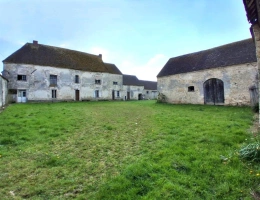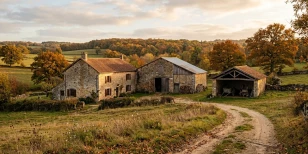
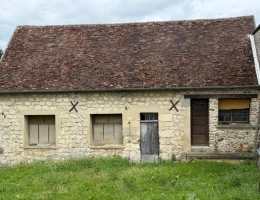
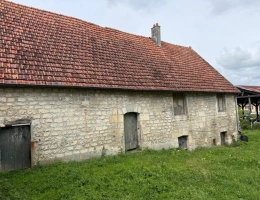
A farmhouse for sale in Île-de-France, a Brie farm building complex in millstone grit or a barn from the Île-de-France Beauce plain waiting to be restored: although largely urbanised, the region still holds a meaningful rural stock, mostly in its outer rural belt. This page brings together the farmhouses, barns and mas for sale in Île-de-France listed on ma-propriete.fr: Brie farm buildings arranged in a square, millstone-grit or dressed-stone barns, outbuildings with a few hectares of land, and former coaching inns in rural areas.
Below you will find the actual prices of the rural market across the region's seven departments, an honest overview of where such buildings genuinely exist, and the points to watch given their proximity to built-up areas. For a gîte project, our white paper on setting up a rural gîte will help you assess whether it stacks up.
There are no statistics dedicated to farmhouses and barns: a renovated farmhouse sells like a country house with outbuildings and land, whereas a bare barn or a farm to renovate often sells well below. The most useful benchmark therefore remains the price of country houses.
How much does a country house cost in Île-de-France? According to DVF data (notarised sales) analysed by the ma-propriete.fr observatory, the median price of a country house in Île-de-France stood at €280,000 in 2025, with an average price of €295,207 and a median price of €2,603/m² of living space (3,611 house sales in rural municipalities over the year). 10% of houses sold for less than €171,000 (floor price, 1st decile) and 10% for more than €435,000 (ceiling price, 9th decile). The typical country house offers 116 m² of living space on an average plot of 1,590 m², i.e. around 0.2 ha.
The region is well above the national median (€189,200). Since the second half of 2020, the regional median price has risen from €274,325 to €280,000, i.e. +2.1%; over one year (2024-2025) the change is +3.6%.
| 2025 indicator | Île-de-France | France |
|---|---|---|
| Median price | €280,000 | €189,200 |
| Average price | €295,207 | €207,100 |
| Floor price (1st decile) | €171,000 | €90,000 |
| Ceiling price (9th decile) | €435,000 | €340,000 |
| Median price per m² of living space | €2,603/m² | €1,830/m² |
| Average living space | 116 m² | 108 m² |
| Average plot size | 1,590 m² | 3,181 m² |
| Number of sales in 2025 | 3,611 | 150,313 |
Differences between departments are significant: the median ranges from €250,600 in Seine-et-Marne (77) to €346,650 in Yvelines (78). The table below compares 2025 prices and their change since 2020.
| Department | Median price 2025 | Average price 2025 | Median price per m² | Change 2020-2025 | Sales 2025 |
|---|---|---|---|---|---|
| Seine-et-Marne (77) | €250,600 | €259,889 | €2,368/m² | +2.3% | 2,149 |
| Yvelines (78) | €346,650 | €378,718 | €2,966/m² | -1.0% | 763 |
| Essonne (91) | €284,600 | €297,767 | €2,741/m² | +3.5% | 433 |
| Val-d'Oise (95) | €333,000 | €336,830 | €2,993/m² | +0.5% | 266 |
A regional average also hides large gaps between municipalities. A smallholding to renovate, a restored longère with its outbuildings, a farmhouse on several hectares of land or a manor house with parkland do not sell at the same price, and the location matters as much as the building: coastline, tourist area, peri-urban countryside close to a job market or deep countryside. The table below shows the median price of country houses in Île-de-France by type of municipality (cumulative sales from mid-2020 to 2025) and its change between 2021 and 2025.
| Type of municipality | Median price 2020-2025 | Median price per m² | Change 2021-2025 | Sales 2020-2025 |
|---|---|---|---|---|
| Inland tourist areas (hinterland, mountains) | €250,000 | €2,369/m² | -1.3% | 135 |
| Peri-urban countryside (city catchment area) | €289,000 | €2,645/m² | -5.6% | 22,270 |
These benchmarks help you assess a listing, estimate a property before putting it up for sale, or set your budget, whether you are looking for a holiday home, a permanent move to the French countryside or a property to turn into a rural gîte. To go further, see our observatory of country house prices in France (national, regional and departmental analysis, downloadable annual report) and work out the full cost of your purchase, including French notary fees, with our notary fees calculator.
The Brie farmhouse, typical of the Seine-et-Marne, is arranged in a closed square around a large courtyard, with the dwelling, cowshed, stables and threshing barn built in millstone grit or dressed stone under flat tile. In the Vexin français, straddling the Yvelines and Val-d'Oise, Beauce-style buildings suited to large-scale cereal farming can also be found. There is no mas in Île-de-France; the word has no local meaning here. In the Hauts-de-Seine, Seine-Saint-Denis and Val-de-Marne, densely urbanised departments, this type of property has practically disappeared and now surfaces only very rarely on the remaining rural fringe.
These often sizeable farm buildings convert into a home, several dwellings or gîtes, subject to local planning zoning and a change of use. Where adjoining hectares of farmland remain, they suit keeping horses, a well-established activity in the Seine-et-Marne and Yvelines, or a smaller-scale permaculture project.
In the Seine-et-Marne, the Brie region around Provins, Coulommiers and Rozay-en-Brie holds most of the region's farm-building stock. In the Yvelines, the Vexin français near Magny-en-Vexin and the Versailles plain keep a few Brie-style farms. In the Val-d'Oise, the Vexin around Marines adds to this limited supply. The Essonne, in the Hurepoix and the French Gâtinais near Milly-la-Forêt, also offers isolated farm buildings. In the Hauts-de-Seine, Seine-Saint-Denis and Val-de-Marne, supply is virtually non-existent, as these departments are entirely urbanised.
Areas close to Paris, Versailles and the Chevreuse valley remain well above the regional average, despite the scarcity of farm buildings. By contrast, the deep Brie and the Île-de-France Gâtinais, further from the capital, offer relatively more affordable farm buildings, though the market stays tight across Île-de-France as a whole.
Check the permitted use of the buildings against the local plan: in an agricultural zone A, a farm barn can only become housing if it is expressly identified as eligible for a change of use, a frequent constraint in the Seine-et-Marne where the surrounding land is often still farmed. Examine the roof (flat tile, slate, or asbestos-cement sheets on sheds), the timber frame and the drainage, which needs upgrading on most isolated farm buildings.
If farmland is included, ask about any current farm lease, very common in this large-scale farming region, and about the pre-emption right of the Safer. Finally, cost the renovation precisely: on these large buildings, renovation often represents a budget comparable to the purchase itself.
On ma-propriete.fr, filter Île-de-France farms and farm buildings by budget, built area and land area, set up an email alert to follow new listings, and widen your search to all rural properties for sale in neighbouring regions.