

Talking about a manor house for sale in Martinique means describing a local reality quite different from the noble residences of Brittany or Touraine: the island built its character heritage around Creole estate houses and former sugar works from the colonial period, across the Nord Atlantique, Nord Caraïbe and Sud districts. These residences, often set on high ground on a former cane or coffee estate, keep their working outbuildings and, occasionally, a rum distillery still in operation. Browse the manor houses for sale listed here by the island's private owners, agencies and notaries.
This page sets out the property types found on the island, the areas where estate homes and master houses still stand, from the Nord Caraïbe to the Sud by way of the centre and the Nord Atlantique, and the checks specific to old buildings in a volcanic and cyclone-prone zone. To approach the purchase of a character property as a whole and plan the steps involved, read our guide to buying prestige property in France.
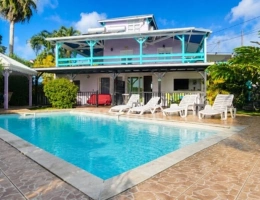
The Martinique master house is recognisable by its front-facing gallery, its rendered rubble-stone walls or timber frame on a masonry plinth, its steeply pitched corrugated roofs and its turned-wood or wrought-iron balustrades. The oldest residences, tied to a former sugar estate, often retain a stone sugar-works chimney, a mill, a basin or an old bagasse store, set around a shaded working courtyard planted with fruit trees.
Several of these ensembles, such as estates in the Nord Caraïbe and Nord Atlantique districts, are registered as historic monuments for their working buildings, gardens or avenues of royal palms. Condition varies widely from one property to another: some have been restored with real care for the original materials, lime-rendered walls and local timber included, while others, left empty since the eruption of Mount Pelée or after long years without an occupant, need a complete overhaul of the roof, the frame and the floors.
The Nord Caraïbe, around Saint-Pierre, Le Carbet and Le Prêcheur, holds the island's oldest surviving estate remains, at the foot of Mount Pelée. The Nord Atlantique, from Sainte-Marie to La Trinité and Le Robert, keeps large agricultural properties turned over to banana and sugar cane. In the centre, Fort-de-France, Schoelcher and Le Lamentin hold most of the island's economic activity, while in the south, Sainte-Anne, Le Marin, Rivière-Pilote and Sainte-Luce draw buyers seeking properties close to the coast and the marinas.
Martinique Aimé Césaire airport, near Fort-de-France, provides links to mainland France and the neighbouring islands; the island has no rail service, and travel runs mainly along the coastal road network. The most sought-after areas lie in the south, between Sainte-Anne and Le Marin, and on the residential high ground near Fort-de-France, while the north, more agricultural, more rugged and more shaped by the volcanic relief, stays markedly more affordable for a property of comparable size.
As elsewhere in the French Antilles, many family estates remain in joint co-ownership, which makes it essential to check titles and each heir's share carefully before any offer is made. Near the shore, the fifty geometric paces zone strictly restricts building rights and land use, and must be checked with the town hall before any extension or subdivision project.
Seismic and volcanic risk, real across the whole territory given the proximity of Mount Pelée, warrants a thorough survey of the foundations and load-bearing structure, while cyclonic risk means checking how the roof and the outbuildings are fixed and braced. Also have the property surveyed for termites, common in timber exposed to this humid climate, with a specific report before signing, along with any trace of rising damp in the plinth.
Listings for master houses, Creole estate homes and agricultural domains in Martinique are placed by private owners, specialist local agencies and notaries; filter them by price, living space, land and outbuildings, and set an e-mail alert to follow new listings across the island, from north to south. To explore the island's fine residences and agricultural domains more broadly, browse the prestige property for sale in Martinique.


