
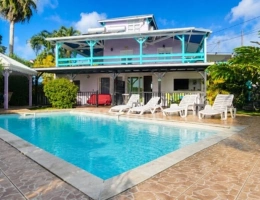
A luxury property for sale in Martinique sits within a contrasting landscape, between the volcanic north dominated by Mount Pelée and the drier south facing the island's resort towns. Buyers find creole houses inherited from the great plantations, former rum distilleries converted into character residences, contemporary villas overlooking the Bay of Fort-de-France, and master houses tucked into the hills of Le Robert or Le François. This varied heritage reflects the island's agricultural and colonial past. Discover every luxury property for sale listed by private owners, agencies and notaries in Martinique.
This page sets out the types of residence found across Martinique, the areas where they are concentrated, the materials and condition of local buildings, and the land and climate checks essential before buying on the island. To plan your project as a whole, read our guide to buying luxury property in France.
Martinique's character buildings bear the mark of the island's former agricultural estates. Colonial plantation houses, often built of prized timber on a volcanic-stone base, combine deep verandas, steep roofs and gardens planted with coconut palms and flamboyant trees. Former distilleries and sugar mills, with their stone buildings and chimneys, are regularly turned into residences surrounded by converted farm outbuildings. On the Caribbean coast, newer villas in concrete and exotic wood open wide onto the sea, while in the hills of Le Robert and Le François, more discreet houses benefit from a climate cooled by altitude and surrounding greenery.
Traditional outbuildings often include a water house, a drying shed, a farm store and a creole garden planted with fruit trees. Older buildings need careful assessment: roof timbers exposed to termites and damp, roofing to check after the cyclone season, lime renders requiring regular care. More recent construction increasingly meets reinforced earthquake standards, Martinique lying in a zone of significant seismic activity, and some properties now add solar equipment suited to steady tropical sunshine. A full survey by a local tropical-building specialist remains essential before making an offer.
The island offers very different settings from one area to the next. The Caribbean north, around Le Prêcheur, Le Carbet and Fond-Saint-Denis, has a wooded relief dominated by Mount Pelée, suited to secluded estates. Le Robert and Le François, to the east, concentrate creole residences among green hillsides facing the Atlantic. In the south, Les Trois-Îlets and Le Diamant draw buyers seeking villas and residences close to the beaches and the Bay of Fort-de-France, while Sainte-Anne and Le Marin remain popular for their proximity to sailing and watersports. Fort-de-France and its surrounding area hold most of the island's older urban character buildings. Le Lamentin, by contrast, plays mainly an economic and logistics role and is not a sought-after area for large residences.
Martinique Aimé-Césaire airport handles connections to mainland France and neighbouring islands; the island has no railway service, and travel relies mainly on the road network. The most sought-after areas lie around Les Trois-Îlets, Le Diamant and Fort-de-France; the Caribbean north and the Atlantic communes offer comparable properties at more accessible levels.
As elsewhere in the French West Indies, the fifty geometric paces zone strictly governs building rights on plots close to the shore and historically forms part of the public domain; its status should always be verified before any purchase or extension project. Older family properties are often held in undivided ownership, which complicates a sale and calls for thorough notarial work on the title. The Loi Littoral coastal law also limits new construction near the sea, a point to check with the local planning authority.
Martinique lies in a zone of strong seismic activity and faces a real cyclone risk, making it essential to check that structures meet current earthquake and cyclone standards. Tropical humidity also encourages termite infestation in older roof timbers, while the proximity of Mount Pelée calls for particular awareness of volcanic risk across the island's north. Working with a local notary and a West Indies building specialist helps secure the purchase of a historic residence or a converted agricultural estate.
Luxury property listings in Martinique, placed by private owners, specialist agencies and notaries, cover a narrow market where each residence has its own particular features, from the coast to the volcanic heights. In the absence of reliable statistics for this territory, we recommend a contact request to our local correspondents, who know the island's areas and buildings and can guide your search.



