
A chateau for sale in Hauts-de-France often stands at the edge of a forest, at the centre of a large farming estate, or near the historic towns of the Nord, in a region shaped by brick building and a long industrial and military history. Five departments make up Hauts-de-France, from the Opal Coast to the Thiérache district, with Picardy residences, Flemish-style manor houses and nineteenth-century chateaux linked to industrial growth. Browse every chateau for sale listed here by private owners, agencies and notaries across Hauts-de-France.
This page gathers what is useful before visiting: the areas where large residences are found, the materials that set the Nord, Picardy and the Aisne apart, and the checks specific to a territory that is rural, industrial and shaped by border history all at once. To plan a complete heritage purchase, read our guide to buying prestige property in France.
DVF land registry data does not identify chateaux as such: the benchmarks below cover sales of houses over 300 m² of living space on 0.05 to 10 ha, above €1,000/m², tracked by our observatory. They frame the market for large residences without describing it entirely: an estate with 30 ha of parkland or a listed monument sold with its farmland falls outside this scope.
In Hauts-de-France, 79 sales were recorded in 2025, with a median price of €756,800*, a floor/ceiling range (P10–P90) of €399,800 to €1,602,000 and a median of €2,131/m² of living space (average 363 m² of living space on 7,624 m² of land). Over five years (2021-2025), the regional median comes to €644,600 across 477 sales. Nationally, the 2025 median stands at €822,000 across 981 sales, with a ceiling (P90) of €3,100,000.
| Scope | Sales | Median price | Floor – ceiling (P10–P90) | €/m² living space (median) |
|---|---|---|---|---|
| Hauts-de-France (2025) | 79 | €756,800* | €399,800 – €1,602,000 | 2,131 |
| Hauts-de-France (2021-2025) | 477 | €644,600 | €393,600 – €1,292,800 | 1,797 |
| France (2025) | 981 | €822,000 | €428,000 – €3,100,000 | 2,308 |
The breakdown by stratum (coastal, rural tourist, ordinary rural) and the five-year trend are in our observatory of prestige property prices in France (in French). Before making an offer, work out purchase costs and borrowing capacity with our financial tools and calculators.
Source: DVF (DGFiP), transactions from 1 January 2021 to 31 December 2025, processed by ma-propriete.fr; prices rounded to the nearest €100. * Fewer than 100 sales: read as an indication only.
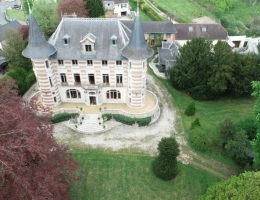
In the Nord and Pas-de-Calais, buildings favour red or orange brick, with slate roofs and sometimes white stone surrounds to window and door openings, inherited from Flemish and Artois architecture. In Picardy, in the Somme, Oise and Aisne, limestone and chalk dominate, with eighteenth and nineteenth-century chateaux built around a central block and pavilions, sometimes rebuilt after the destruction of the two world wars. Several residences keep neo-Gothic or neo-Renaissance façades, a mark left by the great industrial families of the Nord in the nineteenth century. Reconstruction-era buildings, dating mainly from the 1920s, form a distinctive layer of heritage found across much of the Somme and the Aisne.
Outbuildings frequently include brick service wings, stables and an attached farm on properties geared toward agriculture, along with landscaped parkland laid out in the English style on the most important residences. Some estates keep a pond or a stretch of water linked to hunting, a traditional activity across the large forest tracts of the Somme and the Aisne. The condition of roofing and joinery, exposed to a damp and windy climate, weighs heavily on upkeep budgets.
The Nord, around Lille, Cambrai and Douai, concentrates a dense heritage, including the occasional chateau to renovate, inherited from industrial growth, with direct access via the Lille-Europe TGV station. Pas-de-Calais, between the Opal Coast and the Artois district, offers properties around Arras, Boulogne-sur-Mer and Calais, also well served by TGV. The Somme, around Amiens and in the Baie de Somme, keeps a Picardy heritage close to the Haute-Picardie TGV station. The Oise, between Compiègne, Senlis and Beauvais, has no TGV station of its own but sits close to Paris-region rail links. Its proximity to the capital has long attracted Parisian buyers looking for a large weekend or family property within easy reach.
The Aisne, around Laon, Soissons and Saint-Quentin, rounds out the region with more rural properties, also with no direct TGV service. The most sought-after areas lie near the Opal Coast shoreline and around the large towns of the Nord; the Thiérache district, in the north of the Aisne, and the southern Somme remain more affordable and more discreet, with properties leaning toward farming and hunting.
Many Hauts-de-France properties sit on former battlefields of the two world wars: check the risk of unexploded ordnance, particularly well documented in the Somme, Pas-de-Calais and Aisne, before any earthworks or planting project. The Nord and Pas-de-Calais coastline is subject to zoning tied to coastline retreat and marine submersion. Residences that are listed or registered historic monuments, found in both Picardy and the Nord, require the opinion of the Architecte des Bâtiments de France for exterior works.
On the technical side, have the roofing and façades inspected, since they are exposed to a damp climate and strong coastal winds, and check the drainage system, often non-collective on large rural properties. Flood zoning along the Somme and Oise rivers, along with farming easements attached to adjoining farms, deserve checking before any offer.
Chateau listings in Hauts-de-France are published by private owners, specialist agencies and notaries across the five departments; filter listings by price, living space and outbuildings, then set up an e-mail alert to track new properties. Also explore the prestige property for sale in Hauts-de-France.