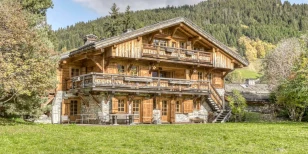

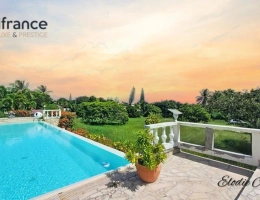
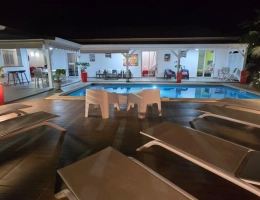
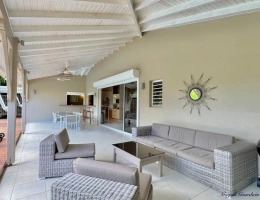
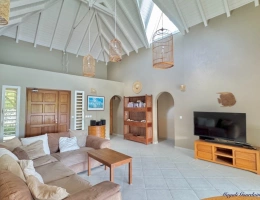
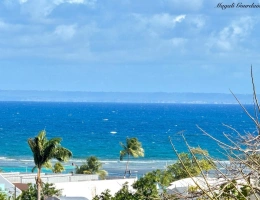
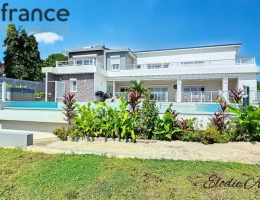

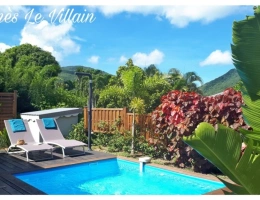
A chateau for sale in Guadeloupe is a rarity: the archipelago never developed the castle-building tradition found in mainland France, and here the term instead points to a different built heritage — grand colonial estate houses, Creole maison de maître residences and former sugar estates scattered across the volcanic hills of Basse-Terre and the limestone plains of Grande-Terre. Some of these homes, built in timber and rubble masonry, still keep their original galleries, verandas and farm outbuildings, while others have been reworked over successive generations. The brightly coloured façades and the tropical gardens surrounding them add to the character of these houses, now sought after by buyers looking for authenticity. Browse every chateau for sale listed here by private owners, agencies and notaries active across the archipelago.
This page sets out the types of residence the term covers locally, the areas of Basse-Terre, Grande-Terre and the outlying islands where they stand, and the land-title and climate checks worth making before a viewing. It suits buyers ready to take on a heritage restoration rather than a move-in-ready home. To plan a heritage purchase from start to finish, read our guide to buying prestige property in France.
Guadeloupe's older buildings are mostly colonial estate houses: a raised maison de maître set on masonry piers for ventilation, with a front gallery, a steeply pitched roof and timber framing cut from local wood. Around them, remnants of a sugar estate or distillery sometimes survive — chimneys, mill stones, settling basins — where the property has kept its original agricultural plot. Corrugated metal roofing has largely replaced older plant-fibre coverings, and the tropical hardwoods used throughout are highly sensitive to humidity, needing constant upkeep to avoid structural decay. Some houses have been reclad in imported exotic hardwood, while others keep their original materials, which weighs directly on the restoration budget to plan for.
Outbuildings tied to these houses include former staff quarters, drying sheds, cisterns and, on the oldest estates, sometimes a private chapel. Only a limited number of estate houses carry historic-monument protection, mainly in Basse-Terre and on the island of Marie-Galante, where several sugar works are registered; elsewhere protection is applied case by case and should be checked rather than assumed. A careful survey of the outbuildings still standing, sometimes altered over the years, helps gauge the scale of a restoration project before buying.
On Basse-Terre, older houses cluster around Capesterre-Belle-Eau, Trois-Rivières and Vieux-Habitants, on sloping ground overlooking the Caribbean Sea, and along the Route de la Traversée that crosses the volcanic massif. On Grande-Terre, the larger farming estates lie more towards Le Moule, Petit-Canal and Sainte-Anne, across plains once given over to sugar cane. Marie-Galante, which has stayed more rural, still holds a notable group of sugar works and estate houses, as do parts of Saint-François. Southern Basse-Terre, around Trois-Rivières and Gourbeyre, rounds out this picture with properties given over to subsistence farming and Creole gardens.
Access to the archipelago runs through Pointe-à-Pitre airport, linked to towns on both Basse-Terre and Grande-Terre by a structured road network, though crossing between the two main islands still takes longer than an equivalent trip in mainland France. Coastal areas near Sainte-Anne and Le Gosier see steadier demand than the interior and the Basse-Terre highlands, which are more remote but valued for their quiet. Ferry links to Marie-Galante and Les Saintes run from Pointe-à-Pitre, a detail worth planning for when a property sits on one of these outlying islands.
Land in the French Antilles is often held in co-ownership inherited across generations, which can slow a sale until title is clarified with the notary. Properties close to the shoreline may fall, wholly or partly, within the zone des cinquante pas géométriques, a distinct coastal public-land regime that should be checked at the preliminary-contract stage. Guadeloupe lies in a recognised seismic and cyclone zone, so older masonry buildings deserve a structural survey before any commitment. Planning and zoning rules should be checked town by town, since they differ noticeably between Basse-Terre and Grande-Terre.
On the technical side, tropical humidity and frequent termite activity call for a careful inspection of timber framing and joinery, along with a check on roof condition after the cyclone season. Individual drainage, water availability during the dry season, and year-round access by a properly maintained road are further points worth examining before committing to a remote property. It is also worth reviewing the claims history recorded on a property, especially after a notable cyclone season.
Listings for older estate houses and large properties in Guadeloupe are published by private owners, local agencies and notaries; you can filter them by area, living space and outbuildings, then set up an e-mail alert to follow new listings as they appear. Farming properties paired with an older building are drawing growing interest, notably from buyers pursuing a career change. You can also browse the full range of prestige property for sale in Guadeloupe.