
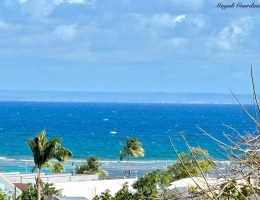
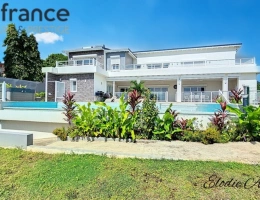
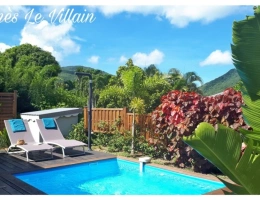

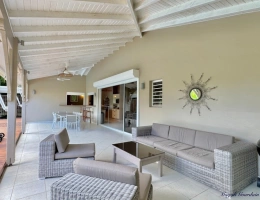
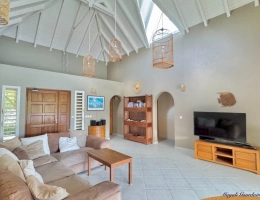
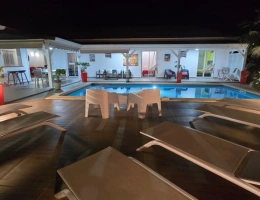
A luxury property for sale in Guadeloupe is best understood through the archipelago's varied relief: a villa overlooking the Caribbean Sea in the hills of Basse-Terre, a restored creole house set among the cane fields of Grande-Terre, a former plantation residence once tied to a sugar mill or a rum distillery, or an extended fisherman's house facing the lagoon at Saint-François. Guadeloupe's character buildings thus blend colonial heritage, tropical architecture and contemporary construction facing the open sea. Browse every luxury property for sale listed by private owners, agencies and notaries across the archipelago.
This page sets out the types of residence found across the archipelago, the areas where they cluster, the building traditions specific to Guadeloupe, and the land and climate checks worth making before buying in a Caribbean setting, from volcanic slopes to lagoon-facing plots. To plan your project as a whole, read our guide to buying luxury property in France.
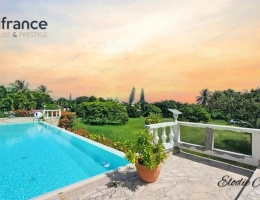
Guadeloupe's character buildings draw on several layered traditions. Creole houses, raised on stilts or a volcanic stone base, combine open verandas, four-sided roofs in sheet metal or shingle, and prized local timbers such as gaiac and mahogany. Former sugar mills and rum distilleries, with their stone industrial buildings and chimneys, are sometimes converted into character residences set among tropical gardens. Along the coast, contemporary villas with wide terraces and infinity pools look out over the sea, while higher up the slopes of La Soufrière, more discreet residences benefit from a climate cooled by altitude.
Traditional outbuildings often include a water house, a storeroom, an outdoor kitchen and a garden planted with mango, coconut and hardwood trees. Older buildings vary widely in condition: roof timbers exposed to damp and termites, roofing needing repair after the cyclone season, and lime renders requiring regular upkeep. More recent construction increasingly meets earthquake and cyclone standards, a feature buyers look for closely, and some estates also add solar installations suited to the archipelago's steady sunshine. A guided visit with a tropical-building specialist helps gauge the scope of any repairs needed before an offer is made.
The archipelago splits into areas with contrasting characters. Basse-Terre, dominated by the volcanic La Soufrière massif and its national park, has a wooded relief suited to secluded estates surrounded by rainforest, around towns such as Vieux-Habitants, Bouillante and Gourbeyre. Grande-Terre, flatter and limestone-based, concentrates seaside villas around Saint-François, Le Gosier and Sainte-Anne, with direct access to beaches and the lagoon. Deshaies and the Côte-sous-le-Vent, on Basse-Terre's north-west coast, draw buyers seeking an unspoilt setting facing the Caribbean Sea. Marie-Galante, La Désirade and Les Saintes form a more confidential market, shaped by their island status and limited sea or air links. Pointe-à-Pitre and its surrounding area hold the archipelago's main urban and port functions, without being a sought-after location for large residences.
Pôle Caraïbes airport, near Pointe-à-Pitre, connects the archipelago to mainland France and serves the inter-island routes; Guadeloupe has no railway station, and internal travel relies on the road network and regular ferry links to neighbouring islands. The most sought-after areas remain the Grande-Terre coast and the Côte-sous-le-Vent; the Basse-Terre hills and the southern islands offer comparable properties in a more secluded setting.
Caribbean land ownership carries particular features worth checking before committing. The fifty geometric paces zone, a coastal strip historically part of the public domain, can restrict building rights and ownership on certain seafront plots; its status should be confirmed with the relevant state authorities. Undivided family ownership, common on older family properties, can slow a sale and calls for a thorough notarial review of the title. The Loi Littoral coastal law and risk prevention plans also govern extension possibilities near the shoreline.
Guadeloupe sits in an active earthquake zone and faces a real cyclone risk, alongside high humidity that encourages termite infestation; technical surveys and the condition of cyclone-protection fittings deserve close attention. The proximity of La Soufrière also calls for awareness of volcanic risk in parts of Basse-Terre, an aspect worth raising with the relevant local authorities. Working with a local notary and a tropical-building specialist helps secure the purchase of an older house or a converted agricultural estate.
Luxury property listings in Guadeloupe, placed by private owners, specialist agencies and notaries, cover a narrow market where every property warrants individual assessment rather than a broad comparison. In the absence of reliable statistics for this territory, we recommend a contact request to our local correspondents, who know the archipelago's buildings and areas and can refine your search to your criteria.



