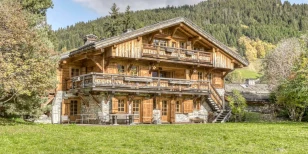


In Haute-Corse, a chateau for sale in Haute-Corse usually means a large notable's residence or a former fortified house, around Bastia, Cap Corse, the Balagne district or Corte, rather than a classic lowland chateau: granite or schist walls, slate roofs, square towers inherited from the Genoese presence, and plain façades facing the sea or the valley. Some inland properties in the Castagniccia district keep outbuildings tied to chestnut farming, long a pillar of the island's economy. Browse every chateau for sale listed by private owners, agencies and notaries across the department.
This page gathers real price benchmarks for the department's large residences, the areas where they are found between the coast and the mountainous interior, the particularities of Genoese-influenced building and the checks worth making before an offer. As everywhere on the island, being cut off from the mainland raises the cost of restoration whenever materials or skilled tradespeople have to be brought over by sea. To plan a full heritage purchase, read our guide to buying prestige property in France.
DVF land registry data does not identify chateaux as such: the benchmarks below cover sales of houses over 300 m² of living space on 0.05 to 10 ha, above €1,000/m², tracked by our observatory. They frame the market for large residences without describing it entirely: an estate with 30 ha of parkland or a listed monument sold with its farmland falls outside this scope.
The local market is too thin to publish a reliable department-level benchmark (5 sales in five years): we give the figures for the Corsica region. Across the Corsica region, the 2021-2025 median stands at €3,752,800* (33 sales), against €822,000 in France in 2025 (981 sales).
| Scope | Sales | Median price | Floor – ceiling (P10–P90) | €/m² living space (median) |
|---|---|---|---|---|
| Corsica (2021-2025) | 33 | €3,752,800* | €830,000 – €5,000,000 | 8,183 |
| France (2025) | 981 | €822,000 | €428,000 – €3,100,000 | 2,308 |
The breakdown by stratum (coastal, rural tourist, ordinary rural) and the five-year trend are in our observatory of prestige property prices in France (in French). Before making an offer, work out purchase costs and borrowing capacity with our financial tools and calculators.
Source: DVF (DGFiP), transactions from 1 January 2021 to 31 December 2025, processed by ma-propriete.fr; prices rounded to the nearest €100. * Fewer than 100 sales: read as an indication only.
Large residences in Haute-Corse often carry the mark of Genoese influence: narrow, tall façades, square watchtowers, schist-slate roofs inland and tile roofs closer to the coast. The Castagniccia district, a former chestnut-growing area, keeps stone houses linked to chestnut-drying sheds and mills, often set on a hillside to overlook the valley. Residences on Cap Corse, more isolated, are marked by watchtowers, ruined or restored, that testify to a long history of coastal defence and piracy in past centuries.
Outbuildings frequently include a chestnut-drying shed, a sheepfold or a former oil mill where the property once kept terraced olive groves. The condition of the slate roofs, the soundness of retaining walls on sloping ground and the upkeep of dry-stone terraces largely determine the cost of works needed on these often old buildings. Chestnut timber framing is common in older roofs and should be checked separately from the slate covering itself, since the two age at different rates.
Large residences are spread between Bastia and its urban area, Cap Corse, a narrow peninsula between two seas, and the Balagne district around Calvi and L'Île-Rousse, known for perched villages and olive groves. The interior of the department, around Corte, former capital of independent Corsica, and the Castagniccia district, offers more isolated and more discreet properties away from coastal tourism, often reached along narrow roads through chestnut woodland. The Niolu district to the west remains the most mountainous and least accessible area, with hamlets that some winters see snowed in for days.
Access relies on the airports at Bastia and Calvi and on sea links to the mainland, since the department has no TGV station. Cap Corse and the Balagne remain the most sought-after coastal areas; the Castagniccia and Niolu districts, more cut off, offer larger sizes for a noticeably more accessible budget. Ferry frequency to the mainland also drops outside the summer season, a point worth checking for owners planning regular travel.
Some residences in Haute-Corse are listed or registered historic monuments, particularly around Bastia and in the Balagne district, which places façade works under the opinion of the Architecte des Bâtiments de France. Wildfire risk, high in summer on land covered in maquis scrubland, brings a statutory brush-clearing duty worth checking before any purchase.
On the technical side, examine the condition of retaining walls and dry-stone terraces on sloping ground, the land's legal status, sometimes complex given the undivided inheritance common in Corsica, and winter road access to properties in the mountainous interior. A prior legal check avoids complications during the sale. Buyers should also confirm that any spring or well supplying the house is registered, since informal water arrangements are still common across rural Corsica, and can take months to formalise once a sale is under way.
Large residence and chateau listings in Haute-Corse are published by private owners, local agencies and notaries; filter them by price, living space, land area and outbuildings, then set up an e-mail alert to follow new listings. To widen your search across the whole island, browse the chateaux for sale in Corsica.