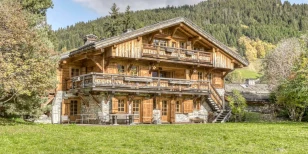


In Corse-du-Sud, a chateau for sale in Corse-du-Sud usually takes the form of a large granite residence once owned by a notable family from Ajaccio, Sartène or the Alta Rocca, rather than a chateau in the classic sense: massive buildings under schist-slate or tile roofs, square towers of defensive origin, and plain façades suited to the Mediterranean climate and southern winds. Some properties, close to the coast or tucked into the maquis scrubland, still keep outbuildings tied to livestock or chestnut farming. Browse every chateau for sale listed by private owners, agencies and notaries across the department.
This page gathers real price benchmarks for the department's large residences, the areas where they are found between the coast and the Alta Rocca, the particularities of Corsican granite building and the checks worth making before an offer. Being an island adds shipping time and cost for any restoration materials that cannot be sourced locally, a point mainland buyers often underestimate. To plan a full heritage purchase, read our guide to buying prestige property in France.
DVF land registry data does not identify chateaux as such: the benchmarks below cover sales of houses over 300 m² of living space on 0.05 to 10 ha, above €1,000/m², tracked by our observatory. They frame the market for large residences without describing it entirely: an estate with 30 ha of parkland or a listed monument sold with its farmland falls outside this scope.
The local market is too thin to publish a reliable department-level benchmark (28 sales in five years): we give the figures for the Corsica region. Across the Corsica region, the 2021-2025 median stands at €3,752,800* (33 sales), against €822,000 in France in 2025 (981 sales).
| Scope | Sales | Median price | Floor – ceiling (P10–P90) | €/m² living space (median) |
|---|---|---|---|---|
| Corsica (2021-2025) | 33 | €3,752,800* | €830,000 – €5,000,000 | 8,183 |
| France (2025) | 981 | €822,000 | €428,000 – €3,100,000 | 2,308 |
The breakdown by stratum (coastal, rural tourist, ordinary rural) and the five-year trend are in our observatory of prestige property prices in France (in French). Before making an offer, work out purchase costs and borrowing capacity with our financial tools and calculators.
Source: DVF (DGFiP), transactions from 1 January 2021 to 31 December 2025, processed by ma-propriete.fr; prices rounded to the nearest €100. * Fewer than 100 sales: read as an indication only.
Older buildings in Corse-du-Sud stand out for their local granite, cut in large blocks for thick walls, and for roofs covered in schist slates or tiles depending on the area. Large residences, often called "maisons de maître" or "palazzi" in local usage, belonged to notable village families and still bear the marks of a defensive past: narrow openings, square towers and occasionally rudimentary machicolations once meant to watch for coastal raids. Some Alta Rocca properties keep a plainer layout, inherited from fortified mid-mountain sheepfolds, and rarely open onto more than one or two small windows per floor.
Outbuildings frequently include a sheepfold, a chestnut-drying oven and dry-stone terraces once used for growing crops on slopes. The condition of the roof, the soundness of the granite walls against the island's moderate seismic activity, and the upkeep of surrounding maquis scrubland, a statutory requirement to limit wildfire risk, all weigh heavily on the property's value. Finding a mason experienced with traditional granite construction can also take longer here than on the mainland.
Large residences cluster first around the Gulf of Ajaccio and its surrounding area, as well as in Sartène, a granite town locally nicknamed "the most Corsican of Corsican towns", and in the Alta Rocca around Zonza and Lévie, a mountainous district covered in maquis and chestnut groves. The coast from Propriano to Bonifacio keeps a handful of isolated seafront properties, while the inland Sartène district remains more discreet. Bonifacio and the far south offer limestone buildings, different from the granite that dominates elsewhere in the department, and generally command a strong premium for their setting.
Access relies on Ajaccio airport and regular sea links from the mainland, since the department has no TGV station. The Gulf of Ajaccio and its surroundings remain the most sought-after and most expensive area; the Alta Rocca and inland Sartène district, further from the coast, offer larger sizes for a more accessible budget. Ferry schedules to the mainland shrink outside the summer season, which owners planning frequent trips should factor in.
Some large residences in Corse-du-Sud are listed or registered historic monuments, notably around Sartène and Ajaccio, which places façade works under the opinion of the Architecte des Bâtiments de France. Wildfire risk linked to surrounding maquis scrubland brings a statutory brush-clearing duty around buildings, always worth checking with the town hall before any project.
On the technical side, examine the land's legal status, sometimes complex in Corsica due to undivided inheritance, the condition of dry-stone retaining walls on sloping land, and water access during the summer. A prior legal check on land ownership avoids later complications. Buyers should also confirm that any well or spring feeding the property is properly registered, since informal water arrangements remain common in rural Corsica.
Large residence and chateau listings in Corse-du-Sud are published by private owners, local agencies and notaries; filter them by price, living space, land area and outbuildings, then set up an e-mail alert to follow new listings. To widen your search across the whole island, browse the chateaux for sale in Corsica.