
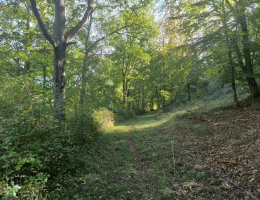
A hunting property for sale in Ariège almost always lies on sloping ground, so quickly does the department climb from the plain of Pamiers to the ridges of the Spanish border. In the Couserans, around Saint-Girons and Mont Valier, as in Haute-Ariège, from Ax-les-Thermes to the Vicdessos, hunting is mountain hunting: isard (the Pyrenean chamois), red deer, wild boar, roe deer and, more locally, mouflon. The foothills, from the Plantaurel to the Pays d’Olmes and the Pays de Mirepoix, combine broadleaved woods, meadows and slopes, while Lower Ariège, around Pamiers and Saverdun, and the Lèze and Arize valleys remain farming country. This page presents the hunting grounds and estates for sale in these areas, listed by private sellers, estate agents or notaires.
Further down the page are the prices of woods sold in the department, the big game culls, where red deer have risen sharply, and the rules specific to Ariège: ACCAs, the cull plan, the presence of bears, and fencing. If your project includes restoring a building, also read our article can you build in a forest?
A hunting estate is rarely valued with a single figure: its price adds up the value of the woodland, the ponds, the buildings and the shooting facilities. The statistics below give benchmarks for wooded land and ponds, based on sales actually recorded.
According to the ma-propriete.fr forest price observatory, built from sales recorded in the French DVF land registry database, the median price of a hectare of forest in Ariège was €3,287/ha in 2025*, across 44 sales, with an average of €3,978/ha. That puts the department below the Occitanie median (€3,333/ha) and below the national median (€4,936/ha). Compared with 2024, the median changed by +31.2%, a movement to interpret with care given the number of sales. Over the more robust 2020-2025 period, 215 sales give a median of €3,000/ha for a median plot size of 4.3 ha.
| Indicator | Ariège (09) | Occitanie | France |
|---|---|---|---|
| Median price 2025 | €3,287/ha* | €3,333/ha | €4,936/ha |
| Average price 2025 | €3,978/ha* | €4,675/ha | €6,214/ha |
| Number of sales 2025 | 44 | 636 | 6,329 |
| Change in median 2024 → 2025 | +31.2%* | −8.2% | +1.9% |
| Median price 2020-2025 | €3,000/ha | €3,560/ha | €4,778/ha |
| Number of sales 2020-2025 | 215 | 3,690 | 35,100 |
Nationally, the price per hectare rises with size: the large properties that appeal to hunters sell for more per hectare than medium-sized woods.
| Size of forest sold (France, 2020-2025) | Median price | Number of sales |
|---|---|---|
| 10 to 20 ha | €4,010/ha | 3,161 |
| 20 to 50 ha | €5,330/ha | 1,850 |
| 50 to 100 ha | €6,810/ha | 581 |
| Over 100 ha | €7,361/ha | 320 |
Ponds trade at a very different level: with too few sales in Ariège, the benchmark is the regional median of €10,466/ha for ponds sold without buildings between 2020 and 2025.
On the listings side, 18 hunting properties are offered on ma-propriete.fr across France as of 2 October 2026, 2 of them in Occitanie. Their median asking price is €888,000 for a median size of about 68 ha. These are asking prices for complete properties: they describe the supply on offer more than the average price of a wooded hectare.
* 30 to 99 sales: indicative value. Source: DVF (French tax authority), processed by ma-propriete.fr; forests of 1 ha or more, cadastral type woodland; ponds without buildings of at least 2,000 m²; July 2020 to December 2025; Moselle, Bas-Rhin and Haut-Rhin are not covered by DVF. Listings recorded on ma-propriete.fr on 2 October 2026.
The game bag records published by the French Biodiversity Agency (OFB) measure hunting pressure and, indirectly, the presence of big game. In Ariège, 2,604 red deer were taken in the 2024-2025 season, about 3% of the national total, alongside 4,571 roe deer and 8,314 wild boar.
| Species | 2021-2022 season | 2024-2025 season | Change |
|---|---|---|---|
| Red deer | 2,226 | 2,604 | +17% |
| Roe deer | 4,802 | 4,571 | −5% |
| Wild boar | 7,013 | 8,314 | +19% |
| Pyrenean chamois | 704 | 714 | +1% |
| Mouflon | 113 | 142 | +26% |
Source: OFB, wild ungulates network, departmental big game bags (total culls, data published on data.gouv.fr).
The Couserans, in the west, brings together the valleys of the Salat, the Lez and their tributaries, overlooked by Mont Valier, around which a reserve protects high mountain wildlife. In Haute-Ariège, the Orlu national hunting and wildlife reserve, near Ax-les-Thermes, run by the French Biodiversity Agency (OFB), is devoted to the isard and the capercaillie. Outside the reserves, isard are stalked under a cull plan set by management unit after counts; red deer are driven or stalked in the beech and fir forests, and mouflon remain more localised. Mountain gamebirds, counted every year, are hunted under very strict limits.
The presence of the brown bear, particularly in the Couserans, calls for caution during driven hunts. A large share of the mountain forest belongs to communes or to the State, such as the Bélesta forest, a renowned silver fir forest in the Pays d’Olmes that is largely commune-owned; private properties tend to be wooded valley slopes, barns with hay meadows or former mountain farmland that has gone back to forest.
The Plantaurel, a limestone ridge running along the foot of the Pyrenees, and the hills of the Pays de Foix, the Pays d’Olmes and the Pays de Mirepoix carry oak and beech woods broken up by meadows. Wild boar, roe deer and red deer use ground that is easier to cover than in the mountains, and a hunting estate here often combines a house, meadows and woods. To the east, the Pays d’Olmes borders the Pays de Sault, and hunting estates in Aude continue these mountain forests.
In the north, Lower Ariège and the Lèze and Arize valleys line up maize and sunflower fields, riverside woods and scattered copses: small game keeps its place, and wild boar damage to newly sown crops is a sensitive subject.
Ariège is organised in ACCAs, the statutory communal hunting associations, often grouped into intercommunal associations, and most communes have one. Land only escapes the association if it reaches, in a single block, the required minimum area, namely 20 ha in the general case laid down by law, a threshold that departmental rules can raise and that is far higher for land above the tree line, and if its owner lodges an objection in the required form and within the set deadlines. For a large estate, check with the departmental federation whether it is currently part of the association or has been withdrawn from it.
Isard, red deer, mouflon and roe deer are under the cull plan: ask for the shoot’s allocations and how they have changed. Big game damage to meadows and crops, compensated by the hunters’ federation, matters in relations with livestock farmers. On planning, restoring an old summer-pasture building requires a specific authorisation under the Mountain Act (loi Montagne). Finally, the act of 2 February 2023 in principle leaves pastoral fencing aside, but mesh closing off a foothill wood to keep game in must, in a natural zone, leave 30 cm beneath its lowest wire and not exceed 1.20 m; if it went up in the thirty years before the act, it must be adapted before 1 January 2027. The details are explained in our article on hunting fences and the 2023 act.
The Ariège hunting properties presented on ma-propriete.fr are listed by private sellers, estate agents and notaires’ offices. Filter them by price or size, create an alert to hear about every new listing and, if you are selling, post your own. Buyers drawn as much by the woodland as by the game will also want to see our forests for sale in Ariège, and those widening their search the hunting estates and shooting grounds of Occitanie.