
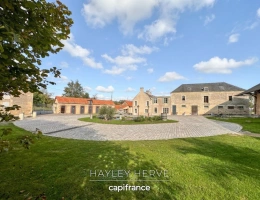

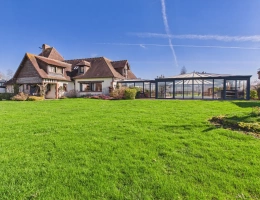
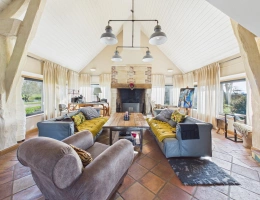

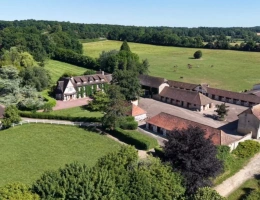


From the Pays de Bray to the Caux plateau, an equestrian property for sale in Seine-Maritime (76) can take very different forms, from breeding pasture to a clos-masure farmstead ringed by tree-lined banks. Listings come from private owners, estate agents and notaires: stud farms for sale and breeding farms around Neufchâtel-en-Bray and Forges-les-Eaux, Caux longères with boxes, livery yards on the outskirts of Rouen and Le Havre, and character houses with paddocks behind Dieppe and Fécamp. Each advert gives the acreage, boxes, facilities and state of the buildings. To compare with other regions, see every equestrian property for sale in France.
In Seine-Maritime, price starts with the soil: the fertile loams of the Pays de Caux are fought over by arable farmers, while the damp pastures of the Pays de Bray remain livestock country. Further down you will find price benchmarks, equestrian areas and the checks to carry out, starting with marl pits. For the other stages of a purchase, follow our buyer's guide for equestrian property in France.
Two public benchmarks help to place the price of an equestrian property: the value of land and pasture, which carries the acreage, and the price of country houses, which carries the buildings; asking prices of listings complete the picture.
In 2025, 209 farmland sales were recorded in Seine-Maritime (DVF data, vineyards excluded): the median price was €11,543/ha and the average €12,013/ha, with 80% of sales between €7,594 and €17,090/ha. Over four years, the median changed by +19.5% compared with 2021. The 2025 SAFER scale values land and pasture sold with vacant possession in Seine-Maritime at €11,600/ha (-0.3% over one year). By local farming area, values range from €7,950/ha (Vallée de la Seine) to €13,150/ha (Pays de Caux). The median is €8,305/ha across the region and €5,307/ha for France as a whole.
For the buildings, the benchmark is the country house: 3,397 sales in rural communes of Seine-Maritime in 2025, at a median of €201,000 and €2,013/m², compared with €189,000 in Normandy and €189,200 nationally. For homes of over 300 m², common on larger estates, the regional median reaches €670,000 across 464 sales recorded from mid-2020 to the end of 2025.
On 24 September 2026, the 15 equestrian listings in Normandy showed a median asking price of €671,450, with a median area of 10.2 hectares.
| 2025 benchmark | Seine-Maritime (76) | Normandy | France |
|---|---|---|---|
| Farmland: DVF median | €11,543/ha | €8,305/ha | €5,307/ha |
| Land and pasture with vacant possession: SAFER scale | €11,600/ha | €9,610/ha | €6,460/ha |
| Country house: median price | €201,000 | €189,000 | €189,200 |
| Country house: median price per m² | €2,013/m² | €1,872/m² | €1,830/m² |
Sources: 2025 DVF sales (French tax authority) processed by ma-propriete.fr, houses in rural communes; 2025 SAFER land value scale (Agreste, July 2026); homes over 300 m²: DVF mid-2020 to end-2025; asking prices of listings on 24 September 2026. * Indicative value (30 to 99 sales). Not published: fewer than 30 sales or area not covered.
Farmland in Seine-Maritime sells well above both the Normandy and French averages. The Pays de Caux sits at the top of the small farming regions and the Vallée de la Seine at the bottom, with the Pays de Bray among the more affordable areas. Country houses also cost a little more than in Normandy or France as a whole, so land and buildings both push prices up. See the breakdown in our farmland price observatory, and estimate a listing's plots with our land value tool.
The Pays de Bray, between Neufchâtel-en-Bray and Forges-les-Eaux, is the department's livestock country: clay soils, damp hedged pastures and a long dairy and grazing tradition. It is the most logical place to find a stud farm for sale in Seine-Maritime, with fields already enclosed, foaling boxes, an open barn for youngstock and a hay barn. The Mauquenchy trotting racecourse gives the area a direct link with racing, of interest to trotter breeders and trainers.
On such heavy ground, water matters both ways: a supply to every field, but also drainage for winter paddocks, which quickly turn to mud. Look at the state of the post-and-rail fencing, whether mares and foals can be kept in separate groups, and whether the paddocks are grouped close to the yard.
On the Caux plateau, the clos-masure, a grassy enclosure ringed by banks planted with beech or oak, gives horses natural shelter from the wind; converted into a horse farm, it houses boxes in the old farm buildings, with an arena and a few paddocks. Around Rouen and Le Havre, a livery yard for sale in Seine-Maritime is aimed first at town-based owners, with an indoor school, tack room and lunge pen. For a riding centre or pony club to take over, closeness to the main towns remains the key criterion, while many buyers simply want a house with a few stables behind Dieppe or Fécamp.
Seine-Maritime brings together contrasting landscapes. The Pays de Caux, a broad arable plateau, ends in the north with the chalk cliffs of the Côte d'Albâtre, between Étretat and Le Tréport; the Pays de Bray, further east, is a hollow of grassland and woods; the Seine valley between Rouen and Le Havre alternates meanders, wooded slopes and wetlands protected by the Boucles de la Seine normande regional nature park. Besides Mauquenchy, Dieppe has a racecourse.
Neither Rouen nor Le Havre has a TGV station, but direct trains run to Paris, and the A13 and A28 motorways lead towards Île-de-France and the north. For British buyers, the ferries from Le Havre to Portsmouth and from Dieppe to Newhaven make the department easy to reach. From Rouen, the A28 brings the Bray grasslands within easy reach.
Marl pits (marnières), old cavities dug to extract chalky marl, are very common beneath the Caux plateau: searching for them, through town hall records and a ground survey, is essential before building anything, from an indoor school to a simple shelter. On the plateau, run-off can cause mudslides in heavy storms, and valley floors are exposed to flooding. On the Côte d'Albâtre, the coastal protection law tightly restricts new construction and cliff erosion must be taken into account; near listed monuments, the Architecte des Bâtiments de France gives an opinion.
There is also a legal point about land: if the seller farms part of the grazing under a tenancy, those fields are not part of the deal. You can only carry on using them if each landowner agrees to sign a new lease with you, which they remain free to refuse. Only a transferable lease, very rarely granted, or certain transfers within the close family allow the existing lease to pass to the incoming owner. Lastly, the SAFER may pre-empt farmland, and breeding or livery work is in principle treated as agricultural, with MSA membership depending on the scale of the activity.
On ma-propriete.fr, equestrian properties in Seine-Maritime are listed by private owners, agents and notaires, and filters for acreage, boxes or an indoor school make shortlisting easier. Listings here are few at any given moment, so an e-mail alert tells you as soon as one goes online; they are also shared through « Propriétés équestres à vendre - ma-propriete.fr », our Facebook group. Broaden your search to our equestrian properties for sale in Normandy.
Planning to sell a Bray stud farm, a yard or a clos-masure set up for horses? Advertise your property with photos, the layout of your fields and a description of the equipment. You choose how the location appears, exact or deliberately vague, which helps if the business keeps running during the sale. We also offer introductions to rural property professionals and a land valuation study.