
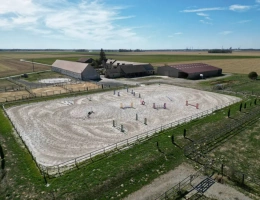
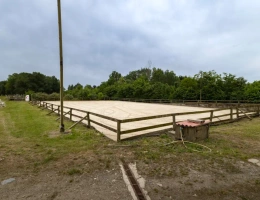
Livery yards, riding centres and homes with a few stables make up most of the market for anyone seeking an equestrian property for sale in Seine-et-Marne (77). The properties listed here come from private sellers, estate agents and notaires: livery yards and stables for sale on the edge of the Fontainebleau forest, pony clubs to take over near Melun or Meaux, Brie farms converted for horses and country homes with boxes in the Gâtinais. Listings state the acreage, the number of boxes and whether there is an indoor school or an arena. For a wider search, see all equestrian properties for sale across France.
In Seine-et-Marne the price of a yard depends less on land values than on the house, the facilities and the distance from Paris: a property near Fontainebleau is not valued like an isolated farm near Provins. Further down you will find reference prices, the key areas and the checks specific to the department. For the purchase itself, follow our step-by-step equestrian property guide.
Two public benchmarks help to place the price of an equestrian property: the value of land and pasture, which carries the acreage, and the price of country houses, which carries the buildings; asking prices of listings complete the picture.
In 2025, 126 farmland sales were recorded in Seine-et-Marne (DVF data, vineyards excluded): the median price was €7,015/ha and the average €7,828/ha, with 80% of sales between €5,009 and €11,030/ha. Over four years, the median changed by +7.9% compared with 2021. On the SAFER scale, land and pasture with vacant possession are worth €7,600/ha in 2025 (-1.4% over one year). By local farming area, values range from €7,260/ha (Zone sud) to €8,350/ha (Périurbain et vallées). Benchmarks stand at €7,465/ha in Île-de-France and €5,307/ha nationally.
As for the house, country homes sold at a median of €250,600 in Seine-et-Marne in 2025 (€2,368/m², 2,149 sales in rural communes), compared with €280,000 in Île-de-France and €189,200 nationally. For homes of over 300 m², common on larger estates, the regional median reaches €1,190,000 across 684 sales recorded from mid-2020 to the end of 2025.
On 24 September 2026, 6 equestrian properties were for sale in Seine-et-Marne on ma-propriete.fr. On the same date, the 14 equestrian listings in Île-de-France showed a median asking price of €1,355,000, half of them between €642,250 and €1,700,000, with a median area of 4.9 hectares.
| 2025 benchmark | Seine-et-Marne (77) | Île-de-France | France |
|---|---|---|---|
| Farmland: DVF median | €7,015/ha | €7,465/ha | €5,307/ha |
| Land and pasture with vacant possession: SAFER scale | €7,600/ha | €8,190/ha | €6,460/ha |
| Country house: median price | €250,600 | €280,000 | €189,200 |
| Country house: median price per m² | €2,368/m² | €2,603/m² | €1,830/m² |
Sources: 2025 DVF sales (French tax authority) processed by ma-propriete.fr, houses in rural communes; 2025 SAFER land value scale (Agreste, July 2026); homes over 300 m²: DVF mid-2020 to end-2025; asking prices of listings on 24 September 2026. * Indicative value (30 to 99 sales). Not published: fewer than 30 sales or area not covered.
The table puts Seine-et-Marne slightly below the Île-de-France average for farmland but well above the national level. The “Zone sud” stands out as the most affordable small farming region and the “Périurbain et vallées” area as the most expensive. Country houses cost less than elsewhere in the region yet far more than the French average, so on a few hectares the house carries much of the price. Dig deeper in our farmland price observatory or put a value on a listing's plots with the land value tool.
Demand from Paris has turned Seine-et-Marne into a land of livery yards, often set in converted farms close to the forests or the main roads. A livery yard for sale in Seine-et-Marne usually offers a row of boxes, an indoor school, a sand arena, a lunge pen, a tack room and paddocks with field shelters, sometimes a horse walker. The value of a working yard rests on how full its boxes are, the condition of the arena footing and how much grazing each horse gets, which tends to shrink closer to the city.
Riding centres and pony clubs to take over form the other half of the market. Buying one means acquiring land, buildings and riders who sign up for the year, so look closely at the clubhouse, the grooming area, the school horses and the rules for premises open to the public. An equestrian centre for sale in Seine-et-Marne is also judged on how easily riders can reach it after work.
Many buyers simply want a house where they can keep their own horses: a Gâtinais longère or a meulière stone house, with a few hectares of grazing and a hay barn. The large Brie farms, built around an enclosed courtyard, lend themselves to conversion into a horse farm or livery business, provided there is grassland around the buildings, which is not always the case on the cereal plateau. Equestrian estates with a manor are scarcer and tend to lie around Fontainebleau and in the valleys.
The main equestrian venues lie in the south. The Fontainebleau forest, crossed by many riding trails, draws hacking enthusiasts, while in Fontainebleau itself the Grand Parquet hosts international show jumping and the Solle racecourse stages race meetings. The Gâtinais, with its regional nature park, and the Loing valley around Nemours extend this area. To the north and east, the Brie between Meaux, Coulommiers and Provins offers more land but less pasture, and the Marne and Seine valleys alternate wooded slopes and flood plains.
Marne-la-Vallée–Chessy TGV station serves the north-west of the department, Melun and Fontainebleau have direct trains to Paris, and the A4, A5 and A6 motorways radiate from the capital. Trotter owners also value the nearby Grosbois training centre in neighbouring Val-de-Marne. The flip side: the best-connected areas face the most urban pressure.
The Seine, Marne, Loing and Morin valleys are prone to flooding: read the flood risk prevention plan before buying in a valley bottom, where fields can stay waterlogged in winter. On the Brie plateau, clay soils call for a ground survey before building an indoor school. The Fontainebleau forest is a protected site, and near listed monuments, as in Provins or Fontainebleau, any project is referred to the Architecte des Bâtiments de France for an opinion. Where the local plan (PLU) zones land for farming, new stabling must be justified by the business.
Another point often misunderstood: when the seller farms rented fields, those plots are not part of the sale. Keeping them means signing a new lease with every landowner, and each of them may simply decline. The seller's lease does not pass to the new owner, except under a transferable lease, which is very unusual, or a transfer to a close relative where the law allows. Bear in mind too the SAFER's pre-emption right over farmland, and the fact that livery or breeding is in principle an agricultural activity, registered with the MSA once it reaches a certain size.
On ma-propriete.fr, yards and homes with paddocks in the department are offered by private owners, agents and notaires. Refine the list by land area, stabling capacity or indoor school, then turn on an e-mail alert. Properties are also posted in the group « Propriétés équestres à vendre - ma-propriete.fr » on Facebook. Widen the search to all equestrian properties for sale in Île-de-France.
Selling a livery yard, a riding centre or a house with stables? Publish an advert including photos, a site plan and a list of facilities. The location can appear in full or only by area, which helps if the business is still open. We can also refer you to rural property specialists and carry out a land valuation study.