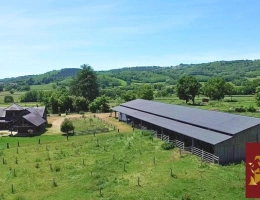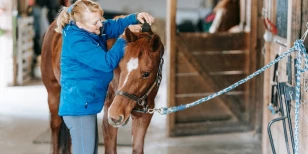
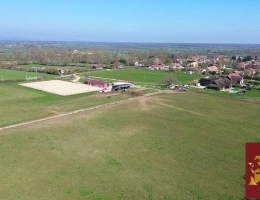
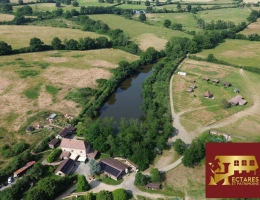
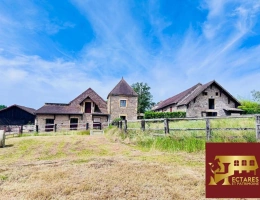
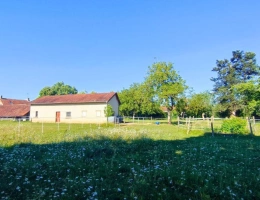
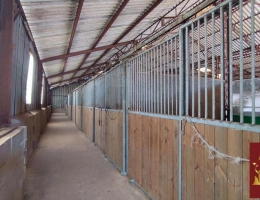
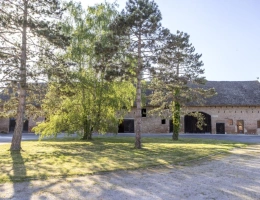
Few French departments offer as much grass for a moderate budget, and an equestrian property for sale in Saône-et-Loire often comes with extensive hedged grassland. Here you will find, from private sellers, agents and notaires, stud farms for sale in the Charolais and Brionnais, breeding estates with a manor house, livery yards near Mâcon or Chalon-sur-Saône, Bresse farms adapted for horses and wooded properties in the Autunois and Morvan. Listings give the acreage, the number of boxes, the facilities and the condition of the buildings. Beyond the department, browse all equestrian properties for sale in France.
Price depends above all on the area: land in the Bresse chalonnaise is more sought after than the grassland of the Charolais or the meadows of the Autunois, and for a stud farm the extent and quality of the grazing often count for more than the house. The sections below give benchmarks, local areas and pre-purchase checks; our step-by-step guide to buying an equestrian property covers the rest.
An equestrian property combines pasture and a house, so its price is best read against two public benchmarks, farmland and country houses, alongside the asking prices of current listings.
The 391 farmland sales recorded in Saône-et-Loire in 2025 (DVF, vineyards excluded) show a median of €2,349/ha; the average reached €2,437/ha and eight sales in ten closed between €1,629 and €3,300/ha. Over four years, the median changed by +7.7% compared with 2021. For land and pasture sold free of any lease, the 2025 SAFER scale gives €2,550/ha (-0.8% over one year). By local farming area, values range from €2,310/ha (Sologne bourbonnaise, Autunois, Morvan) to €3,240/ha (Bresse chalonnaise). Benchmarks stand at €2,773/ha in Bourgogne-Franche-Comté and €5,307/ha nationally.
For the buildings, the benchmark is the country house: 2,691 sales in rural communes of Saône-et-Loire in 2025, at a median of €160,000 and €1,564/m², compared with €157,000 in Bourgogne-Franche-Comté and €189,200 nationally. For homes of over 300 m², common on larger estates, the regional median reaches €514,000 across 245 sales recorded from mid-2020 to the end of 2025.
On 24 September 2026, 9 equestrian properties were for sale in Saône-et-Loire on ma-propriete.fr. On the same date, the 14 equestrian listings in Bourgogne-Franche-Comté showed a median asking price of €617,000, half of them between €501,750 and €908,250, with a median area of 6 hectares.
| 2025 benchmark | Saône-et-Loire (71) | Bourgogne-Franche-Comté | France |
|---|---|---|---|
| Farmland: DVF median | €2,349/ha | €2,773/ha | €5,307/ha |
| Land and pasture with vacant possession: SAFER scale | €2,550/ha | €2,740/ha | €6,460/ha |
| Country house: median price | €160,000 | €157,000 | €189,200 |
| Country house: median price per m² | €1,564/m² | €1,525/m² | €1,830/m² |
Sources: 2025 DVF sales (French tax authority) processed by ma-propriete.fr, houses in rural communes; 2025 SAFER land value scale (Agreste, July 2026); homes over 300 m²: DVF mid-2020 to end-2025; asking prices of listings on 24 September 2026. * Indicative value (30 to 99 sales). Not published: fewer than 30 sales or area not covered.
The figures confirm the department's main asset: farmland sells for markedly less than across Bourgogne-Franche-Comté and well below the French average, which makes large areas of grazing affordable. The Sologne bourbonnaise, the Autunois and the Morvan form the bottom of the range, the Bresse chalonnaise the top. Country houses, close to the regional level, remain much cheaper than nationally. Our farmland price observatory gives more detail, and the land value tool prices the plots in any listing.
The Charolais and Brionnais, hedged cattle country devoted to Charolais beef herds, supply a good share of the stud farms on the market: deep grassland, living hedges, and fields grouped around a stone farmhouse or a manor house. Horse breeders find acreage here that would be hard to put together elsewhere on the same budget. A working stud usually includes foaling boxes, a barn for young stock, paddocks with field shelters, a hay barn and well-kept fencing, and former cattle buildings are often converted into stables.
A stud farm for sale in Saône-et-Loire is judged first on its grazing: how the ground holds up in winter, water in every field, the state of hedges and fences, and room to rotate horses without overgrazing. Then come the technical buildings, hay storage and field access. A lightly equipped Charolais farm will need work to take horses, but its land costs less.
The rest of the market is split between livery yards near Mâcon, Chalon-sur-Saône or Le Creusot, with an arena and indoor school, and riding schools or pony clubs looking for a new owner, valued on their clients and on the state of the tack room, clubhouse and facilities. The Bresse offers farms with meadows suited to a few horses, while the more wooded Morvan and Autunois suit trail riders and equestrian gîtes. Houses with boxes and a few hectares turn up across the department, and some horse farms combine livery with a little breeding.
The Haras national de Cluny, in the Mâconnais, recalls the place of the horse in the department's history. Around it, the landscape divides into hedged grassland in the west, in the Charolais and Brionnais around Charolles and Paray-le-Monial, the Bresse plain in the east around Louhans, the vineyards of the Mâconnais and Côte chalonnaise along the Saône, and the forests of the Autunois and the Morvan to the north-west. The more urban Le Creusot and Montceau-les-Mines area offers local clients for a livery business.
The TGV stations of Mâcon-Loché and Le Creusot-Montceau on the Paris-Lyon high-speed line, and the A6 motorway along the Saône, bring the east of the department within reach of Paris and Lyon. The Autunois, the Morvan and the Sologne bourbonnaise, further from these routes, offer the cheapest land, while the Bresse chalonnaise, close to Chalon-sur-Saône, sits at the top of the range.
Parts of the Saône valley and the banks of the Loire are flood-prone: read the flood risk plan before buying riverside meadows. In the Bresse, clay soils hold water in winter, so check paddock drainage; in the Morvan, hills and forest reduce the usable area. Around Montceau-les-Mines, ask about former mine workings before building. Around the protected monuments of Cluny, Autun or Paray-le-Monial, and of many listed châteaux, any indoor school project goes before the Architecte des Bâtiments de France and must also be justified in a farming zone of the local plan (PLU).
On the land side, separate what the seller owns from what they rent. Grassland farmed under a tenancy is not part of the sale; to keep using it, the buyer must agree a new lease with each owner, who is free to decline. The current lease cannot be handed over to the new owner of the stud, apart from the rare transferable lease (bail cessible) and a few situations within the close family. Finally, the SAFER may pre-empt farmland put up for sale, and horse breeding normally falls under the agricultural regime, MSA affiliation depending on scale.
Listings for the department combine private sales, rural agency mandates and properties handled by notaires. Filter by acreage, boxes or indoor school, and set up an e-mail alert for each new match. New offers are also posted to the ma-propriete.fr Facebook group, « Propriétés équestres à vendre - ma-propriete.fr ». To compare with Côte-d'Or, Nièvre or Jura, see the equestrian properties for sale in Bourgogne-Franche-Comté.
Selling a stud, a livery yard or a grassland farm? Offer your property for sale with photos, a plan of the plots and details of the facilities. You choose whether to show the exact village or just an area, a sensible precaution while breeding or livery continues. We can also put you in contact with rural land experts or run a valuation study of your land.