

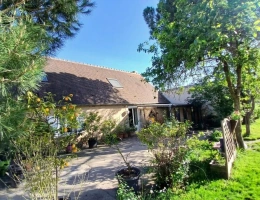
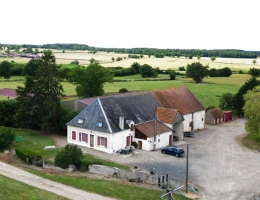
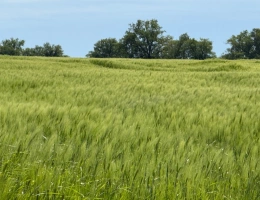
The poultry farms for sale in Indre belong to a corner of the Berry that stayed loyal to livestock, where birds are raised both in contract units and as farmhouse production sold at market. Chicken, guinea fowl, duck and small turkey batches sit alongside laying houses whose table eggs supply Châteauroux and the market towns around it. The properties entrusted to us come from farmers preparing a handover, specialist rural agencies and country notaries; each listing gives the covered area, the production system, whether there is an outdoor range, and the nature of the outlet. They take their place among the poultry farms for sale throughout France.
Alongside the listings you will find the benchmarks buyers usually lack: the value of Berry farmland, the districts where handovers appear, how to examine buildings that are sometimes old, and the health controls specific to poultry keeping. For a setting-up project, our white paper « Créer une exploitation agricole » (in French) describes the steps, from the takeover assessment to the funding plan.
Land remains the largest item when buying a poultry farm. According to sales recorded by the French tax administration (DVF, vineyards excluded), the median price of agricultural land in Indre (36) stood at €4,500/ha in 2025, with an average of €5,116/ha across 249 sales; 80% of transactions fall between €2,666 and €9,146/ha, against a national median of €5,307/ha.
The SAFER benchmark of land values (2025 figures) puts vacant land and pasture at €5,730/ha (+2.1% year on year, +23.0% over ten years), against a national average of €6,460/ha; land already let sells around 17% lower.
Beyond the farmed area, the worth of a holding here rests on its tool and its outlets: the frame and insulation of the house, ventilation, heating, silos, biosecurity entry room, the quality and tree cover of the range, and access to water. Add the flock present on the day of sale, the handling equipment, and above all the regularity of collections, whether they rely on a production organisation or on a market customer base patiently built up. For comparison, lean on our land price observatory and our financial calculators.
The department offers two quite distinct families of property. On one side, industrial-scale contract houses, where the buyer measures usable length and width, year of construction, the performance of the powered ventilation and the heating, the condition of the silos and the compliance of the entry room. On the other, smaller free-range poultry holdings set in an old farmstead, with light shelters, a grass range and sometimes an approved on-farm slaughter room. In either case the floor of the building, its drains and the ease of cleaning between batches weigh directly on the asking price and on the work to be budgeted.
Where a flock is taken over, have its health status, its age and the timetable of coming placements set out clearly, since a sale in mid-crop changes the cash position of the first months considerably. On farmhouse units, goodwill, meaning the customer base, the market pitches and the approval of the workshop, is appraised independently of the walls. Properties combining a dwelling house, outbuildings and pasture call for a clear split of the price between home, production tool and land.
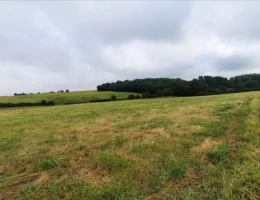
The Boischaut Sud, around La Châtre and Sainte-Sévère, remains the livestock country of the department: hedged fields, medium-sized holdings, more affordable land and steady handovers, often combined with a beef herd. To the north, the Boischaut towards Valençay and Écueillé also keeps mixed farms. The Champagne berrichonne, from Issoudun to Levroux, is an arable plain where poultry units appear as a diversification and where land changes hands at higher prices. Westwards, the Brenne and its ponds, around Le Blanc and Mézières-en-Brenne, offer grassland and characterful properties, while the Creuse valley towards Argenton mixes small parcels and slopes.
Distance to slaughtering and feed facilities counts in the arithmetic: it bears on transport costs and on access to contracts, which is narrower here than in western France. In return, the entry price stays moderate and buildings are not in short supply. A buyer aiming at direct selling will favour communes close to Châteauroux or to the visitor routes of the Brenne.
The classified installations regime applies according to flock size: declaration, registration or authorisation, with mandatory notification of a change of operator to the prefecture. The buyer reads the order in force, checks the biosecurity plan, the separation of clean and dirty zones, the state of the fencing and the avian influenza instructions, which matter particularly where ranges adjoin wetlands used by wild birds. In the Brenne, part of the land falls within nature protection perimeters, so building or enlarging there calls for serious prior examination.
Check too the spreading plan, manure storage capacity and access to water, a sensitive question in districts where boreholes are regulated. Legally, an existing rural lease continues with the new farmer subject to the landlord's agreement, and the transaction goes through the structures control, the French authorisation regime for taking over farmland, and SAFER's pre-emption right. An integration contract deserves a line-by-line reading before any offer: remaining term, takeover conditions, investment commitments.
Private vendors, agencies specialising in rural property and Berry notaries place the holdings you are browsing. Sort by built area, by budget or by the production you want, a broiler farm or a laying unit, and set an alert to follow new opportunities as soon as they appear. You can also turn your attention to all poultry farms for sale in Centre-Val de Loire.