
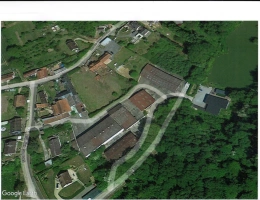
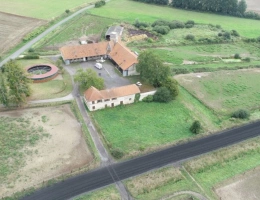
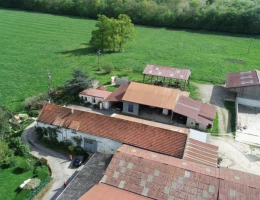
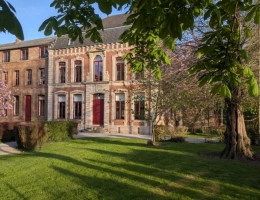
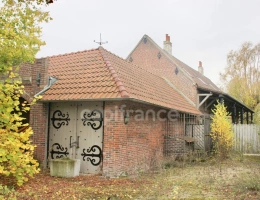
Looking for a pig farm for sale in Hauts-de-France means prospecting a region where pigs grew out of a powerful lowland agriculture, rich in cereals and in industrial by-products. The holdings shown cover a wide span: a finishing house built into a mixed arable farm, a farrow-to-finish site with farrowing and weaner accommodation, or a smaller straw-bedded operation in the hedgerow country. Rural property agencies, notarial offices and farmers organising their handover lodge these mandates, setting out installed capacity, classified-installation status and the spreading acreage. The same selection work feeds our national page of pig farms for sale.
This page goes further than a catalogue: land values across the five departments, the areas where sites come free, a method for judging the state of a pig house, and the checks to complete before signing. If your plan is a first setting-up, our white paper « Créer une exploitation agricole » (in French) walks through the administrative and financial stages.
Land value drives much of the asking price for a pig farm. French tax transfer statistics (DVF, vineyards excluded) show, for 2025, a median of €7,976/ha in Hauts-de-France, an average of €8,940/ha and 1,365 sales; 80% of transactions settle between €6,000 and €14,000/ha, against a national median of €5,307/ha.
On the SAFER side, the value of vacant land and pasture is set at €10,890/ha for 2025, moving -0.5% over a year and +9.4% over ten, against €6,460/ha nationally; expect an average discount of 17% where a lease is running.
On this kind of business, acreage alone never explains the asking price. Look first at how far the rooms have been modernised, slurry storage capacity, the extent of a spreading plan secured by solid agreements, the permit attached to the site, the value of the breeding herd and access to the by-products that lighten the feed bill. Set the adjoining fields against their market with our land price observatory, then cost your project with our financial calculators.
The holdings on offer usually mix generations of buildings: finishing accommodation on slats raised during the big investment waves, weaner rooms taken in hand more recently, a farrowing house sometimes left as it was. Examine each production stage separately: pens and floors, under-slat pits and drainage, forced ventilation and its controls, heating, dry or liquid feeding, automation, alarms and back-up power. Move on to the slurry store and its cover, any phase separation, the loading bay, the biosecurity entry room, the silos and the on-farm feed mill, common here given the surrounding cereal production.
Two neighbouring holdings can carry very different prices depending on compliance with group housing for gestating sows, how recent the upgrading work is and the occupancy rate of the places. The herd is valued in its own right, on health status, genetics and batch management. Where the sale brings together the dwelling, the livestock buildings and the farm's land, insist on a line-by-line valuation: that document is what makes the negotiation readable and the funding defensible.
Nord (59) has two faces: inland Flanders, around Hazebrouck and Bailleul, combines a high density of units, intensive holdings and expensive land, while the Avesnois, hedgerowed and grass-based, holds more modest operations often kept alongside cattle. Pas-de-Calais (62) is the other firm pole: the Artois and the Ternois, from Saint-Pol-sur-Ternoise to Arras, bring together arable cropping, storage capacity and indoor units, whereas the Boulonnais and the Montreuillois, more pastoral and under coastal tourist pressure, offer few available sites.
Somme (80) concentrates its supply in the Santerre and the Vermandois, where silty plateaux, sugar beet, potatoes and processing industries provide both spreading acreage and feed by-products; the Ponthieu and the Vimeu put forward smaller holdings, sometimes needing complete modernisation. Aisne (02) reads in two halves: the south and centre, from the Vermandois to the Soissonnais and the Laonnois, follow the same arable-plain logic, while the pastoral, dairy-oriented Thiérache only brings to market complementary units, rarely designed to carry heavy capacity.
Oise (60) closes the picture with the most constrained profile. The Picardy plateau, around Breteuil and Saint-Just-en-Chaussée, still holds substantial farms able to house a unit, but nearness to the Paris region, land values and the steady spread of residential development weigh on the south of the department, from the Valois to the Beauvaisis. Region-wide, buyers will find the most openings in a broad arc running from Flanders to the Artois and the Santerre; elsewhere, patience and a search open to several departments remain sensible.
Nothing shapes a site's future more than its administrative file. Depending on numbers, the installation falls under declaration, registration or authorisation, and any change of operator is notified to the prefecture. Ask for the prefectural order, any supplements, the inspection reports and an up-to-date spreading plan with the signed agreements. As the region is designated a nitrate vulnerable zone, the permitted spreading periods, the storage capacity required and the fertilisation balance tightly frame how the unit is run and sometimes rule out any increase in stock.
In a densely populated territory, statutory separation distances from dwellings, the local plan and the history of legal challenges count heavily: a building standing alone today can find itself hemmed in by a planned housing scheme. Check biosecurity too, from zoning to rendering arrangements, the continuation of rural leases with the landlord's agreement, the structures control, the French authorisation regime for taking over farmland, and SAFER, and, where a GAEC, a joint farming company, holds the business, the terms for transferring shares.
The economic set-up is part of what changes hands. Many units in the region belong to a producer group that handles collection of the animals and sometimes feed; others run under an integration contract, where the stock stays in the integrator's ownership and the purchase price is adjusted accordingly. Ask about the remaining term, the transfer arrangements and volume commitments. Some animals travel to abattoirs outside the region, including across the Belgian border, so build that haulage cost into your projections.
The regional advantage lies in feed: local cereals, pulp and by-products from sugar, starch and vegetable processing supply an on-farm feed mill at a cost that is often favourable. Alongside that model, a few units run outdoor, label rouge or organic production for the nearby conurbations, and such a fattening farm trades on its goodwill as much as on its walls.
The mandates published here come from retiring owners, from rural estate agencies based in the region and from notarial offices. Refine your search by capacity, type of unit or attached acreage, save an alert so new entries reach you, and if you widen your horizon, browse all the farms for sale in Hauts-de-France.