A pig farm for sale in Île-de-France is an uncommon opportunity: farming around the capital lives on cereals and sugar beet, and livestock, pigs above all, now holds only a residual place. What does come up is almost always a small farmhouse unit, outdoor or straw-based, grafted onto a mixed arable holding and geared to selling at the gate. Such holdings are entrusted to rural property professionals, to notaries, or posted by the farmer directly, with detail on the buildings, the land and the permits in force. The offer across the country can be browsed among the pig farms for sale.
This page adds what listings leave out: the level of land values around Paris, how farmland is really shared between the departments, how to weigh up buildings seldom designed for pigs and the checks to run before signing. For a setting-up project, the stages are laid out in our white paper « Créer une exploitation agricole » (in French).
Land value drives much of the asking price for a pig farm. French tax transfer statistics (DVF, vineyards excluded) show, for 2025, a median of €7,465/ha in Île-de-France, an average of €7,932/ha and 214 sales; 80% of transactions settle between €5,253 and €10,940/ha, against a national median of €5,307/ha.
On the SAFER side, the value of vacant land and pasture is set at €8,190/ha for 2025, moving +5.7% over a year and +7.5% over ten, against €6,460/ha nationally; expect an average discount of 17% where a lease is running.
On a holding here, value rarely rests on area: it sits in adaptable buildings, the paddocks and their fencing, effluent storage capacity and the spreading area genuinely available, the sow herd, the feed self-sufficiency the cropping plan allows, and above all the goodwill attached to direct selling, whether a shop, markets, weekly boxes or restaurant accounts. To build your funding plan, work through our financial calculators; to compare land values, open our land price observatory.
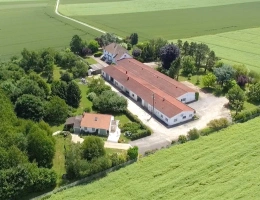
Expect multi-purpose buildings rather than houses designed for the species: converted storage sheds, old cowsheds partitioned off, light structures on deep litter, mobile huts on temporary grassland. The first thing to assess is whether the fabric can hold animals in compliant conditions: height under the frame, air renewal, floors and falls, drainage of effluent, water supply, a quarantine room and a loading area. On a pig unit of this profile, the upgrading work ahead sets the fair price far more than the general look of the place.
The herd, where one remains, is valued separately: breeding numbers, batch or continuous management, health status, breed and whether an outlet is already organised. Equipment counts too, from the mill and mixer to the slurry tanker, not forgetting electric fencing and grain bins. If a dwelling house forms part of the whole, have it clearly separated out: around Paris the residential value can exceed that of the working tool and distort any comparison with other regions.
Seine-et-Marne (77) holds most of the region's farmland and remains the first place to search: the Brie, the Gâtinais and the Provinois line up large cereal farms where a livestock enterprise sometimes serves as diversification, with roomy farmsteads and buildings that can be put to use. Yvelines (78) offers the second pool, from the Mantois to the Saclay plateau by way of the plaine de Versailles, with a strong direct-selling culture but contested land and demanding planning documents.
Essonne (91) brings together the Hurepoix, the Beauce and the Essonne valley: holdings there are geared first to arable cropping, and livestock enterprises belong to diversification, often with visitors welcomed on farm. Val-d'Oise (95) shows a comparable profile, split between the Vexin français, protected by its regional nature park, and a far more built-up plaine de France; the park's charter governs construction and landscape, which weighs on any plan to extend a livestock building.
Hauts-de-Seine (92), Seine-Saint-Denis (93) and Val-de-Marne (94) are almost entirely built up: professional farming survives there through a few market-garden or horticultural holdings and urban farms, and a pig enterprise coming to market is all but inconceivable. Focus the search on the outer ring, then, and be ready to consider mixed farm units capable of housing an enterprise rather than waiting for a ready-made sow herd to be advertised.
How the unit is classified depends on animal equivalents: declaration, registration or authorisation as a classified installation, each regime carrying its own requirements, and a change of operator being notified to the prefecture. Ask for the order that applies and check the storage capacity it demands. The whole region is designated a nitrate vulnerable zone: spreading periods, storage capacity and the spreading record are regulated, and the spreading plan must be measured against the area genuinely available, including land made over by neighbouring arable farmers.
Neighbours are the other major constraint. Statutory distances from dwellings, odour, machinery movements and noise take on particular weight in communes where housing is advancing right up to farmsteads. Anticipate the risk of objection, check the zoning in the local plan and any easements, and gauge the biosecurity, fencing and wild-boar separation obligations that apply to an outdoor system.
The sheer density of consumers is the main commercial argument: a farm shop, markets, weekly boxes, butchers and restaurants absorb the output of a modest unit without difficulty, provided health approval, cutting facilities and the cold chain keep pace. That goodwill, its customers and its contracts are valued independently of the walls, and their transfer is prepared with the veterinary services. Ask the seller about the logistics, the share delivered and the labour required, rarely negligible on this model.
Legally, a takeover frequently runs through company shares, in a GAEC or an EARL, with tax and warranty effects that differ from a conventional purchase. The structures control, the French permit regime governing who may farm a given holding, and SAFER's right of pre-emption both apply as soon as land is involved; competition for farmland here means such files are examined especially closely.
Sellers, rural estate agencies and notarial practices post their instructions here, with descriptions of varying depth. Use the filters on price, area and type of enterprise, then create an alert, which is essential in a market where openings stay rare and go quickly. To widen the search to other productions, look at the farms for sale in Île-de-France.