

Buying a pig farm for sale in Centre-Val de Loire usually means taking over a unit attached to an arable holding, in a region where pigs remain a minority enterprise yet a long-established one. The sites on offer range from a mid-sized finishing house run on home-grown cereals to a complete farrow-to-finish operation, and on to farm-scale businesses that process and sell their meat on site. Mandates come from farmers preparing their retirement, from agencies specialising in rural property and from notarial offices; they state capacity, the administrative status of the site and the land that goes with it. These holdings also appear in our national overview of pig farms for sale.
Beyond the listings, this page brings together what frames a takeover: land values across the six departments, the areas where units change hands, how to judge the real wear on a pig house, and the permits to verify before making an offer. Anyone building a setting-up project will find our white paper « Créer une exploitation agricole » (in French) useful.
Land value drives much of the asking price for a pig farm. French tax transfer statistics (DVF, vineyards excluded) show, for 2025, a median of €5,480/ha in Centre-Val de Loire, an average of €5,892/ha and 1,195 sales; 80% of transactions settle between €3,003 and €9,349/ha, against a national median of €5,307/ha.
On the SAFER side, the value of vacant land and pasture is set at €6,260/ha for 2025, moving -6.1% over a year and +8.3% over ten, against €6,460/ha nationally; expect an average discount of 17% where a lease is running.
The worth of a pig business lies mostly outside the land. What counts first is the layout of the rooms and when they were last refurbished, effluent storage capacity, the spreading area genuinely under control, the permit attached to the installation, the quality of the breeding herd and, in this cereal-growing region, an on-farm feed mill that secures the feed bill. Place the adjoining fields with our land price observatory and stress-test your takeover plan with our financial calculators.
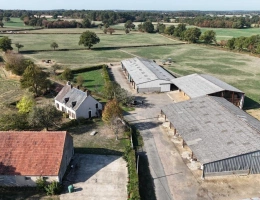
The regional stock grew by successive additions around arable farmsteads, which produces composite sets: a partly slatted finishing room built against a converted older shed, a recent weaner house next to an ageing farrowing unit. Inspect it item by item: pens, floors and under-slat pits, drainage, ventilation and its controls, heating in the weaner rooms, dry or liquid feeding, automation and alarms. Then assess the slurry store and whether it is covered, the loading bay, the biosecurity entry room, grain storage and the feed mill where one goes with the unit.
Group housing for gestating sows, how recent the refurbishments are and the occupancy rate of the places explain most of the gap between two holdings that look alike on paper. The sow herd is priced separately, on health status, genetics and the batch system in use. Where the sale covers the dwelling house, the silos and the arable land, ask for a detailed breakdown: it shapes the funding structure, the basis for negotiation and the way a lender will read the file.
Cher (18) carries a sizeable share of supply: the Champagne berrichonne, from Bourges towards Dun-sur-Auron and Saint-Amand-Montrond, combines large arable rotations with indoor units that use the harvest on site, while the more hedgerowed Pays-Fort and Boischaut hold smaller units often kept alongside a cattle herd. Indre (36) follows much the same logic: around Issoudun and Châteauroux, the wide fields of the Champagne berrichonne make spreading straightforward and leave room to expand, whereas the Boischaut Sud and the edges of the Brenne host more modest herds, frequently kept outdoors or under a quality scheme.
Loir-et-Cher (41) shows the sharpest contrast: the Beauce, north of the valley, offers deep soils and easy access to grain, while the wooded Sologne, turned towards forestry and shooting, holds only isolated units and land whose price answers to something other than farming. Indre-et-Loire (37) keeps most of its units in the Gâtine tourangelle and the Richelais, away from the Loire valley vineyard slopes where competition for land and residential neighbours make any new build awkward; direct selling, on the other hand, finds a dense customer base there.
Eure-et-Loir (28) splits between the Beauce, where finishing units lean on large arable structures and substantial storage, and the hillier Perche, where herds stay family-sized. Loiret (45) completes the picture: the Gâtinais and the Orléans Beauce hold the most recent sites, while the Sologne and the Loire valley offer few openings. Region-wide, listings are scarce and come up irregularly, so anyone planning a takeover is wise to watch several departments at once, and to consider a site needing rebuilding rather than waiting for a turnkey unit.
The administrative status of the site governs everything else. Depending on numbers, the installation falls under declaration, registration or authorisation as a classified installation, and any change of operator must be notified to the prefecture. Ask for the prefectural order and its supplements, the inspection reports and the spreading plan in force. Much of the region is designated a nitrate vulnerable zone, with the Beauce aquifer under particular scrutiny: the spreading area available, rather than the places in the buildings, often sets the ceiling on how far a unit can grow.
Neighbours are the second sensitive point. Statutory separation distances from dwellings, the local planning documents and the history of odour complaints decide whether an extension is realistic. Legally, check that rural leases continue with the landlord's agreement, that the deal passes the structures control, the French authorisation regime for taking over farmland, and SAFER, and, where a GAEC, a joint farming company, holds the business, how shares are transferred and what financial commitments remain.
Far from the large western basins, the region has fewer downstream facilities close at hand: animals often travel to abattoirs outside the territory, which weighs on haulage costs and belongs in the business plan. Many farmers belong to a producer group that organises collection and sometimes feed supply; some work under an integration contract, an arrangement in which the organiser retains ownership of the stock. Ask about the remaining term, the transfer conditions and the partner's investment policy before committing.
Closeness to the Paris conurbation and a busy tourist trade explains another route: on-farm processing, producer shops, markets and short supply chains, often backed by a label rouge, outdoor or organic specification. A unit sold with an approved cutting room and an established customer base trades on the value of the going concern as much as on the livestock buildings themselves.
Retiring farmers, rural estate agencies and notaries across the Centre feed this page. Narrow by type of unit, capacity or attached acreage, switch on an alert so each new listing reaches you, and if your plans remain open, browse all the farms for sale in Centre-Val de Loire.