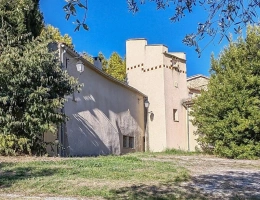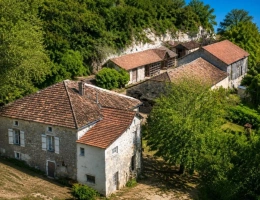
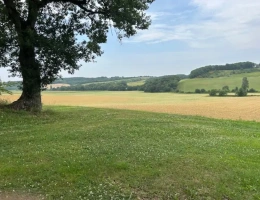
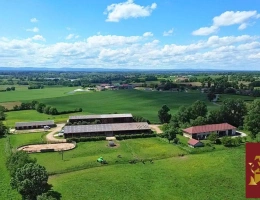
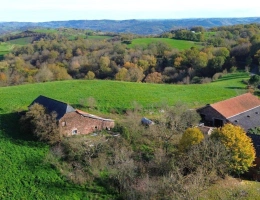
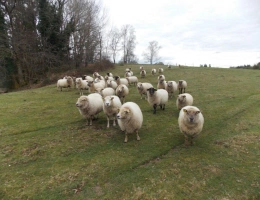
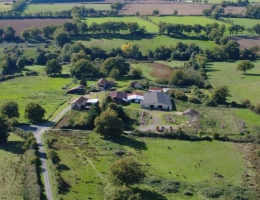
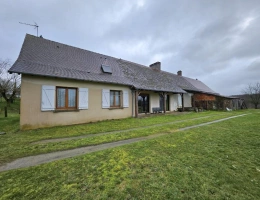
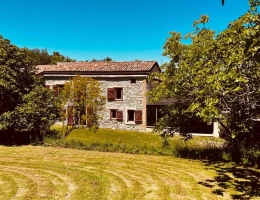
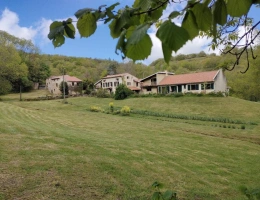
Looking for a mixed farm for sale in France? This page brings together the mixed holdings currently offered by farmers preparing their handover, rural estate agencies and notaries: farms combining cereals and cattle, farmsteads with pasture and a sheep flock, arable units with a poultry house, holdings run organically or selling direct. It is the largest group of listings on the portal. Each listing states the area of land, the split between owned and rented ground, the farm buildings, the dwelling house and the livestock enterprises, so that you can compare offers before contacting the seller. It complements all the farms for sale in France on ma-propriete.fr.
Beyond the listings, this page gathers the benchmarks buyers usually lack when taking over a crop and livestock farm: farmland and pasture prices region by region, the areas where supply is densest, what to check on the parcels, the buildings and the leases, and the steps of a takeover that goes through. Our white paper « Créer une exploitation agricole » (in French) describes the status options and access to support schemes.
On a mixed holding, value is shared between land, buildings and livestock enterprises, but the land and pasture form the base: they carry the crop rotation, the forage area and the feed self-sufficiency of the herd, and therefore the economic balance of the farm. Knowing the regional price of land is the first step before discussing a global asking price.
Across France, 14,328 sales of agricultural land were recorded in 2025, at a median price of €5,307/ha (average €6,059/ha; 80% of transactions between €2,500 and €10,537/ha). The SAFER benchmark of land values puts vacant land and pasture at €6,460/ha (+0.9% year on year) and tenanted land at €5,350/ha (+2.5%), an average discount of around 17% where a tenant farmer is in place.
| Region | Sales 2025 (DVF) | DVF median price (€/ha) | SAFER vacant land (€/ha) | 1-year change | SAFER tenanted land (€/ha) |
|---|---|---|---|---|---|
| Brittany | 1,297 | 5,500 | 6,540 | +0.3% | 5,180 |
| Pays de la Loire | 1,873 | 3,267 | 4,100 | +1.5% | 3,350 |
| Normandy | 1,442 | 8,305 | 9,610 | +2.9% | 8,410 |
| Hauts-de-France | 1,365 | 7,976 | 10,890 | -0.5% | 7,650 |
| Grand Est | 1,233 | 5,611 | 6,510 | -4.4% | 6,120 |
| Île-de-France | 214 | 7,465 | 8,190 | +5.7% | 7,000 |
| Centre-Val de Loire | 1,195 | 5,480 | 6,260 | -6.1% | 5,700 |
| Bourgogne-Franche-Comté | 1,303 | 2,773 | 2,740 | -6.2% | 2,750 |
| Nouvelle-Aquitaine | 2,103 | 4,538 | 5,770 | +5.5% | 3,900 |
| Occitanie | 995 | 7,015 | 7,260 | -0.3% | n/a |
| Auvergne-Rhône-Alpes | 1,230 | 3,887 | 5,100 | +4.9% | 4,140 |
| Provence-Alpes-Côte d'Azur* | 59 | 13,518 | 12,260 | +2.8% | n/a |
| Corsica* | 19 | 5,012 | — | — | n/a |
Mixed farming is found in every region, but it dominates in the hedgerow country and the mid-altitude uplands, where pasture and arable share the same holding. On this type of property, value cannot be read per hectare alone: the balance between ploughland and grassland, how close the parcels lie to the farmstead and the quality of the buildings around the yard weigh as much as the headline area. From one region to the next, the benchmark varies fourfold, from €2,740/ha in Bourgogne-Franche-Comté to €10,890/ha in Hauts-de-France. See the full analysis, department by department, on our agricultural land price observatory, estimate your plots with the land value tool, and work out notary fees and borrowing capacity with our financial calculators. * Fewer than 100 recorded sales: indicative value. n/a: no tenanted-land benchmark published for this region.
A crop and livestock farm is read first through its farmstead. The dwelling house, often old and generously sized, the storage shed, the cattle housing or sheep shed, the byre, the poultry house, the silos and the manure pad form a group set around a yard, whose condition and compliance account for much of the price. A house that can be lived in as it stands sets these farms apart from a purely arable holding: it widens the pool of buyers to families looking for both a business and a home, and it is valued against the local residential market.
Then come the livestock enterprises and the machinery. The herd or flock, suckler or dairy cattle, sheep, poultry or pigs depending on the farm, is valued separately, as are forage stocks and growing crops. The machinery line-up is usually broader than on a specialised unit, since it has to cover both the grain harvest and haymaking, part of it sometimes held jointly or through a machinery cooperative. Each item is priced on its own rather than as a lump sum.
A farm with land and house of this kind can be found in every region, which is why the listings are so numerous. They are especially common in the Massif Central, from the Aveyron to the Cantal and the Creuse, where cereals and pasture feed suckler herds; across the wider South-West, from the Gers to the Dordogne, where crops, poultry and waterfowl sit side by side; in Bourgogne-Franche-Comté and Grand Est, where lowland farms combine cereals and cattle; and in Normandy and the Pays de la Loire, where hedgerow country mixes ploughland and grazing.
The choice of area shapes the project as much as the price. In hedgerow and upland country, land remains more affordable, but parcels are fragmented and buildings are often old. On the cereal plains, land costs more and the livestock enterprise becomes a complement rather than a mainstay. Access to abattoirs, cooperatives and local selling outlets is worth checking before settling on a region.
The first concerns rented land. A large share of the area is frequently farmed under a rural lease: the tenancy continues with the new farmer, but assigning the lease requires the landlord's agreement, and the operation remains subject to the structures control and to SAFER's pre-emption right. Next comes the transfer of the basic payment entitlements under the Common Agricultural Policy and of any coupled livestock aid, together with the regulatory status of the livestock buildings, which fall under declaration or registration in the ICPE environmental regime depending on the numbers kept.
On the technical side, the buyer should examine the health status of the herd and the livestock records, the manure-spreading plan and effluent storage capacity, access to water and the state of the drainage, and, where the farm is certified organic, the remaining conversion period. The match between forage area and herd size deserves particular attention: it governs feed self-sufficiency and therefore the cost of production.
The sale of a mixed farm takes several forms. When the seller owns the land, the sale covers the land, the farmstead, the buildings, the livestock and the machinery, each valued separately; when the business is run as a company, a GAEC, EARL or SCEA, the transaction goes through a transfer of shares, which keeps leases and contracts in the company's name but commits the buyer to its liabilities. Our article selling the assets or the shares of a farming company specifies the warranties to ask for in each case. Many handovers happen in stages, the buyer first joining as a partner before buying out the retiring farmer's shares.
For the buyer, the process follows a logical order: define the project and its financing, obtain the agricultural qualification, analyse the accounts enterprise by enterprise, then secure the land with the landlords and SAFER before signing. The article finding a farm to set up in agriculture describes the channels to use when looking for a family farm to take over. For the seller, the handover is prepared years ahead: regularising leases, updating the parcel records, deciding what happens to the dwelling house if it is not sold with the business. The complete guide to selling a farm and the article preparing your farm for sale set out these steps.
There is no usable average: everything depends on the area held freehold, the price of land in the region, the condition of the farmstead and the house, and the value of the livestock enterprises. The price is built item by item, land at the local price of farmland and pasture, buildings according to condition and compliance, herd, machinery and stocks at market value. The table above gives the order of magnitude for the land alone.
Yes. There is no nationality condition; French farms change hands to European and non-European buyers every year. Nothing prevents a non-farmer from buying, but farming the land means passing the structures control and holding the agricultural professional qualification to claim setting-up aid. Some buyers instead own the land and let it under a rural lease to a neighbouring farmer, or join him in a company.
Every sale of agricultural property is notified to SAFER, the rural land agency, by the notary, and it may exercise its pre-emption right on the land, with exceptions such as a sale to the sitting tenant or to a family member. It can also support the handover by inviting candidates to apply. The structures control rules cover setting-up projects as well as enlargements.
No. Many buyers reshape the farm: closing one enterprise, converting to organic production, developing direct sales or farm tourism, or increasing the cereal area. This diversification is what makes mixed farming attractive, since it spreads risk across several productions. Any change should be costed before purchase, because it alters the need for buildings, machinery and working capital, and may affect the support payments received.
The valuation adds together items of a very different nature: land at the regional price of farmland and pasture, adjusted for fragmentation and for the rented share; the dwelling house against the local residential market; the farm buildings according to condition, use and compliance; the herd animal by animal; the machinery at second-hand quotation. The seller's accounting centre or a rural surveyor produces this breakdown.
The mixed farms for sale on ma-propriete.fr come from private farmers, rural estate agencies and notaries' offices. Filter by region, area, price, type of livestock or the presence of a dwelling house, and set up an e-mail alert to be told of every new mixed holding put on the market. Handing over your farm? Post your listing so that the buyers who browse our listings daily can see it.