
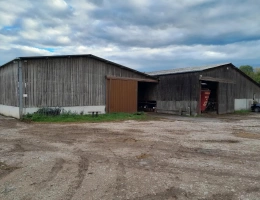
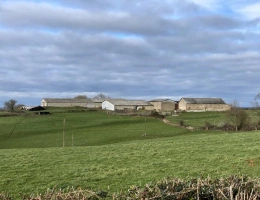

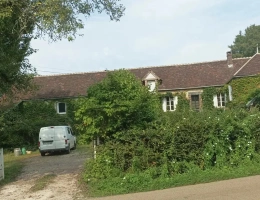
What we list as a sheep farm for sale in Bourgogne-Franche-Comté is a working ovine unit — buildings, ewes and grass — not a former farm building turned into a home; the same search brings up both, so the point is worth settling straight away. Between the Charolais bocage, the limestone plateaux and the first slopes of the Jura, the region holds systems with little in common. Sellers are farmers approaching retirement, agencies specialising in rural property and notarial offices, and their particulars cover flock, breed, grazing area and how the buildings are laid out. Each one joins our national selection of sheep farms for sale.
What a listing leaves out is set out here: what grass is worth from one department to the next, where ovine handovers surface most often, how to judge a building converted from another use, and the checks that belong to this sector. If an installation project is taking shape, our white paper « Créer une exploitation agricole » (in French) covers each stage in turn.
Land weighs heavily on the budget for a sheep farm. Transfers published by the French tax authorities (DVF, excluding vineyards) put the median for farmland in Bourgogne-Franche-Comté at €2,773/ha in 2025, with an average of €2,907/ha over 1,303 sales. Eight transactions in ten settle between €1,813 and €4,185/ha, where the national median is €5,307/ha.
A second reference, the SAFER land value benchmark, sets vacant land and pasture at €2,740/ha for 2025, -6.2% in a year and -8.1% over a decade; the French average is €6,460/ha, and a sitting tenant costs a plot roughly 17% of its value.
Area alone does not make the value of a sheep unit. It is built on the sheepfold and its lambing capacity, the bedded pen, the handling yard and loading ramp, hay and straw storage, and a milking parlour where the enterprise is dairy. The ewe flock itself, the state of fencing and troughs, how tightly the fields sit around the buildings and the outlets already contracted complete the picture. Our land price observatory gives the land benchmark; our financial calculators test whether the figures hold.
Many sheep buildings in the region began as cattle housing or as barns: headroom is generous, but ventilation, daylight and bay widths do not always suit a flock run in batches. Look at how lambing is organised, at whether individual pens can be set up, at the floor and whether it will take a loader clearing bedding, and at the trough space available per ewe. A proper handling yard — race, sorting gates, weigh crate, loading ramp — saves a great deal of time. Forage storage, in volume and in ease of access, deserves the same scrutiny.
The animals are appraised independently of the walls. Age profile of the ewes, lambing rhythm and success rate, lamb mortality, health status, where the rams come from and how they are replaced: ask for the records rather than the headline averages. Shearing equipment, temporary fencing, the feeder wagon and the troughs all belong on the inventory. Where a listing bundles dwelling, buildings, land and stock, a written split of the price is essential, because a sheep holding and a country house are not financed on the same terms.
Saône-et-Loire (71) leads the way: the Charolais and the Brionnais gave their name to the Charollais sheep breed, and flocks share the bocage with suckler cattle; supply is steadiest here, at prices held up by demand for grass. Nièvre (58) carries that bocage on towards the Morvan and the Puisaye, with large grass holdings, buildings in need of modernising and some of the most reachable land in the region. Yonne (89) mixes the damp Puisaye, the Forterre and the Tonnerrois plateaux, where sheep often occupy thin soils and slopes that arable farming has left behind.
Côte-d'Or (21) grazes its flocks on the Châtillonnais plateaux, in the Auxois and on the limestone swards behind the Côte, sometimes as part of a nature management scheme; Dijon and the vineyard belt make the land market noticeably tighter. Haute-Saône (70) offers sizeable grass holdings between the plateaux and the Vosges foothills, with moderate entry prices and buildings that often serve several purposes. Territoire de Belfort (90), very small, releases only a handful of properties a year, usually modest units backing onto the Vosges piedmont and a local customer base.
In the Jura (39), Comté cheese shapes farming, yet the Petite Montagne, the reculées and the Revermont keep sheep that maintain dry slopes; the buildings on offer there are often old. Doubs (25) follows the same pattern, sheep remaining a minority alongside Comté dairying, with a few units on the plateaux and in the Haut-Doubs. Overall, look to Saône-et-Loire and Nièvre for volume, to Nièvre, Yonne and Haute-Saône for the most affordable takeovers, and expect sharper competition for land in Côte-d'Or and close to the Comté area.
Grass carries the system here. Look at the balance between permanent pasture, short-term leys and hillside grazing, at how closely the fields sit around the buildings, at water points and at fencing, which buyers routinely underestimate. Hay self-sufficiency, storage capacity and any use of forage crops decide how the cash flow survives a dry year, and dry years are becoming more frequent on the limestone plateaux. A holding with scattered parcels means daily travel that should be costed before any offer is made, especially where upland grazing lies well away from the yard.
The outlet deserves equal attention. Lambs go to a producer group, a regional abattoir, a butcher or a direct customer base, and a quality-label specification or organic certification transfers with the commitments attached to it. Ask about the selling calendar, the weights and seasons targeted, and what happens to the wool clip. Predation, long absent here, is spreading from the eastern uplands: find out what has been recorded locally and what protective measures the seller already uses.
Start with the land: a large share of it is rented, the lease continues with the incoming farmer subject to the landlord's agreement, and permission to farm comes under the structures control, the French authorisation regime for taking over farmland, with SAFER able to pre-empt the sale. On the building side, a sheep unit falls under the departmental sanitary regulations and crosses into the classified installations regime above a certain number of animals: distances to neighbouring houses, manure storage and spreading, and water management all need checking before you bid. Look too at lorry access to the buildings and at rights of way over outlying blocks.
Have a joint inventory drawn up of the stock, the forage and the machinery, and clarify where support payments stand: the ewe premium, basic payment entitlements, agri-environment schemes and any conversion under way. Where the farm is run as a company, transferring shares follows a different timetable and tax treatment from selling the assets. The agricultural professional qualification and the formal installation route should be under way before signature, particularly if you are applying for the young farmer grant.
The properties shown here come from farmers selling without an intermediary, from rural estate agencies and from notaries settling an estate. Filter by department, by grass area or by flock size, then set up an e-mail alert so every new sheepfold with its land reaches you as it is listed. The search can also be widened to every farm for sale in Bourgogne-Franche-Comté.