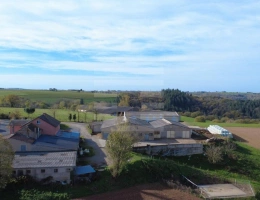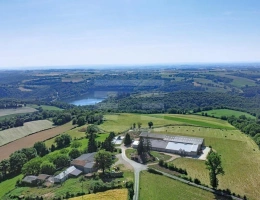
A sheep farm for sale in Tarn means here a working unit — dairy or suckler ewes, buildings, meadows and rough grazing — and not a characterful old house restored for living in, which other pages cover. The department holds an unusual position: its Lacaune hills send ewe's milk to the cheese industry of the southern Massif Central, while the slopes, the Ségala and the Montagne Noire carry suckler flocks. The properties shown are entrusted to us by farmers arranging their departure, by local rural property firms and by notaries. They join our selection of sheep farms for sale.
Beyond the advert you will find here what land, meadow and rough grazing are worth in the department, the districts where a sheep holding still comes free, how to judge a building and its milking block, and the checks to run before making an offer. Our white paper « Créer une exploitation agricole » (in French) supports anyone working through the setting-up route.
Land weighs heavily on the budget for a sheep farm. Transfers published by the French tax authorities (DVF, excluding vineyards) put the median for farmland in Tarn (81) at €6,000/ha in 2025, with an average of €6,408/ha over 86 sales. Eight transactions in ten settle between €2,887 and €10,000/ha, where the national median is €5,307/ha.
A second reference, the SAFER land value benchmark, sets vacant land and pasture at €6,530/ha for 2025, +3.3% in a year and +5.5% over a decade; the French average is €6,460/ha, and a sitting tenant costs a plot roughly 17% of its value.
At equal area, two sheep farms here are not worth the same. The gap lies in the fold and its bedded area, in the sheep milking parlour and bulk tank where milk is sold, in the handling pens and loading dock, in grass harvesting machinery and forage reserves. Add the value of the flock, its genetics and health record, the state of fences and water points, and the nature of the outlet, a milk contract, a producer group or direct selling. Cross-check those items with our land price observatory before costing them in our financial calculators.
Livestock buildings here are often long and low, designed for sizeable numbers on straw bedding, with storage sheds alongside. Inspection covers ventilation and air volume, the height under the trusses, which decides whether bedding and mucking out can be done by machine, the lambing pens and the feeding arrangement. In dairy units the milking block weighs heavily: number of units, milk line, tank, dairy room, water quality and electrical compliance explain part of the price gap between two otherwise comparable holdings. A drafting race, a weigh crate and a dock a lorry can reach are worth far more in use than they cost to build.
The flock deserves the same attention. A dairy ewe flock here rests on the Lacaune breed, selected for milk yield; suckler flocks combine hardy breeds with terminal crosses. Ask for ewe and ram numbers, milk recording or breeding results, the age profile, health qualifications, the lambing calendar and the shearing calendar. Where a farm is offered with the house, the outbuildings and the land, insist on an item-by-item breakdown: characterful rural housing sells well in this department.
The Lacaune hills, around Lacaune, Murat-sur-Vèbre and Brassac, form the dairy heart of the department: upland meadows, rough grazing, buildings sized for milking and inclusion in the Roquefort protected designation of origin, whose rules govern feeding and flock management. Holdings there change hands regularly as farmers retire. To the north, the Tarn Ségala, from Carmaux to Pampelonne and Monestiés, combines grass, cereals and mixed livestock on acid soils, with more affordable land and medium-sized units.
Southwards, the Montagne Noire and the foothills of the Sidobre, from Dourgne to Mazamet, offer upland grazing, hay meadows and woodland where suckler flocks use land that can hardly be ploughed. By contrast the Castres plain, the Albigeois and the Gaillac vineyards leave few openings: crops and vines lift land prices beyond what a grass-based system can carry. The north-west, towards Cordes-sur-Ciel and the limestone country, offers a few family-sized units, often sold with the dwelling.
In the dairy sector the outlet makes part of the value: ask the seller which company collects the milk, on what terms the reference volume transfers to a new owner and how close the collection round passes. Farm units that process on site are taken over with their health approval, their cellar and their customers, which means examining actual trade and dependence on a handful of outlets. On the meat side, lambs are sold through a producer group, under a quality label, organically or direct, each route carrying its own rules and calendar.
On regulation, check the regime applying to the building, departmental health rules or the classified installations regime depending on numbers and siting, along with manure storage capacity and whether the spreading plan matches the area available. Check the holding register, identification and veterinary reports. Land here mixes ownership and tenancy: read the rural leases and the landlord's position, then reckon with the structures control, the French authorisation required above certain thresholds, and with the pre-emption right of SAFER, the rural land agency. Finally have the transfer of payment entitlements and the ewe premium conditions confirmed.
Farmers selling direct, rural estate agencies in the Tarn and notarial offices keep this page supplied as handovers come along. Compare on the area held, on budget or on the type of unit, dairy or meat, then set an alert: a holding with a sound milking building finds a buyer quickly. Handing yours on? Send us the listing. Widen afterwards to sheep farms for sale in Occitanie.