


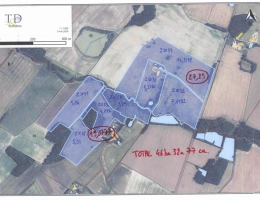
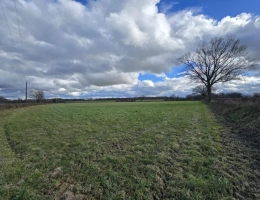
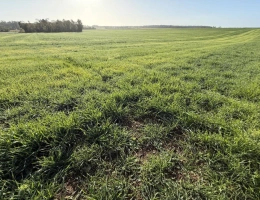
Looking for a market garden for sale in Centre-Val de Loire means looking at three neighbouring trades: field and covered vegetable growing along the Loire and Cher valleys, ornamental horticulture around Orléans, and nursery production, long established at Orléans and Olivet. The holdings shown here are entrusted by growers preparing their handover, by rural land specialists and by notaries; each listing states the covered area, the water supply and the outlets already in place. You will find them among the market gardens and nurseries for sale throughout France.
Alongside the listings, this page gives what you need to judge an offer: regional land values, the areas where handovers cluster, the true condition of greenhouses and tunnels, and the checks specific to vegetable and ornamental growing. Our white paper « Créer une exploitation agricole » (in French) deals separately with the route to setting up, from funding to the agricultural qualification.
Land value drives much of the asking price for a market garden or nursery. French tax transfer statistics (DVF, vineyards excluded) show, for 2025, a median of €5,480/ha in Centre-Val de Loire, an average of €5,892/ha and 1,195 sales; 80% of transactions settle between €3,003 and €9,349/ha, against a national median of €5,307/ha.
On the SAFER side, the value of vacant land and pasture is set at €6,260/ha for 2025, moving -6.1% over a year and +8.3% over ten, against €6,460/ha nationally; expect an average discount of 17% where a lease is running.
Beyond the hectares, the value of a vegetable or ornamental holding lies in its equipment and its customers: multi-span structures and tunnels, heating and thermal screens, growing benches, drip lines, an authorised borehole, cold storage and a washing and packing area. Add the goodwill itself, the young plants and the nursery stock, and the places held on markets, with box schemes or with garden centres. Place the land with our land price observatory, then cost your takeover with our financial calculators.
The state of the covered area drives much of the asking price. Look at the age of the glasshouses and multi-span structures, the condition of the hoops and films on the tunnels, the heating system and any thermal screens, then the irrigation setup: abstraction point, declared or authorised borehole, storage capacity, booms and drip lines. The soil matters just as much, through its texture, its drainage and its rotation history. A vegetable farm on the market with a washing station, a cold store and a compliant packing area trades well above a holding where everything, heating included, still has to be built.
Ornamental businesses read differently. A greenhouse business is judged on its growing benches, its ebb-and-flow or overhead watering, its concreted areas, its water recovery pond and its handling trolleys; a plant nursery for sale is judged on its growing-on ground, its shading, its containers and its standing stock, which represents years of work and is valued apart from the land. Greenhouses sold on their own, without land or customers, remain the exception.
Where the sale includes the dwelling house, the sheds and the land, ask for an item-by-item breakdown: house, production tool, machinery, plant stock and goodwill are neither financed nor written down in the same way. That split also helps when negotiating the equipment and when putting the bank file together.
Loiret carries the ornamental tradition: the Orléans area and Olivet concentrate nurseries and pot-plant growers, and horticultural holdings come on the market there more often than elsewhere in the region, while the Loire valley upstream and downstream of Orléans keeps pockets of vegetables on easily worked alluvial soils. Loir-et-Cher combines the sandy ground of the Sologne, suited to specialist crops, with the Loire slopes around Blois, where direct selling finds plenty of customers. Indre-et-Loire continues that axis: the Loire, Cher and Vienne valleys, light soils, steady demand around Tours and land that is more keenly contested as the city gets closer.
Further north, Eure-et-Loir lives mainly on arable farming, but proximity to the Paris region sustains field vegetable holdings and a pressure on land that is felt near Chartres and Dreux. Cher and Indre offer the most affordable ground in the region: a smallholding with a few tunnels still changes hands modestly there, and farms are more scattered, often geared to the markets of Bourges and Châteauroux and to local supply chains.
Water deserves the first look: where the supply comes from, the authorisation or declaration covering the borehole, the volume granted, and whether the area faces repeated summer restrictions. The second check is planning, since many greenhouses and tunnels have been put up without formalities: depending on height and footprint they require a prior declaration or a building permit, and an undeclared structure can hold up a resale. Finally, read the local planning document, especially around the towns, where suburban growth eats into market garden land.
The sale remains subject to SAFER's pre-emption right and to the structures control, the French authorisation regime for taking over farmland; where part of the land is rented, the rural lease continues with the buyer subject to the landlord's agreement. If the holding is certified organic, the certification transfers but requires steps with the certifying body. Look too at the seasonal labour available locally and at accommodation for workers, which governs harvest as much as the greenhouses do.
Private sellers, rural estate agencies and notaries supply this regional selection. Narrow it by covered area, price or type of production, switch on an alert for new listings, and carry your search on to all farms for sale in Centre-Val de Loire.