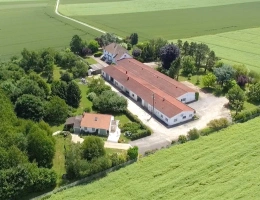
Taking on a dog kennel for sale in Île-de-France means buying a pet-care business on the doorstep of France's largest urban area. The region holds relatively few establishments for a very wide pool of owners: boarding kennels for dogs and cats, breeding businesses whose stock is entered in the French pedigree book, and sites that combine both. What appears here comes from owners stepping back, from rural estate agencies and from notaries, and states the licensed capacity, the number of boxes, the size of the plot and the house that nearly always goes with the business. These listings sit within all the dog kennels and boarding businesses for sale in France.
This page adds what listings leave out: where rural property values stand across the Paris region, which areas actually produce sellers, how to read the condition of the buildings, and the authorisations without which no handover is worth signing — whether the target is a boarding kennel, a cattery or a dog breeding business. If you are building a business rather than buying one, our white paper « Créer une exploitation agricole » (in French) helps structure the plan and the funding.
In most sales the dwelling house is the largest single item, ahead of the kennel buildings and the goodwill. According to our country house observatory, the median price of a house in a rural commune in Île-de-France stood at €280,000 in 2025 (+3.6% year on year), or €2,603/m² of living space, across 3,611 recorded sales. The national median is €189,200.
What you pay for here is the whole set-up rather than the acreage: heated, well-drained boxes, individual runs, fenced exercise paddocks, a treatment room and a cattery kept clear of the dogs change a site's value entirely. Then comes the business itself — a loyal customer base, booking records, an online reservation system, occupancy through the school holidays and a reputation in the surrounding communes. Put the figures in context on our country house price observatory and test your plan with our financial calculators.
A kennel is judged first on its fabric. Look at how the boxes are built — blockwork, insulation, heating, drainage for wash-down water — whether each opens onto its own run, how high and how sound the fencing is, and whether there are grass exercise paddocks, an isolation box and a treatment room. Ventilation and acoustic treatment weigh just as heavily, since they govern both animal comfort and the neighbours' peace. A breeding business adds a whelping area and weaning accommodation for puppies; a cattery calls for separate volumes and separate air, because cats cope badly with close proximity to dogs.
A kennel almost always changes hands as a package: the owner's house, the land, the working buildings and the goodwill. Ask for an item-by-item breakdown rather than one headline figure, because the house follows the local property market while the rest follows trading performance. A purpose-built, compliant and recent site sells well above a converted farm whose boxes were added one season at a time. A well-prepared handover therefore starts with a costed list of the work still outstanding and with a close reading of the vendor's accounts.
Almost all the available property sits in the outer ring. Seine-et-Marne, from the Brie plateau through the Gâtinais and out towards Provins, offers the largest number of sites: space, hamlets set apart and easy access from the eastern side of the conurbation. Yvelines has establishments around the Rambouillet forest, the Mantois and the Houdanais, on a dearer property market. Essonne draws on the Hurepoix and the Étampes area to the south, where plots are often large enough to keep the boxes away from houses. Val-d'Oise mainly offers the Vexin français and the Pays de France, within immediate reach of the northern suburbs.
The three inner departments — Hauts-de-Seine, Seine-Saint-Denis and Val-de-Marne — hold virtually no suitable land: urban density, plot prices and the separation required from dwellings make a kennel very hard to establish there. Together with Paris, though, they are the heart of the customer catchment. Demand for boarding is strong and sharply seasonal, driven by school holidays, long weekends and business travel. A site on one of the radial routes out of the capital, reachable within the hour, fills its boxes far more steadily than a remote property, however well equipped that property may be.
Any boarding or breeding activity requires someone holding the ACACED, the French certificate of knowledge for domestic pets, and a declaration to the departmental directorate for population protection (DDPP), the veterinary and consumer-protection authority. Above nine weaned dogs the premises fall under the classified installations regime, with declaration or authorisation depending on numbers, and detailed requirements on siting, effluent and noise. Check that the order in force genuinely covers the capacity advertised, and that the change of operator will be properly notified: an overstated capacity is paid for at full price.
Noise is the second risk. Barking is the leading cause of neighbour disputes and of administrative closure: measure the distance to the nearest dwellings, read the departmental public health regulations and ask the town hall about earlier complaints. Check the local planning zoning, that the buildings were lawfully erected and, where the premises are rented, the terms of the lease. Finally, have the goodwill and the walls valued separately, and ask to see the animal entry and exit registers.
Owners organising their handover, rural estate agencies and notaries all post here, and listings move quickly on a market this narrow. Narrow the results by capacity, price or type of activity, then save an alert so you hear the moment a new establishment reaches the market. You can also browse all farms for sale in Île-de-France.