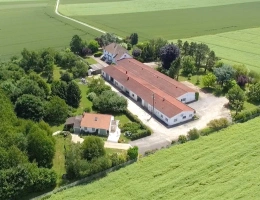
A dog kennel for sale in Essonne is almost always found south of a line drawn between Arpajon and Corbeil-Essonnes: the closely built northern half of the department leaves little room for animal boarding, while the Hurepoix, the Gâtinais français and the edges of the Beauce plain still hold sites remote enough for kennel buildings. Such properties reach the market through operators preparing to step back, through agencies that work the rural fringe of the Paris region, and through notaries; the particulars usually give the authorised headcount, the number of boxes, the type of buildings and the size of the plot. The national picture sits with dog kennels and boarding businesses for sale.
To that we add what listings leave out: property values in the southern half of the department, the geography of a very large customer base concentrated in the north, the building features that move the takeover budget, and the paperwork to verify before signing. The white paper « Créer une exploitation agricole » (in French) guides anyone whose plan also takes in a farming activity.
In most sales the dwelling house is the largest single item, ahead of the kennel buildings and the goodwill. According to our country house observatory, the median price of a house in a rural commune in Essonne (91) stood at €284,600 in 2025 (+1.6% year on year), or €2,741/m² of living space, across 433 recorded sales. The national median is €189,200, against €280,000 across Île-de-France.
Beyond the dwelling, value sits in the working tool and in the trade: the capacity written into the permit, the quality of the boxes and their runs, the area of exercise paddocks, whether a treatment room and an isolation box exist, and the true distance to the nearest houses. Goodwill then counts heavily where demand outruns supply: the customer book, bookings renewed season after season, standing with local vets. Place the dwelling with our country house price observatory and test your funding plan with our financial calculators.
Start with the night building: the nature of the partitions, the condition of the slab and its fall towards a collection point, how wash water is discharged, the ventilation, the heating, the laundry and the feed store. Then come the individual runs, covered or open, the exercise paddocks and the real height of the fencing, which is often underestimated. A treatment room, an isolation box for arrivals and a reception area kept apart from the boarding zone separate a finished business from premises extended piece by piece. Where a cattery occupies its own volume it brings a second clientele and is priced in its own right, provided it is genuinely shielded from barking.
Nearly every property offered bundles the house, the land, the working buildings, the equipment and the goodwill. Insist on a figure against each item: the lender and the notary both need it, and the tax treatment of the deal turns on it. Check that every lean-to, canopy or extension added over the years was properly declared, since putting that right takes time in agricultural or natural zones. Premises with a building plot in reserve hold an edge, so long as the local planning document really allows construction there.
Demand comes first from the towns of the north and centre - Massy, Palaiseau, Évry-Courcouronnes, Corbeil-Essonnes, Sainte-Geneviève-des-Bois, Athis-Mons - and from the southern edge of Paris itself, where pet ownership remains widespread despite flat living. The businesses sit wherever space allows: around Étampes and Dourdan, in the Juine valley, on the Hurepoix plateaux, in the Gâtinais français towards Milly-la-Forêt and La Ferté-Alais. That gap between where customers live and where kennels stand is the heart of the model: a site within an easy hour's drive of the dense suburbs fills without trouble, provided the approach is clear and parking adequate.
Ask the seller which communes the customers come from, what share of trade is school-holiday boarding and what share is weekday care, since the two are run quite differently. Orly airport and the employment cluster on the Saclay plateau feed steady demand outside holiday peaks.
Trading requires that someone in charge holds the ACACED certificate of competence, that the activity is declared to the departmental veterinary service, and that entry and exit registers are kept under a designated vet. Above nine weaned dogs the premises fall under the classified installations regime: declaration first, then authorisation for larger numbers. Ask for the receipt or the order, compare the capacity written on it with what is actually practised, and read the requirements on noise, on setback distances and on effluent. In a department where housing estates keep advancing, that document drives value as much as the walls do.
Ask at the town hall about complaints already lodged and about the zoning in the local plan, neighbouring parcels included: a new estate built close to the runs can undermine the business for good. Taking over a dog breeding business or a boarding site runs either through a sale of goodwill or the purchase of shares: have the transferred contracts, the deposits already banked and the position of any staff set out in writing.
You will see properties sold directly by their owners here, alongside others handled by rural estate agencies or by local notaries: working boarding kennels, a breeding unit being handed on, a property to convert. Set the filters to your budget and to the capacity you want, then put an alert in place, because properties of this kind move quickly. The wider regional offer sits among dog kennels for sale in Île-de-France.