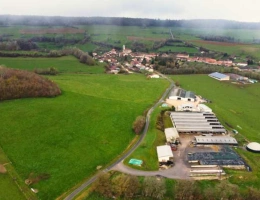
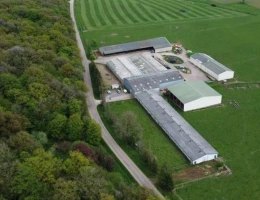
Buying a dog kennel for sale in Grand Est means looking at a large region, densely settled along the Lorraine corridor and the Rhine valley, and bordered by three countries. Supply mixes general boarding kennels on the edge of towns, rural kennels inherited from hunting in the Ardennes and the Argonne, and dog breeding businesses handed on with their stock. Rural property professionals, notaries and operators about to retire publish these listings, detailing authorised numbers, the make-up of the buildings and the goodwill on offer. Our national listing of dog kennels and boarding businesses for sale includes them all.
Past the listings themselves, this page equips you for a useful viewing: rural property price benchmarks for the region, the departments where boarding demand is steadiest, the boxes and services to inspect, and the permits to transfer into the buyer's name. Where the business comes with land, « Créer une exploitation agricole » (in French), our white paper, covers the ground from funding to legal status.
In most sales the dwelling house is the largest single item, ahead of the kennel buildings and the goodwill. According to our country house observatory, the median price of a house in a rural commune in Grand Est stood at €150,000 in 2025 (+4.2% year on year), or €1,400/m² of living space, across 7,885 recorded sales. The national median is €189,200.
What changes hands here goes well past the buildings: authorised capacity, the standard of boxes and runs, exercise paddocks, a treatment room, a quarantine area, but equally the client base built up over years, how evenly occupancy spreads between holiday periods, working links with veterinary practices and the online booking tool. Distance from the nearest houses governs both peace of mind and any scope to expand. For the property base, turn to our country house price observatory; to check the project balances, to our financial calculators.
Regional stock varies widely: insulated masonry blocks built for cold winters, lighter-framed kennels that cost less but demand upkeep, and former farm outbuildings converted to the purpose. Look at insulation and heating in the sleeping areas, ventilation that keeps condensation down, the fall and surfacing of the floors, how wash-down water is collected, how waste is handled and the state of the fencing. Count the area of the exercise paddocks and how well they drain, since waterlogged ground soon becomes unusable. Premises with a quarantine unit, a treatment room and a laundry carry more value than a site needing wholesale reconstruction.
Properties on the market usually combine the business, a dwelling house and amenity land. Have a precise split drawn up between real estate, equipment and goodwill, because funding and taxation differ for each. Check whether a cattery exists and whether it is properly separated from the dog blocks: feline boarding run alongside brings extra income for little floor space. When breeding comes with the business, the affix and the bloodlines behind it count as much as the buildings.
Custom follows the cities and the main roads. Bas-Rhin, around Strasbourg, and Haut-Rhin, between Colmar and Mulhouse, offer the densest catchments and the firmest prices. Moselle, from Metz to Thionville, adds cross-border commuters whose working hours stretch the day, while Meurthe-et-Moselle leans on the Nancy conurbation. Marne, with Reims, Épernay and Châlons, and Aube, around Troyes and the lakes of the Forêt d'Orient, combine urban demand with tourist traffic.
Further out, the Ardennes around Charleville-Mézières and the Meuse towards Verdun and Bar-le-Duc remain country of forest and hunting, where kennels are plentiful but boarding custom thinner on the ground; Haute-Marne, around Langres and Chaumont, sits in the same bracket with more affordable property. The Vosges stand apart thanks to mountain tourism, from Gérardmer to La Bresse, which sustains demand outside the summer weeks. Always weigh the asking price against the population within half an hour's drive and against the competition already trading there.
On the paperwork side, the business needs a manager holding the ACACED, a certificate of competence covering companion animals, and an activity recorded with the departmental veterinary service. Once more than nine weaned dogs live together, the site comes under the classified installations regime, formality rising with headcount, and any handover has to be reported to the prefect. Obtain the order in force, which caps numbers and sets the requirements on noise, effluent and siting. The minimum distance from third-party dwellings, laid down in departmental sanitary rules, governs any extension and should be measured on the ground.
In Bas-Rhin, Haut-Rhin and Moselle, property is registered through the livre foncier, the land register kept under the local law inherited from the region's German period: the timetable and formalities of a sale differ from the rest of the country, which is worth anticipating with the notary. Then check the planning zoning, the lawfulness of the buildings and the absence of any pending noise proceedings. Since a handover generally concerns the fonds de commerce, the intangible business assets recognised under French law, confirm that the trading name, the booking site, the customer file and any lease are included.
This page runs on instructions entrusted by operators arranging a handover, by rural property firms and by notaries' offices. Target a department, a number of places or a budget, save an alert to receive what comes up, then open the field to farms for sale in Grand Est if a property to convert is among your options.