

Looking for a country house for sale in Martinique? From the volcanic massif of Mont Pelée to the drier, rolling south, the island offers a contrasting rural housing stock: wooden Creole cottages with verandas, masonry village houses, former farmhouses tied to sugar cane or banana growing, gardens planted with fruit trees. This page brings together the country houses for sale in Martinique published on ma-propriete.fr by private sellers, estate agents and notaries.
The Martinique market for country houses is narrow: few properties come up for sale each year, and prices are assessed listing by listing, depending on the commune, aspect and condition of the building, rather than through statistical benchmarks. Our complete guide to buying a country house in France helps you along the way, from surveying tropical construction to financing.
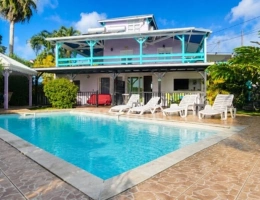
The Martinique Creole cottage, timber-built on stilts or a masonry base, with its veranda and steeply pitched metal roof, remains the reference rural house. Around former plantations, some colonial-era houses in volcanic stone or masonry, sometimes with farm outbuildings (a former water house or mill), are waiting for full renovation. More recent builds favour reinforced concrete block, in line with the earthquake and cyclone-resistance standards applied across the island. Gaïac timber, once used for roof frames and stilts, has largely given way to reinforced concrete, better suited to current standards but less present in older buildings awaiting restoration.
The land attached to these houses often includes mango, coconut and banana trees and a working orchard; some hillside properties still have wooded plots. The most sought-after houses sit in hamlets away from the village centre, with clear views over the Caribbean Sea or the Atlantic. In the hills of Le Carbet and Fonds-Saint-Denis, some properties still have dry-stone terracing left over from former hillside farming. A handful of these dry-stone terraces have been replanted with fruit trees by recent buyers, turning a purely visual feature back into a small productive orchard.
The north, around Morne-Rouge, l'Ajoupa-Bouillon and Fonds-Saint-Denis, has a wet volcanic terrain well suited to orchards and large wooded estates, but is more remote. The centre, around Le Lamentin, Le Robert and Rivière-Salée, combines local employment with accessible countryside. The south, around Sainte-Anne, Le Marin, Sainte-Luce and Les Trois-Îlets, is the most sought-after area for a country house close to the sea, whether as a holiday home or a main home, thanks to its drier climate and beaches. The east, around Le François, La Trinité and Le Vauclin, more exposed to the trade winds, remains less sought-after despite often larger and more affordable plots. Buyers drawn to the south for its beaches often overlook how much larger a plot the same budget buys just a few kilometres inland.
Communes on the Atlantic centre, such as Le François and Le Vauclin, and the hillsides above Fort-de-France, offer more affordable prices for a house with a large plot, particularly when the building still needs work. Le Prêcheur and Grand'Rivière, at the northern tip, remain quiet markets where country houses mostly pass down through inheritance.
Exposure to natural hazards is decisive: a high seismic zone, cyclone risk, and sometimes landslide risk on volcanic slopes, all worth checking against the commune's risk prevention plan. The drainage system should be inspected in rural areas, along with the state of the roof timbers after storms. The energy rating matters less than natural ventilation and orientation in this tropical climate. Landslide risk particularly affects the northern slopes, cut by heavy rainfall; a soil survey is recommended before any extension project. A geotechnical survey is worth commissioning before any building work on sloped land in the north of the island.
Also check the ownership situation: many rural properties are still held in family joint ownership, which can slow the transaction, as well as compliance with the local plan if you plan to convert a former farm outbuilding into living space. Fibre coverage for remote working is improving but still uneven between the coast and the hillsides. Finally, check for a right-of-way easement on properties reached only by unpaved communal tracks. A quick comparison of two or three neighbouring communes usually reveals the best trade-off between budget and plot size.
On ma-propriete.fr, filter Martinique country houses by budget, living space and land area, set up an email alert so you never miss a new listing, and if needed widen your search to all rural properties for sale on ma-propriete.fr.