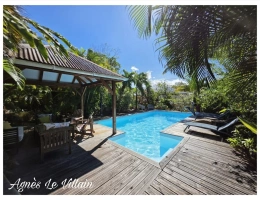

Looking for a country house for sale in Guadeloupe? Between volcanic, forested Basse-Terre, flatter limestone Grande-Terre, and the outlying islands of Marie-Galante or Les Saintes, the archipelago offers a very distinctive rural housing stock: wooden Creole cottages under corrugated-metal roofs, shaded verandas, masonry village houses, gardens planted with tropical fruit trees. This page brings together the country houses for sale in Guadeloupe published on ma-propriete.fr by private sellers, estate agents and notaries.
The Guadeloupe market for country houses remains narrow and highly local: the number of available properties is limited, and prices are assessed listing by listing, depending on the commune, the aspect and the condition of the building, rather than through statistical averages. Our complete guide to buying a country house in France helps you structure your search, from surveying tropical construction to financing.
The typical Guadeloupe rural house is the Creole cottage: a timber frame, plank cladding, a steeply pitched corrugated-metal roof designed to shed heavy rain, and a veranda that shields against the sun and serves as an outdoor living room. Many more recent homes are built in reinforced concrete block, strengthened to meet the earthquake and cyclone-resistance standards that apply across the archipelago. In the hills of Basse-Terre, older houses linked to banana or sugar-cane farming can still be found, sometimes with outbuildings to renovate. Some older cottages still have a timber frame in gaïac or courbaril, local hardwoods prized for their resistance to wood-boring insects, now hard to source.
The land attached to these country houses is typically planted with mango, coconut, breadfruit or citrus trees, forming a genuine tropical orchard; some properties still have a traditional kitchen garden. The most secluded houses sit in the farming hamlets of the Grands-Fonds or the hillsides of Basse-Terre, prized for peace and quiet and views over the Caribbean Sea. Cottages held in joint ownership in the most remote hamlets often sell below their real value, simply because viewings are hard to arrange.
On Basse-Terre, around Capesterre-Belle-Eau, Trois-Rivières, Gourbeyre and Vieux-Habitants, country houses sit within wooded volcanic terrain at the foot of the national park and La Soufrière volcano, in a wetter climate that favours orchards. On Grande-Terre, the communes of Le Moule, Sainte-Anne and Morne-à-l'Eau offer a more open rural setting on limestone plains, close to the beaches of the south. Deshaies and the leeward coast see strong demand for houses with sea views, whether as a holiday home or a main home. The north of Basse-Terre, around Sainte-Rose and Deshaies, keeps a wilder character, while Baie-Mahault and Le Gosier, closer to Pointe-à-Pitre, see stronger demand for main homes.
Marie-Galante, Les Saintes and La Désirade form a separate, very small market: country houses there are scarce, often passed down within families, and their value depends heavily on ferry links and proximity to the village centre rather than a clear expensive-versus-affordable split as on mainland Guadeloupe. A cottage on Marie-Galante is valued above all for its authenticity and unhurried pace of life, far from any speculative logic.
Exposure to natural hazards dominates the buying criteria: a high seismic zone, cyclone risk, and in some coastal or riverside areas, flood or storm-surge risk, all worth checking against the commune's risk prevention plan. The drainage system, often a private, non-mains setup in rural areas, should be inspected, along with the state of the roof timbers after past cyclones. The energy rating is less discriminating at these latitudes, where natural ventilation matters more than conventional thermal insulation. Metal roofs, when not properly fixed and maintained, remain the weak point of many cottages during a cyclone; their fastenings should be checked before buying. A properly maintained termite barrier is also worth confirming, especially on older timber-framed cottages.
Also check the ownership situation: many Guadeloupe country houses are still held in inherited joint ownership, which can lengthen the sale process, as well as compliance with the commune's local plan if you intend to extend the house or convert a former farm outbuilding into living space. Also have the plot boundaries surveyed, since property lines can be imprecise in older farming hamlets. A quick check with the notary usually clarifies the inheritance situation before an offer is made.
On ma-propriete.fr, filter Guadeloupe country houses by budget, living space and land area, set up an email alert so you never miss a new listing, and if needed widen your search to all rural properties for sale on ma-propriete.fr.