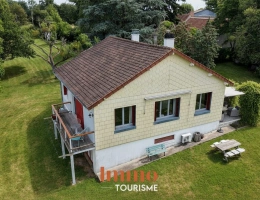
Looking for a country house for sale in Indre (36)? At the heart of the Berry region, between the Brenne and the Vallée Noire, the department has kept a rural architecture that remains affordable: Berry-style houses in limestone and brick, timber-framed farmhouses, market-town manor-style houses with garden, longères to renovate in open countryside. It attracts both local families looking for a spacious main home and city dwellers seeking a peaceful holiday home. This page brings together the country houses for sale in Indre published on ma-propriete.fr by private sellers, estate agents and notaries.
To help you decide, we present the actual prices of country houses in Indre, the areas worth knowing from Châteauroux to the Boischaut and the Brenne, and the criteria that determine the value of a house in the countryside. Our complete guide to buying a country house in France completes these benchmarks, from surveying an old building to financing.
How much does a country house cost in Indre (36)? According to DVF data (notarised sales) analysed by the ma-propriete.fr observatory, the median price of a country house in Indre (36) stood at €95,000 in 2025, with an average price of €103,640 and a median price of €1,042/m² of living space (1,345 house sales in rural municipalities over the year). The price range is wide: 10% of houses sold for less than €45,328 (floor price, 1st decile) and 10% for more than €170,000 (ceiling price, 9th decile). The typical country house here offers 98 m² of living space on an average plot of 4,049 m², i.e. around 0.4 ha.
This market is well below the regional median (Centre-Val de Loire: €150,000) and well below the national median (€189,200). Since the second half of 2020, the median price has risen from €84,900 to €95,000, i.e. +11.9%; over one year (2024-2025) the change is +3.3%.
| 2025 indicator | Indre | Centre-Val de Loire | France |
|---|---|---|---|
| Median price | €95,000 | €150,000 | €189,200 |
| Average price | €103,640 | €157,230 | €207,100 |
| Floor price (1st decile) | €45,328 | €75,000 | €90,000 |
| Ceiling price (9th decile) | €170,000 | €251,580 | €340,000 |
| Median price per m² of living space | €1,042/m² | €1,519/m² | €1,830/m² |
| Average living space | 98 m² | 103 m² | 108 m² |
| Average plot size | 4,049 m² | 2,999 m² | 3,181 m² |
| Number of sales in 2025 | 1,345 | 10,907 | 150,313 |
A departmental average hides large gaps. A smallholding to renovate, a restored longère with its outbuildings, a farmhouse on several hectares of land or a manor house with parkland do not sell at the same price, and the location matters as much as the building: coastline, tourist area, peri-urban countryside close to a job market or deep countryside. The table below shows the median price of country houses in Indre (36) by type of municipality (cumulative sales from mid-2020 to 2025) and its change between 2021 and 2025.
| Type of municipality | Median price 2020-2025 | Median price per m² | Change 2021-2025 | Sales 2020-2025 |
|---|---|---|---|---|
| Inland tourist areas (hinterland, mountains) | €81,818 | €909/m² | +14.4% | 679 |
| Peri-urban countryside (city catchment area) | €110,000 | €1,133/m² | +6.3% | 2,423 |
| Deep countryside (outside urban influence) | €86,200 | €949/m² | +5.9% | 5,032 |
These benchmarks help you assess a listing, estimate a property before putting it up for sale, or set your budget for a holiday home or a permanent move to the French countryside. To go further, see our observatory of country house prices in France (national, regional and departmental analysis, downloadable annual report) and work out the full cost of your purchase, including French notary fees, with our notary fees calculator.
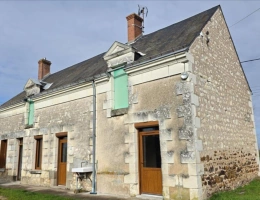
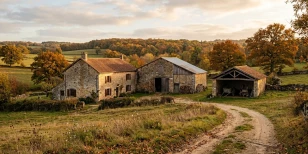
The traditional Berry-style house combines local limestone with brick quoins, under a steeply pitched flat-tile roof or slate depending on the area. In the market towns, the 19th-century manor-style house often dominates the main street, with its front steps and tall windows. In the Brenne, rural buildings are organised around the ponds, with low farmhouses and stone outbuildings suited to farming activity that is still common. Towards the Boischaut and the Vallée Noire, made famous by George Sand, timber-framed farmhouses typical of the hedgerow countryside can be found. Some Berry-style houses still keep a dovecote or a vaulted storeroom, traces of farming activity that ended only recently.
The land is often generous: several hectares of meadow, some woodland, sometimes a private pond in the Brenne. Outbuildings (barn, shed, bread oven) are common and lend themselves to a gîte or holiday home project, provided a budget is set aside for their restoration. Many of these outbuildings need a roof repair before any use, as old flat tiles deteriorate over time.
Around Châteauroux, the prefecture, and towards Issoudun to the north-east, the Champagne berrichonne offers arable plains and affordable market-town properties. The Brenne, to the south-west towards Mézières-en-Brenne and Rosnay, attracts buyers for its thousand ponds and unspoilt natural setting, protected as a regional nature park. Towards Le Blanc and the Creuse valley, the countryside becomes hillier. To the south, towards La Châtre and Argenton-sur-Creuse, the Vallée Noire and the southern Boischaut extend this hedgerow landscape. Towards Buzançais and Châtillon-sur-Indre, between Châteauroux and the neighbouring Touraine, the market also remains very affordable.
Indre remains overall one of the most affordable departments in the Berry region for a country house, with limited differences between areas: the Brenne and the outskirts of Châteauroux are somewhat more sought after than the more rural south of the department, further from the main transport links. Buyers arriving from the Paris region or elsewhere in central France often compare these areas to choose between natural heritage and market-town life.
Three factors dominate: proximity to Châteauroux and its main roads (there is no TGV station in the department, the nearest being Châtellerault, in the Vienne), the condition of the building (roof, damp in limestone walls, insulation) and the size of the plot, particularly in the Brenne where a pond strongly affects the price. A renovated Berry-style house in the Champagne berrichonne and a timber-framed farmhouse to renovate in the Boischaut can differ markedly in price. In the Brenne, having a private pond also means checking its regulatory status and its upkeep, which is often the owner's responsibility.
Also check the private drainage system, very common for isolated properties, the local plan zoning for a barn to convert, the fibre-optic coverage for remote working, and the energy rating, often decisive for large old Berry-style houses. The risk of clay shrink-swell, present across part of the department, is also worth checking before buying.
On ma-propriete.fr, filter Indre country houses by budget, living space and land area, set up an email alert so you never miss a new listing, and if needed widen your search to all country houses for sale in Centre-Val de Loire. It is also worth comparing areas close to the Brenne, more sought after for their natural setting, with the more rural rest of the department.