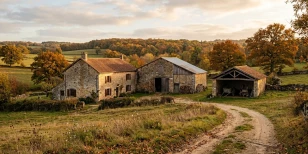
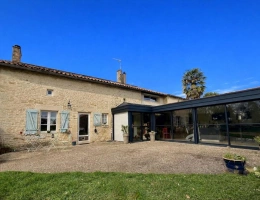

Looking for a country house for sale in Deux-Sèvres (79)? Between the Gâtine bocage, the Mellois plain and the edges of the Marais Poitevin wetlands, the department offers varied rural housing: manor-style houses in local stone, longères with canal-tile roofs, limestone farmhouses to renovate, village houses with garden and outbuildings. This page brings together the country houses for sale in Deux-Sèvres published on ma-propriete.fr by private sellers, estate agents and notaries.
We present the actual prices of country houses in Deux-Sèvres, the areas worth knowing around Niort, Parthenay and Thouars, and the criteria that determine the value of a property in the Gâtine or the Mellois. Our complete guide to buying a country house in France completes these benchmarks, from surveying an old building to financing.
How much does a country house cost in Deux-Sèvres (79)? According to DVF data (notarised sales) analysed by the ma-propriete.fr observatory, the median price of a country house in Deux-Sèvres (79) stood at €144,065 in 2025, with an average price of €146,778 and a median price of €1,316/m² of living space (2,410 house sales in rural municipalities over the year). The price range is wide: 10% of houses sold for less than €74,000 (floor price, 1st decile) and 10% for more than €225,640 (ceiling price, 9th decile). The typical country house here offers 112 m² of living space on an average plot of 3,102 m², i.e. around 0.3 ha.
This market is well below the regional median (Nouvelle-Aquitaine: €170,000) and well below the national median (€189,200). Since the second half of 2020, the median price has risen from €127,000 to €144,000, i.e. +13.4%; over one year (2024-2025) the change is +2.9%.
| 2025 indicator | Deux-Sèvres | Nouvelle-Aquitaine | France |
|---|---|---|---|
| Median price | €144,065 | €170,000 | €189,200 |
| Average price | €146,778 | €188,636 | €207,100 |
| Floor price (1st decile) | €74,000 | €83,000 | €90,000 |
| Ceiling price (9th decile) | €225,640 | €315,785 | €340,000 |
| Median price per m² of living space | €1,316/m² | €1,657/m² | €1,830/m² |
| Average living space | 112 m² | 110 m² | 108 m² |
| Average plot size | 3,102 m² | 4,005 m² | 3,181 m² |
| Number of sales in 2025 | 2,410 | 26,126 | 150,313 |
A departmental average hides large gaps. A smallholding to renovate, a restored longère with its outbuildings, a farmhouse on several hectares of land or a manor house with parkland do not sell at the same price, and the location matters as much as the building: coastline, tourist area, peri-urban countryside close to a job market or deep countryside. The table below shows the median price of country houses in Deux-Sèvres (79) by type of municipality (cumulative sales from mid-2020 to 2025) and its change between 2021 and 2025.
| Type of municipality | Median price 2020-2025 | Median price per m² | Change 2021-2025 | Sales 2020-2025 |
|---|---|---|---|---|
| Inland tourist areas (hinterland, mountains) * | €115,900 | €1,182/m² | -18.0% | 75 |
| Peri-urban countryside (city catchment area) | €165,000 | €1,530/m² | +7.9% | 5,451 |
| Deep countryside (outside urban influence) | €121,000 | €1,138/m² | +13.2% | 9,583 |
* Between 30 and 99 sales: indicative value.
These benchmarks help you assess a listing, estimate a property before putting it up for sale, or set your budget for a holiday home or a permanent move to the French countryside. To go further, see our observatory of country house prices in France (national, regional and departmental analysis, downloadable annual report) and work out the full cost of your purchase, including French notary fees, with our notary fees calculator.
In the Mellois area and the south of the department, around Melle or Chef-Boutonne, the manor-style house in pale limestone, under a canal-tile roof, reflects the neighbouring Charente and Poitou influence. In Gâtine, to the north, around Secondigny or Coulonges-sur-l'Autize, the wetter, more wooded bocage produced lower longères and farmhouses, covered in slate, with walls of local granite or schist. On the edges of the Marais Poitevin wetlands, around Coulon or Damvix, low white-stone houses often come with access to water, a canal or a conche. These local-stone houses are often distinguished by a built-in bread oven or a dovecote, features prized by buyers. Local stone quarried nearby was traditionally used even for garden walls and boundary markers, giving villages a strong unity of style.
The land attached to these properties is generous across much of the department: garden, orchard, adjoining pasture, sometimes several hectares of farmland. Outbuildings (barn, bread oven, shed) are common and lend themselves to a gîte or workshop project, a common side activity in this rural department. Use as a bed-and-breakfast or rural gîte remains widespread in this department, strongly geared towards farming and tourism.
Around Niort, the prefecture served by a TGV station on the Paris–Bordeaux line, and towards Melle and the Mellois, the country house benefits from open farmland and good accessibility. Gâtine, around Parthenay and Secondigny, offers a more hilly, wooded bocage landscape suited to peace and quiet, with views often limited by hedgerows. Towards Thouars and the Thouarsais area to the north, the building style edges closer to that of neighbouring Anjou, with more use of tuffeau stone. Villages near the Marais Poitevin, such as Coulon, combine a well-preserved natural setting with good access from Niort.
Areas close to Niort and its TGV station sit above the departmental average, while the deeper Gâtine and the Thouarsais area, further from the main routes, offer stone houses with a large plot at markedly more affordable prices, well suited to a second home or a gîte project. These areas further from the main routes suit a second home or a tourist-accommodation project well. Buyers should compare not just distance to Niort but also the quality of the secondary road network linking a property to town.
Distance to Niort and its TGV station, the condition of the old building (roof, timber frame, damp) and the size of the plot are the main price factors. Many Gâtine longères and farmhouses, not originally insulated, carry a poor energy rating and need energy-efficiency work before serving as a main home. Near the Marais Poitevin, the risk of flooding and a high water table are also worth checking. Damp in uninsulated stone walls remains a common point of concern during viewings in Gâtine. Farmhouses converted decades ago without modern insulation standards often require a full re-roofing before energy-efficiency works can begin.
Also check the private drainage system, widespread in scattered rural housing, the presence of a well, fibre-optic coverage for remote working and the agricultural planning rules before considering converting a barn or shed. Have the well water quality checked before any domestic use, particularly in livestock-farming areas. A pre-purchase inspection of the roof timbers is particularly advisable for the lower, older longères typical of the Gâtine bocage.
On ma-propriete.fr, filter Deux-Sèvres country houses by budget, living space and land area, set up an email alert so you never miss a new listing, and if needed widen your search to all country houses for sale in Nouvelle-Aquitaine.