

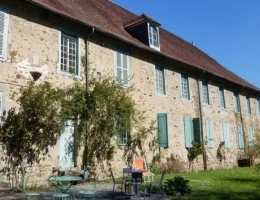
Looking for a country house for sale in Creuse (23)? On the granite plateau of the Marche area and at the gateway to the Millevaches plateau, the department offers particularly well-preserved granite rural architecture and some of the most accessible prices in France. The low population density and the sheer scale of the farming landscape leave plenty of room for a house project with a large amount of land. This page brings together the country houses for sale in Creuse published on ma-propriete.fr by private sellers, estate agents and notaries.
We present the actual prices of country houses in Creuse (notarised sales 2020-2025), the areas worth knowing from Guéret to Aubusson, and the criteria that determine the value of a house in the countryside, from the building itself to the size of the attached land. Our complete guide to buying a country house in France completes these benchmarks, from surveying an old building to financing.
How much does a country house cost in Creuse (23)? According to DVF data (notarised sales) analysed by the ma-propriete.fr observatory, the median price of a country house in Creuse (23) stood at €91,800 in 2025, with an average price of €97,479 and a median price of €930/m² of living space (1,054 house sales in rural municipalities over the year). The price range is wide: 10% of houses sold for less than €41,000 (floor price, 1st decile) and 10% for more than €164,820 (ceiling price, 9th decile). The typical country house here offers 103 m² of living space on an average plot of 5,691 m², i.e. around 0.6 ha.
This market is well below the regional median (Nouvelle-Aquitaine: €170,000) and well below the national median (€189,200). Since the second half of 2020, the median price has risen from €73,000 to €91,600, i.e. +25.5%; over one year (2024-2025) the change is +7.8%.
| 2025 indicator | Creuse | Nouvelle-Aquitaine | France |
|---|---|---|---|
| Median price | €91,800 | €170,000 | €189,200 |
| Average price | €97,479 | €188,636 | €207,100 |
| Floor price (1st decile) | €41,000 | €83,000 | €90,000 |
| Ceiling price (9th decile) | €164,820 | €315,785 | €340,000 |
| Median price per m² of living space | €930/m² | €1,657/m² | €1,830/m² |
| Average living space | 103 m² | 110 m² | 108 m² |
| Average plot size | 5,691 m² | 4,005 m² | 3,181 m² |
| Number of sales in 2025 | 1,054 | 26,126 | 150,313 |
A departmental average hides large gaps. A smallholding to renovate, a restored longère with its outbuildings, a farmhouse on several hectares of land or a manor house with parkland do not sell at the same price, and the location matters as much as the building: coastline, tourist area, peri-urban countryside close to a job market or deep countryside. The table below shows the median price of country houses in Creuse (23) by type of municipality (cumulative sales from mid-2020 to 2025) and its change between 2021 and 2025.
| Type of municipality | Median price 2020-2025 | Median price per m² | Change 2021-2025 | Sales 2020-2025 |
|---|---|---|---|---|
| Tourist coastline | €83,000 | €930/m² | +59.1% | 115 |
| Inland tourist areas (hinterland, mountains) | €78,000 | €808/m² | +21.4% | 1,413 |
| Peri-urban countryside (city catchment area) | €76,000 | €810/m² | +7.4% | 101 |
| Deep countryside (outside urban influence) | €84,000 | €882/m² | +24.0% | 5,016 |
Note: in Creuse (23), the municipalities classified as "coastline" have no access to the sea. They are municipalities bordering lakes of more than 1,000 hectares (or, in Eure, the Seine estuary) covered by the 1986 Loi Littoral, which also applies to such inland lakes and estuaries.
These benchmarks help you assess a listing, estimate a property before putting it up for sale, or set your budget for a holiday home or a permanent move to the French countryside. To go further, see our observatory of country house prices in France (national, regional and departmental analysis, downloadable annual report) and work out the full cost of your purchase, including French notary fees, with our notary fees calculator.
The Creuse country house is recognisable first by its local granite, often left exposed as ashlar on the finer façades, under a slate or flat-tile roof depending on the town. There are also low courtyard farmhouses built to withstand the plateau's harsh climate, as well as grander manor-style houses in towns linked to the history of Creuse stonemasons, who once travelled across France to build in the 19th century. The dry-stone walls still lining some country lanes bear witness to an old, largely authentic farming landscape. In market towns such as Chénérailles, Bourganeuf and Felletin, this granite style continues with covered market halls and two-storey town houses, often lime-rendered to cope with the damp local climate.
The land attached to these houses is often generous: a garden, an orchard, pasture and stone outbuildings (barn, cattle shed, bread oven), sometimes completed by a pond or a few hectares of woodland. It is one of the rare departments where a property with several hectares remains within reach of a moderate budget, which attracts buyers looking for space. Buyers should nonetheless weigh the upkeep of large wooded plots and the frequent poor state of farm outbuildings, whose roof and timber frame deserve a careful survey before any gîte or second-home project.
Around Guéret, the prefecture and main employment hub, and La Souterraine, served by Intercités trains towards Paris and Limoges, country houses benefit from the department's best access. Aubusson, known for its tapestry-making, and the Creuse river valley attract buyers looking for calm and craft heritage. Further east, near the Millevaches plateau, the harsher climate and higher altitude shape a more austere style, suited to long winters. In between, the Limousin hedgerow country around Bourganeuf and Royère-de-Vassivière, with its ponds and Lake Vassivière, appeals to second-home buyers seeking unspoilt nature and walking country.
The Basse Marche area to the west, near Bellac and Dun-le-Palestel, and the north of the department near Boussac, remain among the most affordable areas in France for a stone house with a large plot, while the areas around Guéret and La Souterraine sell a little above the departmental average. Either way, the charm of a town with shops remains a sought-after criterion, since the department's low population density leaves some hamlets quite far from everyday services.
Three factors dominate: proximity to Guéret or to the La Souterraine Intercités station, the condition of the building (roof, timber frame, damp and energy rating, often a drawback for uninsulated old farmhouses) and the size of the land, particularly whether woodland or a pond comes with it. A renovated house near Guéret and a farmhouse to renovate on several hectares in the Basse Marche area can show a marked price gap, with the upkeep of large plots also weighing on the choice. A private pond or a spring also adds value, while a poorly sunlit orientation or difficult winter access can put some buyers off.
Also check the private drainage system, very common in this scattered rural housing, fibre-optic coverage for remote working, still uneven in some areas, and the local planning rules if you plan to convert a barn into living space. Creuse's granite subsoil also exposes some areas to radon, a natural gas worth managing with proper ventilation, while clay-shrinkage subsidence risk stays generally limited compared with more clay-rich neighbouring departments.
On ma-propriete.fr, filter Creuse country houses by budget, living space and land area, set up an email alert so you never miss a new listing, and if needed widen your search to all country houses for sale in Nouvelle-Aquitaine, a region bringing together a very wide range of rural properties beyond the Creuse plateau alone.