

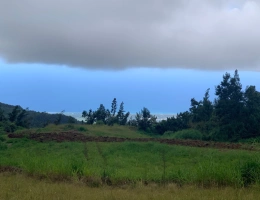
A luxury property for sale in Réunion reflects the island's contrasting relief, from villas overlooking the Indian Ocean on the west coast to restored creole houses in the Hauts, former plantation residences tied to sugar cane growing, and newer properties facing the lagoon at Saint-Gilles. This varied heritage reflects both the island's agricultural past and its volcanic relief, from the coastal beaches to the mountain cirques of the interior and the slopes of an active volcano. Browse every luxury property for sale listed by private owners, agencies and notaries across Réunion.
This page sets out the types of residence found across Réunion, the areas where they cluster, the building traditions specific to the island, and the land, climate and seismic checks worth making before buying on this volcanic territory in the Indian Ocean. To plan your purchase, read our guide to buying luxury property in France.
Réunion's character buildings draw on several layers of heritage. The creole house, with its finely carved wooden veranda, four-sided roof and brightly painted shutters, remains the most recognisable style in the older districts of Saint-Denis, Saint-Pierre and Saint-Louis. Former plantation residences, tied to sugar cane or geranium growing, still stand in the Hauts, often surrounded by tropical gardens and farm outbuildings. On the west coast, at Saint-Gilles and Saint-Leu, contemporary villas with wide glazed façades benefit from constant sunshine and open views over the lagoon and the Indian Ocean.
Traditional outbuildings often include a bread oven, a vanilla or geranium drying shed, and a creole garden planted with lychee and mango trees. Older buildings warrant close inspection: timber frames exposed to humidity in the Hauts, roofing to check after the cyclone season, and traditional renders needing regular upkeep. Newer construction increasingly meets reinforced earthquake and cyclone standards, an important factor given the activity of the Piton de la Fournaise and the island's exposure to tropical cyclones, and several estates now pair traditional materials with contemporary insulation.
The island divides into clearly distinct areas. The west coast, from Saint-Gilles-les-Bains to Saint-Leu, concentrates the most sought-after seaside villas, with direct access to the lagoon and its sheltered beaches. Saint-Pierre, to the south, offers a denser urban market mixing older residences and newer developments. The Hauts, whether the Plaine des Cafres, l'Entre-Deux or the heights above Saint-Leu, appeal to buyers seeking cooler air and quiet away from the coast. To the east, Saint-André and Saint-Benoît keep a more rural character tied to farming, while the cirques of Salazie and Cilaos remain a confidential market, shaped by sometimes limited road access. Saint-Denis, the departmental capital, concentrates the island's administrative functions and a denser urban building stock rather than a seaside one.
Roland-Garros airport, near Saint-Denis, handles connections to mainland France; Réunion has no railway service, and travel relies on the coastal road and the routes linking the coast to the Hauts. The most sought-after areas remain the west coast and the area around Saint-Denis; the Hauts and the eastern communes offer comparable properties at more accessible levels.
As in the French West Indies, the fifty geometric paces zone governs building rights on plots close to the coast and historically forms part of the public domain; its precise status should be checked before any purchase or coastal extension project. Properties in the Hauts can also be affected by ground-movement risk near the cirques and ravines, a point to check against the commune's risk prevention plan. Undivided ownership, common on older family properties, also calls for careful review of the title.
Réunion lies in an active volcanic and cyclone zone; the Piton de la Fournaise remains regularly active, and the cyclone season requires checks on the condition of roofing and structures. Humidity in the Hauts also encourages termite infestation in older roof timbers, while plots near ravines can carry drainage easements worth checking against the land register. Working with a local notary and a creole-building specialist is recommended before making an offer.
Luxury property listings in Réunion, placed by private owners, specialist agencies and notaries, cover a market where every area, from the coast to the Hauts, has its own particular character. In the absence of reliable statistics for this territory, we recommend a contact request to our local correspondents, who know the island's buildings and areas.


